
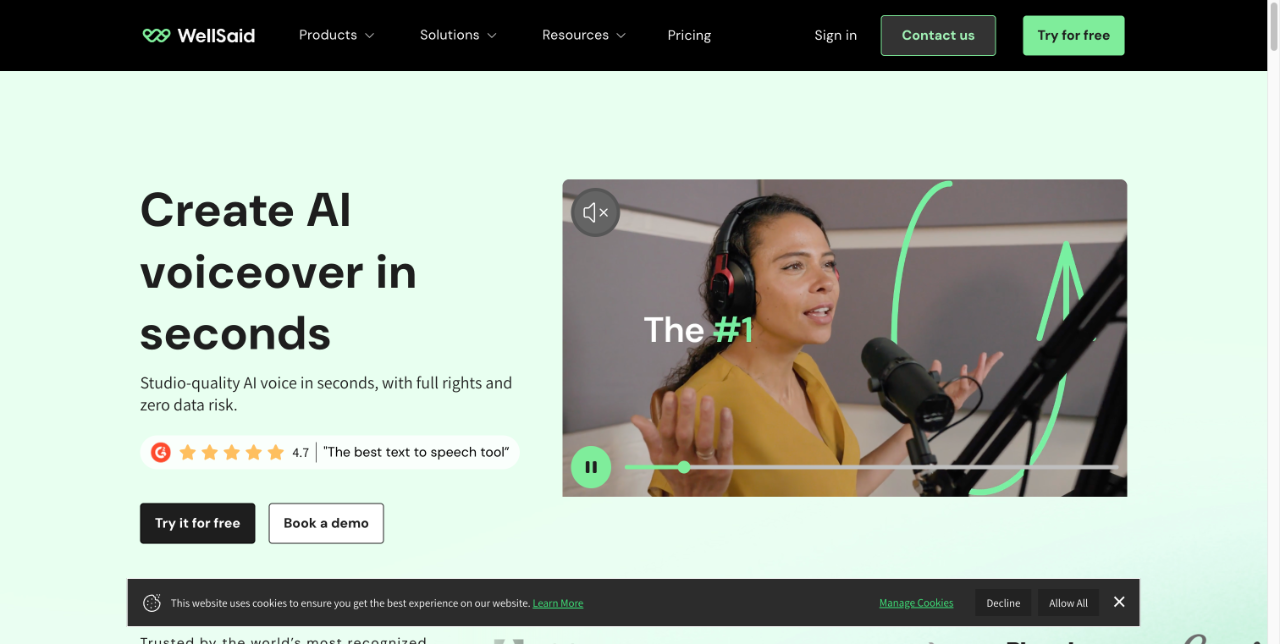
WellSaid Labs offers high-quality AI voice generation for engaging and realistic audio content.
About
WellSaid is an AI-powered voice synthesis platform designed to deliver natural and fluid speech generation services. By leveraging advanced deep learning algorithms, WellSaid transforms text into highly realistic human-like voiceovers, making it suitable for a wide range of use cases including video narration, audiobooks, and corporate training.
Key Features
Pricing & Fees
- Pricing: Individual plans include a free Trial, Starter at $10/mo (billed annually at $120/year, or $19/mo billed monthly), and Pro at $33/mo (billed annually at $396/year); Enterprise plans are available by demo request.
- Free tier: A free Trial requires no credit card and includes 3 download minutes per month (no commercial rights), curated voice actors, and studio tools for tone, pitch, and emotional control.
- Plan limits: Starter offers 240 minutes of downloaded audio per year (or 20 minutes/month on monthly billing), while Pro provides 2,160 minutes per year; extra minutes can be purchased in Studio. Generation is unlimited on paid plans.
- Features by plan: Both paid plans include all English voices and full commercial rights; Pro adds unlimited projects, Adobe Express integration, and up to 48 kHz sample rate, while Starter is capped at 10 projects and 24 kHz.
- API access: A scalable API is offered for integrating WellSaid text-to-speech into products or platforms, alongside an Enterprise plan for team-wide governance.
Who It's For
WellSaid is built for content creators such as video bloggers and podcast producers, educational institutions developing online courses, enterprise users working on customer service systems and training materials, developers building applications that require voice functionality, and accessibility services providing voice support for the visually impaired.
Related Tutorials
View all →

Related Tools
View all → LOVO - AI Voice Generator and Text to Speech LOVO offers 500+ voices in 100+ languages, making it easy to generate realistic AI voiceovers for any project.
 NaturalReader NaturalReader is an AI text-to-speech platform that converts documents, webpages and scanned text into natural-sounding audio for personal, commercial and educational use.
 TTSMaker TTSMaker is a free online text-to-speech and AI voice generator that converts text into spoken audio across 100+ languages and 600+ AI voices, with MP3 and WAV downloads.
 ttsMP3.com Free online text-to-speech converter that turns written text into natural spoken audio in 28+ languages and lets users download the result as an MP3 file.
 Texttovoice.online A free online text to speech converter that turns written English text into natural AI voices with selectable emotions, speeds, and downloadable MP3 files.