
A practical guide to understanding, building, and deploying large language models with hands-on examples and real-world applications.
About
Welcome to Hands-On Large Language Models - A Practical Guide. As artificial intelligence reshapes industries across the globe, large language models (LLMs) have become the core engine driving technological innovation. Yet a significant gap often exists between theory and real-world application. This guide was created to bridge that divide — it is not just another theoretical handbook, but a practical, action-oriented playbook. Our goal is to take you from understanding the fundamental principles of LLMs to mastering the complete skill set required to build, optimize, and deploy production-ready LLM applications, step by step.
Key Features
Pricing & Fees
- Pricing: Not publicly listed on the pages we reviewed; check the official site for current plans.
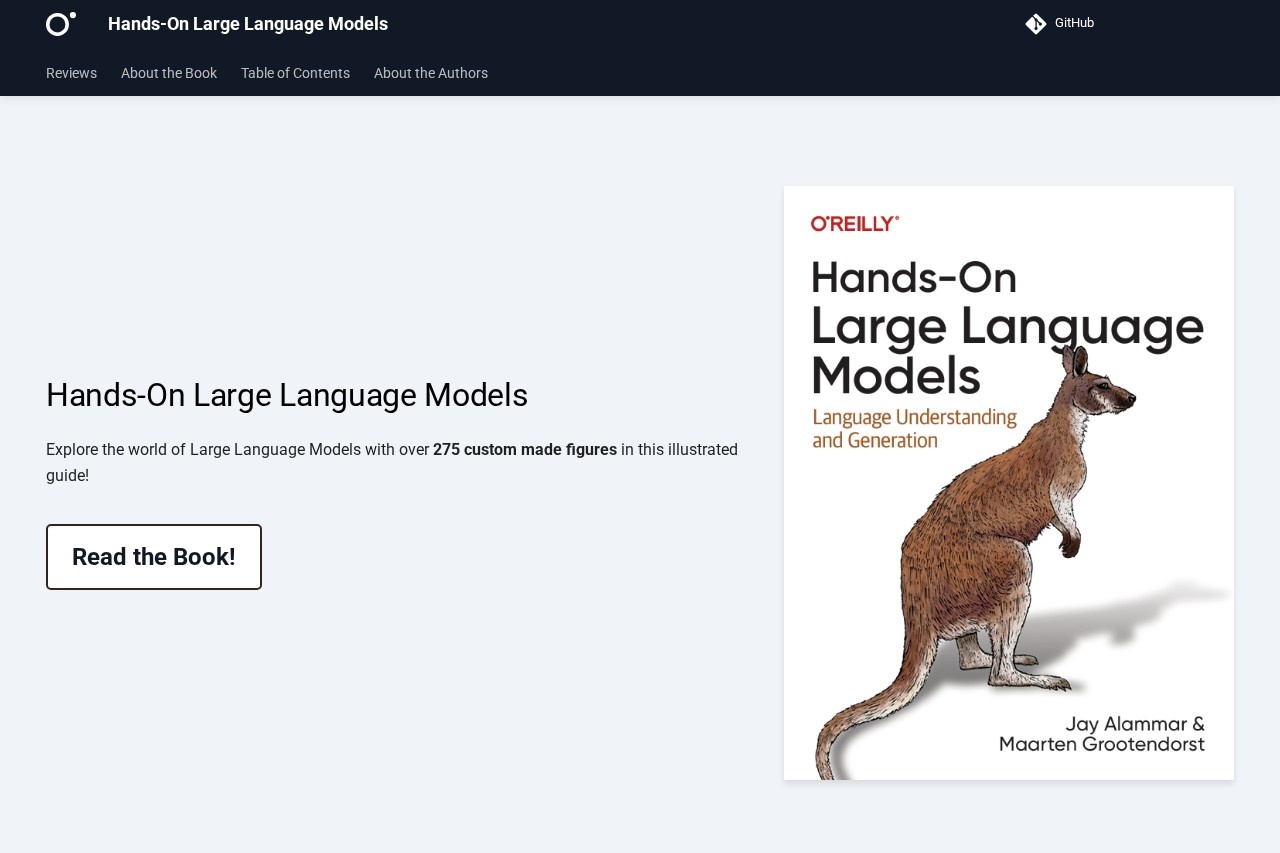
- Format: This is an illustrated guide book on Large Language Models featuring over 275 custom-made figures.
- Hands-On Content: Concepts are taught through runnable code examples, code labs, and worked examples covering topics such as transformer models, tokenizers, semantic search, and RAG.
- Skill Progression: The book starts with introductory material and builds toward fine-tuning and building your own large language models.
- Code Availability: Supporting code and materials are available via the book's GitHub repository.
Who It's For
Whether you are new to AI or an experienced developer looking to deepen your practice, this guide delivers real value. It is ideal for AI and machine learning engineers seeking to rapidly acquire LLM application development and deployment skills; software developers and product managers eager to understand the capabilities and limits of LLMs and integrate AI features into existing or new products; technical team leads and founders looking for a clear picture of the LLM technology stack and implementation paths to make informed decisions; and students and researchers passionate about AI who want a quality reference that connects cutting-edge theory with industrial practice.
Related Tutorials
View all →

Related Tools
View all → DeepEval by Confident AI - LLM Evaluation Framework Open-source LLM evaluation framework with 50+ plug-and-play metrics for AI agents, RAG, chatbots, and more.
 Grok 4 - AI Assistant Grok is an AI assistant by xAI that provides intelligent responses and assistance, making tasks easier and more efficient.
 Poe Poe is a multi-model AI chat platform from Quora that lets users chat with many AI assistants, compare responses, and build custom bots in one place.
 LiblibAI 2.0 An advanced AI platform offering powerful tools for image generation, editing, and creative workflows.
 Cleanup.pictures Cleanup.pictures is a free AI inpainting tool that removes unwanted objects, people, text, logos, watermarks and blemishes from photos in seconds, with a Pro plan for high-resolution exports.