
Local-first desktop and web app for managing AI agent sessions.
About
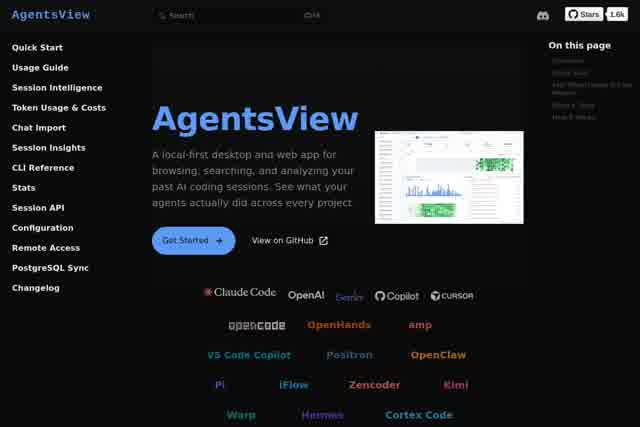
AgentsView is a local-first desktop and web application focused on AI agent session management, designed to deliver an efficient and controllable conversational experience for AI developers and heavy users. Whether you are debugging the conversation flow of multiple AI agents or managing complex multi-turn session histories, AgentsView helps you stay in full command. It combines the security of local data with the convenience of web access, allowing you to stay on top of every "conversation" your AI agents have, anytime and anywhere.
Key Features
Pricing & Fees
- Pricing: AgentsView is free and open source under the MIT license, distributed as a single Go binary with no account required.
- Free tier: All features — session archive, activity dashboards, token and cost reports, REST API, and MCP server — are available at no charge.
- Platform availability: Installs on macOS, Linux, and Windows via desktop app, pip, Docker, or a shell install script, with web and CLI interfaces.
- Plan limits: No accounts, quotas, or paid plans; the local SQLite archive of record stays on your machine unless you opt in to a sharing feature.
- Storage options: Supports SQLite by default, with PostgreSQL, DuckDB, and ClickHouse as database backends.
Who It's For
AgentsView is built for AI developers and researchers who need to frequently debug and compare the performance of different AI agents while managing large volumes of experimental sessions. It also serves product managers and QA testers tracking conversation quality during AI product iterations and reproducing user-reported issues. Heavy AI tool users who rely on multiple agents daily for writing, coding, consulting, and other tasks will find it invaluable for unifying their conversation records. Additionally, privacy-conscious users with high standards for data sovereignty who want to avoid uploading sensitive conversations to public cloud services will appreciate the local-first approach.
Related Tutorials
View all →

Related Tools
View all → Yuxi - RAG Harness for AI Agents Yuxi provides a RAG harness to enhance AI agents with retrieval-augmented generation capabilities.
 omp - A Coding Agent with the IDE Wired In Oh My Pi (omp) is a coding agent that integrates with your IDE, leveraging LSP and DAP for seamless development. Built in Rust for performance.
 DeepEval by Confident AI - LLM Evaluation Framework Open-source LLM evaluation framework with 50+ plug-and-play metrics for AI agents, RAG, chatbots, and more.
 OmniRoute - Free AI Gateway for Multi-Provider LLMs Free, open-source AI router with auto-fallback. 236 providers, one endpoint, 95 MCP tools, 17 routing strategies, A2A protocol, auto-combo engine, semantic cache, memory & skills. Deploy anywhere.
 Dograh - Voice Assistant Workflow Builder Open Source Voice Assistant Workflow Builder.