
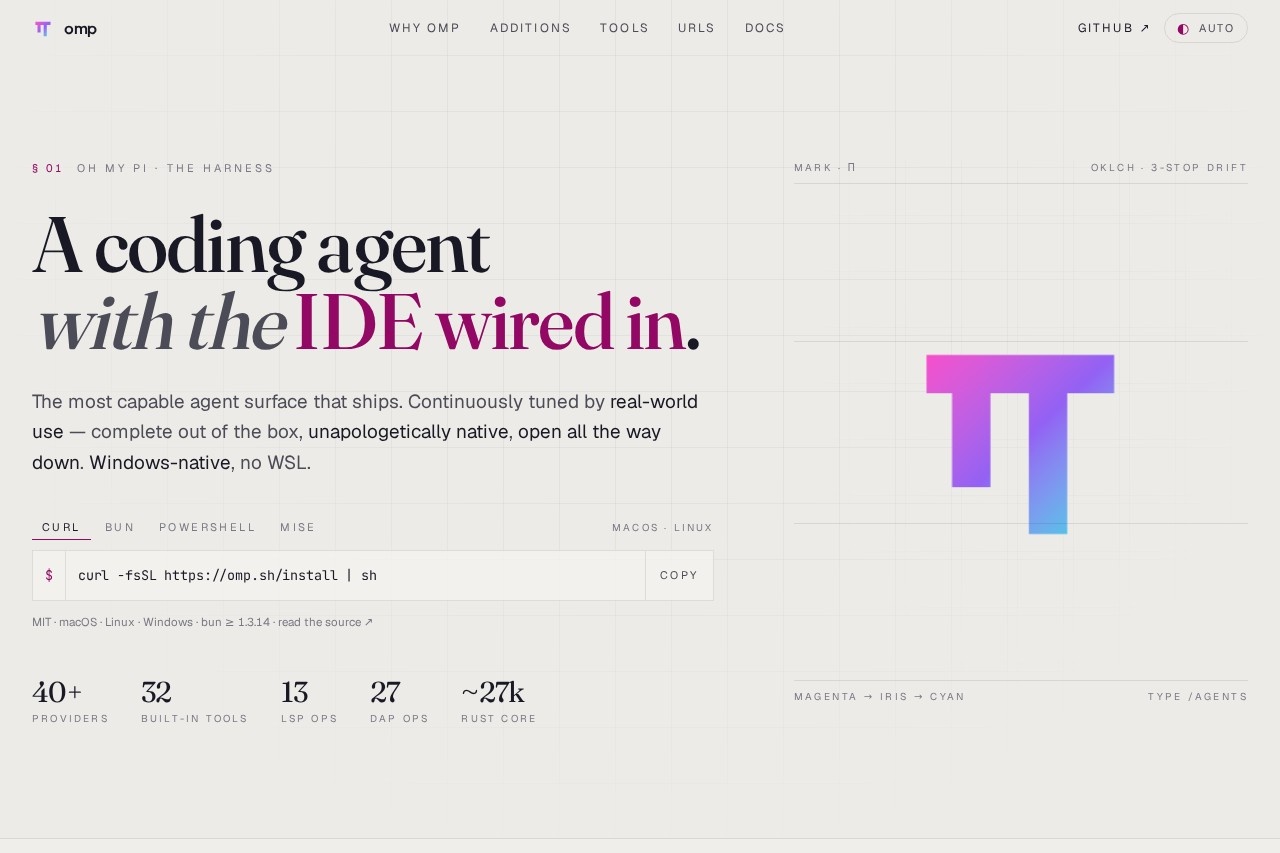
Oh My Pi (omp) is a coding agent that integrates with your IDE, leveraging LSP and DAP for seamless development. Built in Rust for performance.
About
Oh My Pi (omp) is an intelligent coding agent built specifically for the terminal environment, bringing powerful IDE capabilities directly into the command line. Unlike traditional code completion tools, omp is a true "agent"—it can autonomously understand project context, plan execution steps, and handle code writing, debugging, and refactoring right in the terminal. Powered by a native Rust engine, omp launches almost instantly and uses minimal system resources, giving developers an IDE-grade coding experience without ever leaving the command line.
Key Features
Pricing & Fees
- Pricing: Not publicly listed on the pages we reviewed; check the official site for current plans.
- Platform availability: omp runs on macOS and Linux and can be installed directly from the terminal via a one-line install script.
- Local-first design: Sub-agents and the memory system run locally, so your code does not leave your machine.
- Terminal-native architecture: All interactions happen in the command line, driven by a native Rust engine, with no separate GUI required.
Who It's For
omp is designed for terminal power users who rely on Vim, Neovim, or Tmux and want to plug intelligent coding assistance directly into their existing workflow. It's also a great fit for full-stack and backend engineers who frequently debug, refactor, and collaborate across multiple files, as well as independent developers who want to minimize manual steps from planning to deployment. Additionally, engineering teams and CI/CD pipelines can integrate omp into automated workflows, using its sub-agents and rule system to enforce code quality checks and automatic fixes.
Related Tutorials
View all →
Related Tools
View all → Yuxi - RAG Harness for AI Agents Yuxi provides a RAG harness to enhance AI agents with retrieval-augmented generation capabilities.
 DeepEval by Confident AI - LLM Evaluation Framework Open-source LLM evaluation framework with 50+ plug-and-play metrics for AI agents, RAG, chatbots, and more.
 OmniRoute - Free AI Gateway for Multi-Provider LLMs Free, open-source AI router with auto-fallback. 236 providers, one endpoint, 95 MCP tools, 17 routing strategies, A2A protocol, auto-combo engine, semantic cache, memory & skills. Deploy anywhere.
 AgentsView - AI Agent Session Manager Local-first desktop and web app for managing AI agent sessions.
 Dograh - Voice Assistant Workflow Builder Open Source Voice Assistant Workflow Builder.