
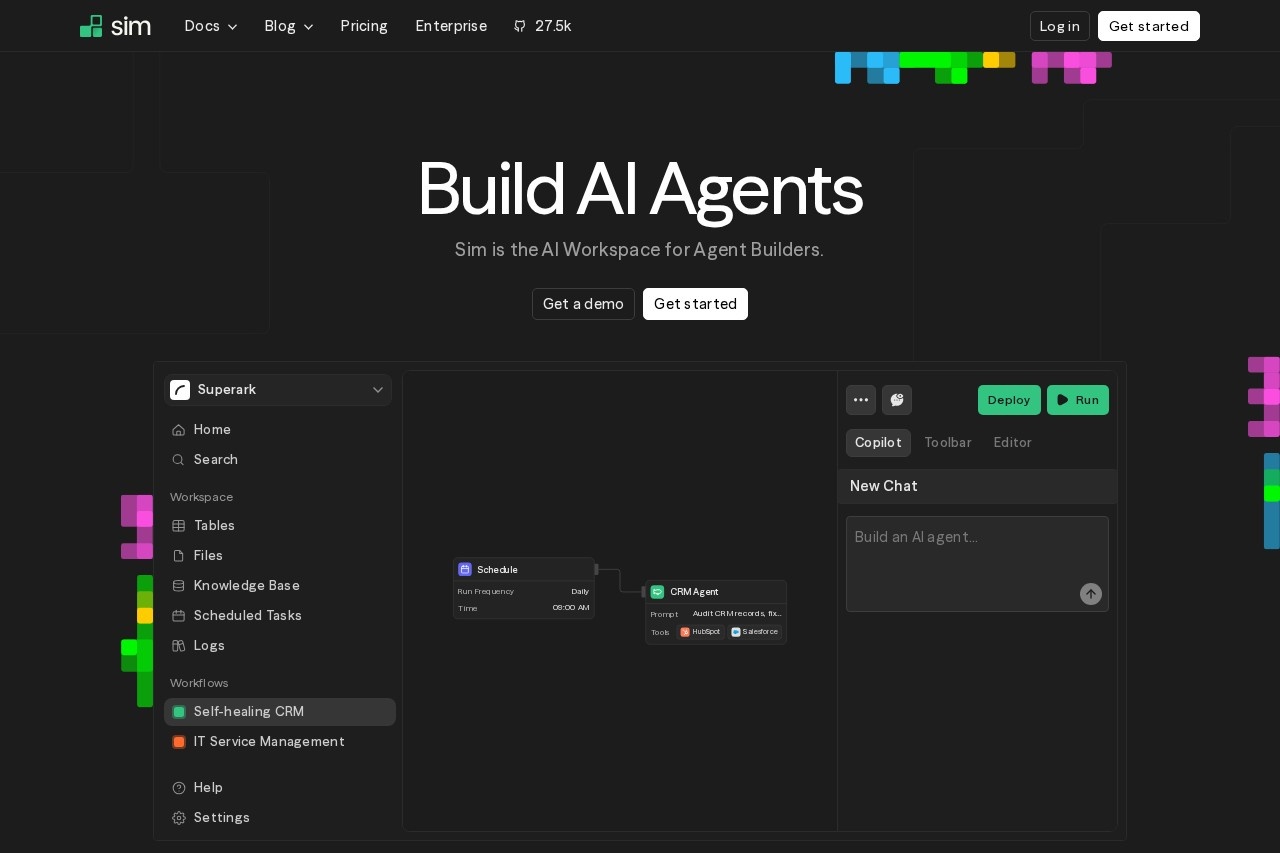
Sim is the open-source platform to build AI agents and run your agentic workforce. Connect 1,000+ integrations and LLMs to orchestrate agentic workflows.
About
Sim is an open-source platform designed to help developers and enterprises build AI agents and run your agentic workforce. It enables you to easily connect over 1,000 integrations and large language models (LLMs) to orchestrate complex agentic workflows, automating and intelligently streamlining your business processes.
Key Features
Pricing & Fees
- Pricing: Four plans are offered: Free at $0, Pro at $25 per user/month, Max at $100 per user/month (both billed monthly), and Enterprise with custom terms; annual billing saves 15%.
- Free tier: The Free plan is available forever with 1,000 one-time credits, 1 workspace, 10 concurrent executions, 5 GB file storage, and 30-day log retention.
- Plan limits: Higher tiers increase usage — Pro includes 6,000 credits per month plus 2,000 weekly refresh credits and 3 workspaces, while Max includes 25,000 credits per month, unlimited workspaces, and 500 GB storage.
- Enterprise features: Advanced capabilities such as SSO, SOC2 compliance, self-hosting, and dedicated support are reserved for the Enterprise plan; Max adds Sim Mailer, KB Live Sync, sandboxes, and Slack Connect.
- Open source: Sim is open source under Apache 2.0 and can run in the cloud or self-hosted, connecting 270+ integrations and every major LLM.
Who It's For
AI developers and engineers looking to rapidly build and experiment with complex multi-agent systems; enterprise automation teams seeking to deeply embed AI agents into existing business processes for greater efficiency; product managers and entrepreneurs planning to build the next generation of AI-agent-powered applications and services; and researchers focused on multi-agent collaboration and automated workflows in academia or industry.
Related Tutorials
View all →

Related Tools
View all → AgentScope - Where Agents Come Alive AgentScope is an open-source multi-agent platform for building LLM-powered applications. It features drag-and-drop workflows, runtime management, and the Spark Design system.
 Eigent Eigent is an open-source desktop multi-agent AI workforce that automates browser, desktop, and file-based tasks using the model of your choice, with local-first control.
 Paperclip Paperclip is an open-source, self-hosted app for managing teams of AI agents for work, with org charts, goals, budgets, and governance in one deployment.
 Yuxi - RAG Harness for AI Agents Yuxi provides a RAG harness to enhance AI agents with retrieval-augmented generation capabilities.
 OmniRoute - Free AI Gateway for Multi-Provider LLMs Free, open-source AI router with auto-fallback. 236 providers, one endpoint, 95 MCP tools, 17 routing strategies, A2A protocol, auto-combo engine, semantic cache, memory & skills. Deploy anywhere.