
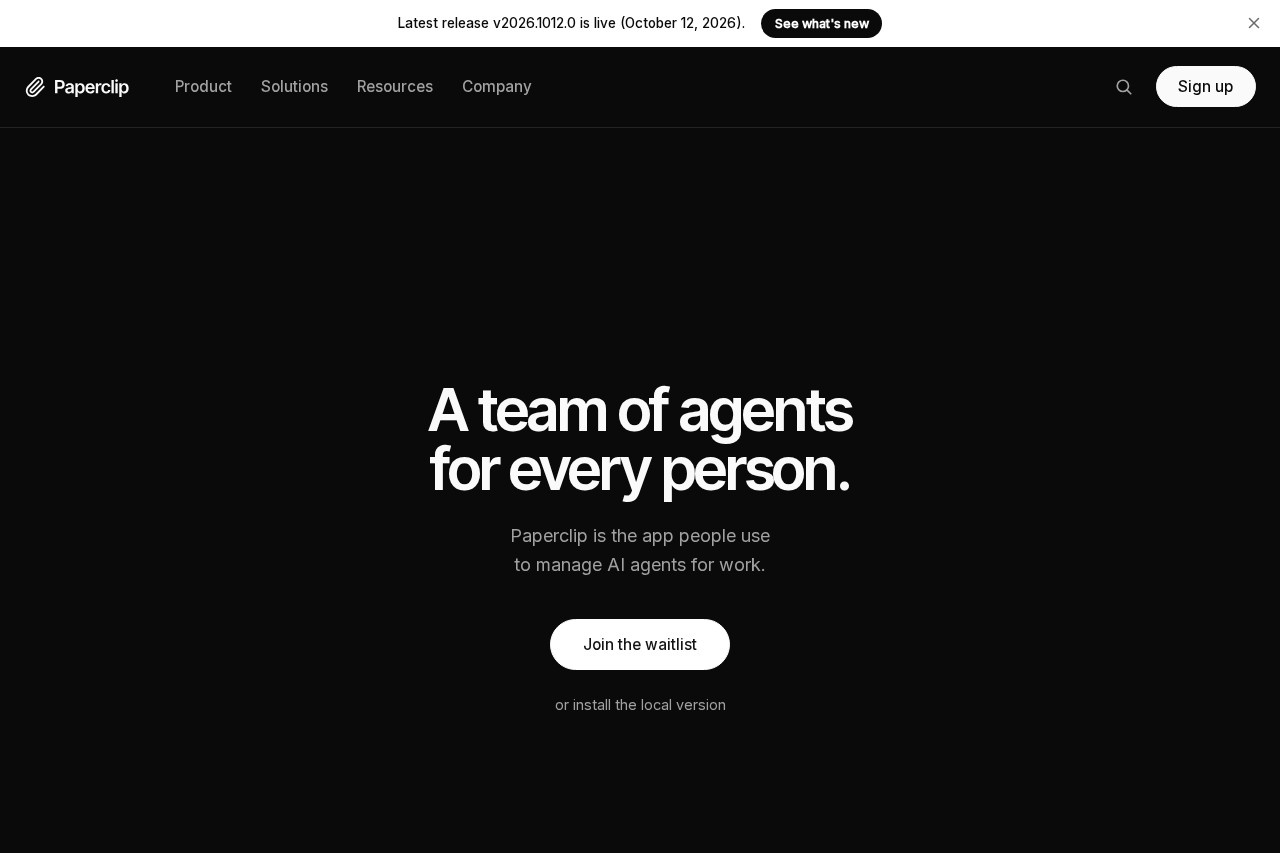
Paperclip is an open-source, self-hosted app for managing teams of AI agents for work, with org charts, goals, budgets, and governance in one deployment.
About
Paperclip is an open-source application for managing teams of AI agents that do work for a business. Instead of wiring together many separate automations or prompting individual chatbots, a user defines an organizational goal, "hires" agents into roles such as CEO, engineer, or marketer, and then supervises them through a single dashboard that includes org charts, budgets, governance rules, and task tracking.
The project is built as a Node.js server with a React interface and is MIT licensed, so anyone can run it locally without creating a hosted account. A local install runs a single Node.js process with an embedded Postgres database and file storage; for production use, it can be pointed at an external Postgres instance. The model behind the product treats the agent workforce like a company: each agent has a boss, a title, and a job description, and human managers approve hires, set spending limits, and review output. The source code is public on GitHub.
Key Features
Pricing & Fees
- Pricing: The self-hosted product is free and MIT licensed; no paid plans are described on the pages reviewed. Check the official site for current plans.
- Installation: Requires Node.js 24.11 or newer; a local install runs with embedded Postgres and file storage, and production deployments can use an external Postgres database.
- Working model: Users define a goal, hire a team of agents to pursue it, approve the strategy, set budgets, and monitor progress from the dashboard.
- Heartbeats: Agents wake on assigned work, follow-up messages, or configured schedules, keeping recurring and scheduled work running.
- Scope: Paperclip is not an agent framework or prompt manager; it orchestrates and governs existing agents rather than dictating how they are built.
Who It's For
Paperclip suits technical founders, solo builders, and small teams who want to run several AI agents as a coordinated workforce instead of a collection of disconnected tools. Typical uses include software development, content and social media production, marketing, QA, research, and outreach, all supervised under shared goals and budgets. It also fits organizations that need self-hosted, open-source software with their own Postgres infrastructure and fine-grained control over agent spending and approvals. Users who prefer a managed SaaS with vendor support may find the self-hosted setup less convenient.
FAQ
What is Paperclip?Paperclip is an open-source orchestration app for managing teams of AI agents that perform business work, providing org charts, budgets, governance, and goal tracking in one deployment.
Is Paperclip free?Yes, the self-hosted product is MIT licensed and free to use; a Paperclip account is not required, and no paid plans are described on the pages reviewed.
Which agents and tools does Paperclip work with?It works with any agent that can receive a heartbeat, including OpenClaw, Claude Code, Codex, Cursor, Gemini CLI, OpenCode, Pi, Hermes, Grok Build, and Kimi Code, and it connects to services such as GitHub, Notion, and Railway.
How is Paperclip different from an agent framework?Paperclip does not define how agents are built; it runs and governs the organization made of existing agents, handling roles, goals, budgets, approvals, and task delegation.
Can Paperclip be self-hosted, and where does data live?Yes, it is self-hosted under an MIT license; locally it uses an embedded Postgres database and file storage, and production deployments can use the operator's own Postgres instance, so data stays on the operator's infrastructure.
Related Tutorials
View all →
Related Tools
View all → Sim Sim is the open-source platform to build AI agents and run your agentic workforce. Connect 1,000+ integrations and LLMs to orchestrate agentic workflows.
 AgentScope - Where Agents Come Alive AgentScope is an open-source multi-agent platform for building LLM-powered applications. It features drag-and-drop workflows, runtime management, and the Spark Design system.
 Eigent Eigent is an open-source desktop multi-agent AI workforce that automates browser, desktop, and file-based tasks using the model of your choice, with local-first control.
 Yuxi - RAG Harness for AI Agents Yuxi provides a RAG harness to enhance AI agents with retrieval-augmented generation capabilities.
 OmniRoute - Free AI Gateway for Multi-Provider LLMs Free, open-source AI router with auto-fallback. 236 providers, one endpoint, 95 MCP tools, 17 routing strategies, A2A protocol, auto-combo engine, semantic cache, memory & skills. Deploy anywhere.