
OpenVINO Toolkit optimizes and deploys AI models across Intel hardware, enabling efficient edge and cloud inference.
About
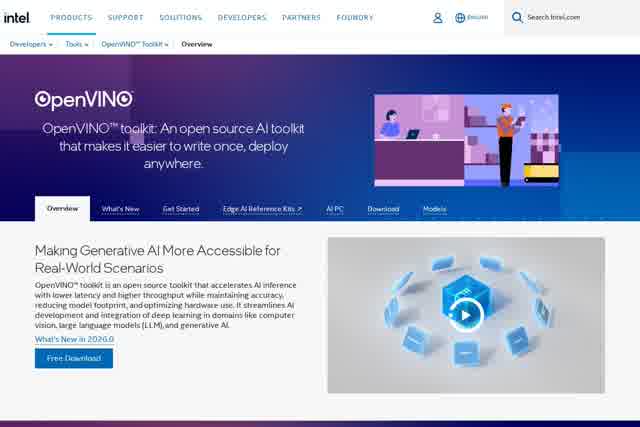
OpenVINO (Open Visual Inference & Neural Network Optimization) Toolkit is a powerful open-source toolkit developed by Intel, designed specifically for optimizing and deploying artificial intelligence inference. It aims to significantly boost the performance of deep learning models on Intel hardware, with broad applications across computer vision, automatic speech recognition, natural language processing, and more.
Key Features
Pricing & Fees
- Pricing: Not publicly listed on the pages we reviewed; check the official site for current plans. OpenVINO is distributed by Intel as an open source toolkit.
- Free to use: The toolkit is open source and available as a free download from Intel.
- Cross-platform support: Runs on Windows, Linux, and macOS operating systems.
- Framework compatibility: Supports models trained in mainstream frameworks such as TensorFlow, PyTorch, and Caffe, deployable across Intel hardware on-premise, on-device, in the browser, or in the cloud.
Who It's For
OpenVINO is well suited for a wide range of developers and organizations, including AI researchers and engineers looking to quickly deploy and optimize deep learning models, enterprise developers focused on delivering efficient AI inference at the edge or in the cloud, and students or hobbyists eager to learn and practice AI model optimization and deployment techniques.
Related Tutorials
View all →
Related Tools
View all → DFlash: Block Diffusion for Flash Speculative Decoding - Z Lab DFlash is a cutting-edge technology by Z Lab that accelerates large language model inference through block diffusion and speculative decoding, delivering up to 3x speedup without compromising quality.
 Tick Stock Panel (TSP) Tick Stock Panel is a self-hosted, zero-maintenance quantitative workbench for A-shares, integrating stock screening, monitoring, and backtesting with LLM-driven strategy customization and analysis.
 Rig - Build Powerful LLM Applications in Rust Rig: A Rust framework for building modular, scalable LLM applications. Features a unified LLM interface, Rust-native performance, and advanced AI workflow abstractions to streamline development.
 Zapier Zapier is a no-code AI orchestration platform that connects more than 9,000 apps so teams can build automated workflows, AI agents, and chatbots without writing code.
 Supervision Supervision by Roboflow provides tools for computer vision projects.