
DFlash is a cutting-edge technology by Z Lab that accelerates large language model inference through block diffusion and speculative decoding, delivering up to 3x speedup without compromising quality.
About
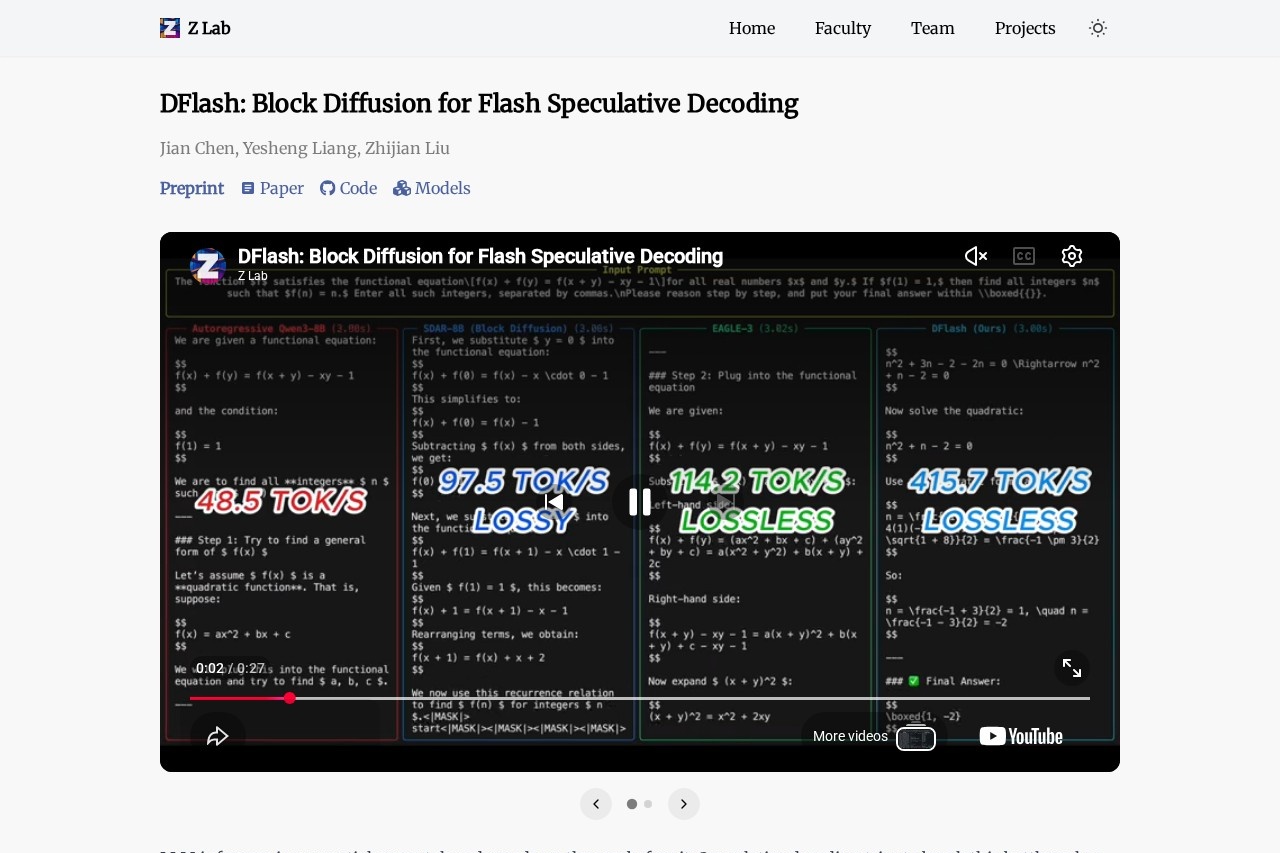
DFlash: Block Diffusion for Flash Speculative Decoding is a cutting-edge technology developed by Z Lab, designed to tackle the efficiency bottlenecks in large language model inference. Traditional autoregressive decoding methods deliver high accuracy, but generation speed is constrained by token-by-token computation, making it difficult to meet the demands of real-time applications. By combining a block diffusion mechanism with speculative decoding, DFlash significantly boosts inference throughput without compromising generation quality. This technology is especially well-suited for fast-response dialogue systems, content generation tools, and edge deployment scenarios, offering developers an efficient and scalable solution.
Key Features
Pricing & Fees
- High Efficiency: Compared to standard speculative decoding, DFlash's block diffusion strategy reduces redundant computation by roughly 40%, delivering 2-3x acceleration on the same hardware.
- Lossless Quality: Through progressive refinement in the diffusion process, generated text maintains coherence and accuracy on par with traditional autoregressive methods, and even performs better on certain tasks.
- Ease of Use: Comes with pretrained models and ready-to-run configuration examples, allowing quick deployment without deep knowledge of diffusion model internals.
- Scalability: Supports elastic scaling from a single GPU to multi-node clusters, adapting seamlessly to both cloud and on-premises environments.
Who It's For
AI researchers and engineers looking to explore new decoding paradigms and optimize large model inference performance; product developers who need to integrate real-time AI capabilities such as chatbots or code completion into their applications; edge computing practitioners deploying large models on resource-constrained devices while prioritizing low power consumption and fast response; and enterprise technology decision-makers evaluating options to reduce LLM serving costs and improve user experience.
Related Tutorials
View all →.webp)
Related Tools
View all → Rig - Build Powerful LLM Applications in Rust Rig: A Rust framework for building modular, scalable LLM applications. Features a unified LLM interface, Rust-native performance, and advanced AI workflow abstractions to streamline development.
  Supervision Supervision by Roboflow provides tools for computer vision projects.
  TensorRT-LLM TensorRT-LLM is NVIDIA's high-performance inference library for LLMs, delivering low latency and high throughput.
  Flowise Flowise is a low-code platform for building AI agents and LLM applications, enabling rapid development and deployment of AI solutions.
  Xinference Xinference provides a flexible platform for deploying and serving AI models, supporting various frameworks and easy integration.