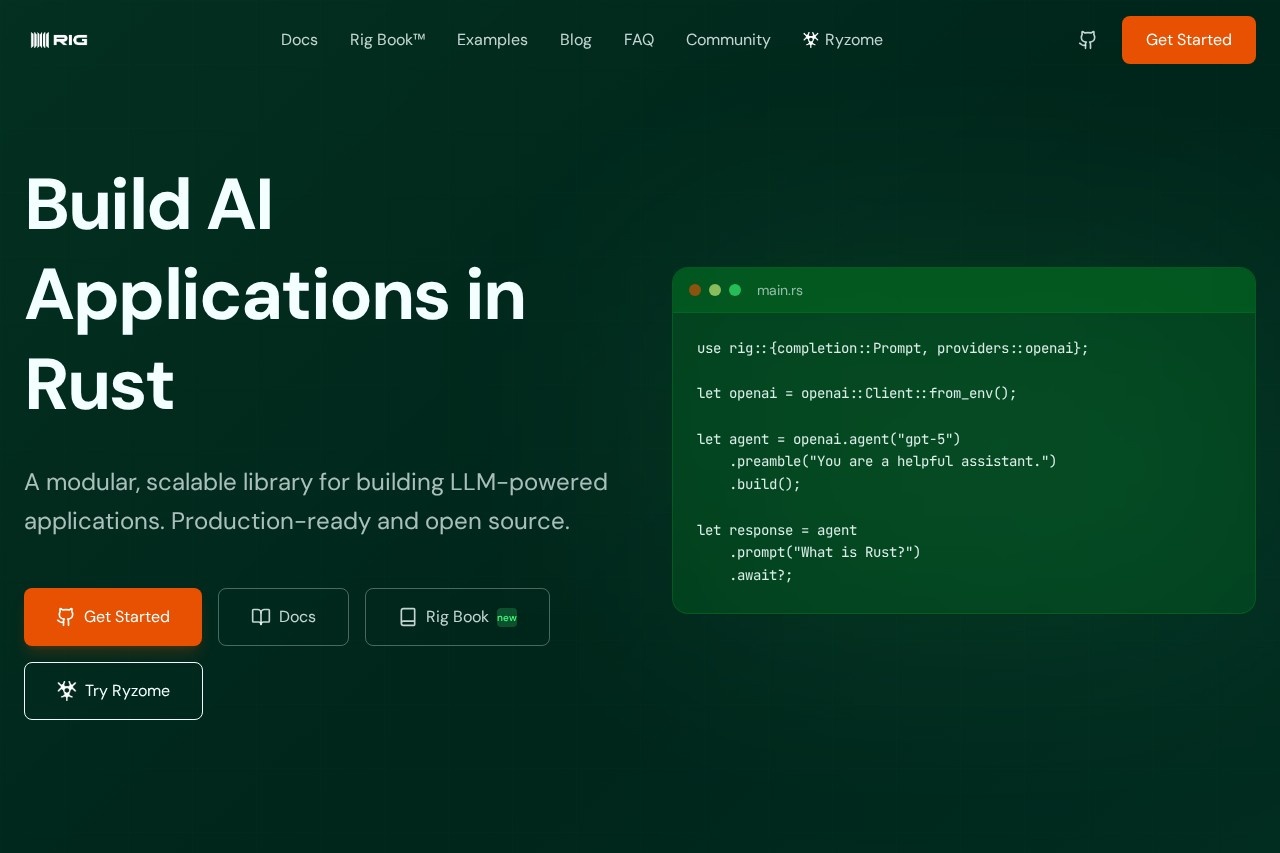
Rig - Build Powerful LLM Applications in Rust
Rig:用 Rust 构建强大的 LLM 应用程序框架
在人工智能应用开发日新月异的今天,开发者需要一个既强大又可靠的工具来构建下一代智能系统。Rig 应运而生,它是一个专为 Rust 语言设计的框架,旨在帮助开发者轻松构建模块化、可扩展的大型语言模型(LLM)应用程序。通过提供统一的 LLM 接口和先进的 AI 工作流抽象,Rig 将 Rust 原生的高性能与人工智能开发的灵活性完美结合,极大地简化了开发流程。
主要功能
Rig 框架提供了一套完整的功能集,以满足现代 LLM 应用开发的核心需求:
- 统一的 LLM 接口:通过标准化的 API 连接和切换不同的底层模型(如 OpenAI, Anthropic,或本地模型),减少供应商锁定。
- 高级工作流抽象:提供链(Chain)、代理(Agent)等模式,方便构建复杂的多步骤推理和任务自动化流程。
- 模块化设计:核心组件如提示词管理、工具调用、记忆模块均可插拔,便于定制和扩展。
- Rust 原生性能与安全:充分利用 Rust 的内存安全、零成本抽象和高并发特性,构建稳定高效的后端服务。
特色优势
选择 Rig,意味着为您的项目注入独特的竞争力:
- 卓越的性能:得益于 Rust 语言,您的应用将具备极高的吞吐量和极低的延迟,特别适合对性能有严苛要求的场景。
- 强大的类型安全:在编译期捕获大量潜在错误,确保复杂 AI 工作流的正确性,减少运行时调试成本。
- 清晰的工程结构:框架鼓励清晰的关注点分离,使得大型 AI 应用代码更易于维护、测试和团队协作。
- 面向生产环境:从设计之初就考虑了部署、监控和可观测性,助力应用平稳上线。
适用人群
Rig 非常适合以下开发者与团队:
- 希望将 AI 功能集成到现有 Rust 后端系统或高性能服务中的工程师。
- 追求极致性能、安全性和可靠性的 LLM 应用构建者。
- 需要构建复杂、可维护且面向生产的 AI 工作流和智能代理的团队。
- 熟悉或愿意学习 Rust,并看好其在 AI 基础设施领域前景的技术爱好者。
常见问题
Q: 我需要很深的 Rust 知识才能使用 Rig 吗?
A: 具备 Rust 中级知识(熟悉异步编程、trait 等)即可开始。框架的清晰抽象有助于您快速上手。
Q: Rig 支持哪些 LLM 提供商?
A: Rig 设计上支持主流的云 API 和本地模型。具体支持列表会随版本更新而扩展,框架的统一接口使得集成新提供商相对简单。
Q: Rig 适合初学者学习 LLM 应用开发吗?
A: 如果您同时希望学习 Rust 和 LLM 应用开发,Rig 是一个很好的实践项目。但若您纯粹想快速原型验证,可能 Python 生态的框架更为直接。
Q: 如何开始使用 Rig?
A: 访问我们的官方文档和 GitHub 仓库,那里提供了详细的入门指南、示例代码和 API 参考。
English
Rig: A Powerful Framework for Building LLM Applications in Rust
In today's rapidly evolving landscape of AI application development, developers need a tool that is both powerful and reliable to build next-generation intelligent systems. Rig was created to meet this need—it is a framework designed specifically for the Rust language, aimed at helping developers effortlessly build modular, scalable Large Language Model (LLM) applications. By providing a unified LLM interface and advanced AI workflow abstractions, Rig perfectly combines Rust's native high performance with the flexibility of AI development, greatly simplifying the development process.
Key Features
The Rig framework offers a comprehensive set of features to address the core needs of modern LLM application development:
- Unified LLM Interface: Connect and switch between different underlying models (such as OpenAI, Anthropic, or local models) through a standardized API, reducing vendor lock-in.
- Advanced Workflow Abstractions: Provides patterns like Chains and Agents to facilitate the construction of complex multi-step reasoning and task automation pipelines.
- Modular Design: Core components such as prompt management, tool calling, and memory modules are pluggable, making customization and extension easy.
- Rust-Native Performance and Safety: Leverages Rust's memory safety, zero-cost abstractions, and high concurrency to build stable and efficient backend services.
Highlights
Choosing Rig means injecting unique competitiveness into your project:
- Exceptional Performance: Thanks to the Rust language, your applications will achieve extremely high throughput and low latency, making them especially suitable for performance-critical scenarios.
- Strong Type Safety: Many potential errors are caught at compile time, ensuring the correctness of complex AI workflows and reducing runtime debugging costs.
- Clear Engineering Structure: The framework encourages a clean separation of concerns, making large-scale AI application code easier to maintain, test, and collaborate on within teams.
- Production-Ready: Deployment, monitoring, and observability were considered from the outset, helping applications go live smoothly.
Who It's For
Rig is well-suited for the following developers and teams:
- Engineers looking to integrate AI capabilities into existing Rust backend systems or high-performance services.
- LLM application builders who prioritize extreme performance, security, and reliability.
- Teams that need to build complex, maintainable, and production-oriented AI workflows and intelligent agents.
- Technology enthusiasts who are familiar with or willing to learn Rust and see its potential in the AI infrastructure space.
FAQ
Q: Do I need deep Rust knowledge to use Rig?
A: Intermediate Rust knowledge (familiarity with async programming, traits, etc.) is sufficient to get started. The framework's clear abstractions help you ramp up quickly.
Q: Which LLM providers does Rig support?
A: Rig is designed to support mainstream cloud APIs and local models. The specific list of supported providers expands with each version update, and the framework's unified interface makes integrating new providers relatively straightforward.
Q: Is Rig suitable for beginners learning LLM application development?
A: If you also want to learn Rust and LLM application development at the same time, Rig is a great hands-on project. However, if your goal is purely rapid prototyping, frameworks in the Python ecosystem might be more direct.
Q: How do I get started with Rig?
A: Visit our official documentation and GitHub repository, where you'll find detailed getting-started guides, example code, and API references.