
CAMEL-AI.org offers tools for AI research and development. It provides resources for building and testing AI models.
About
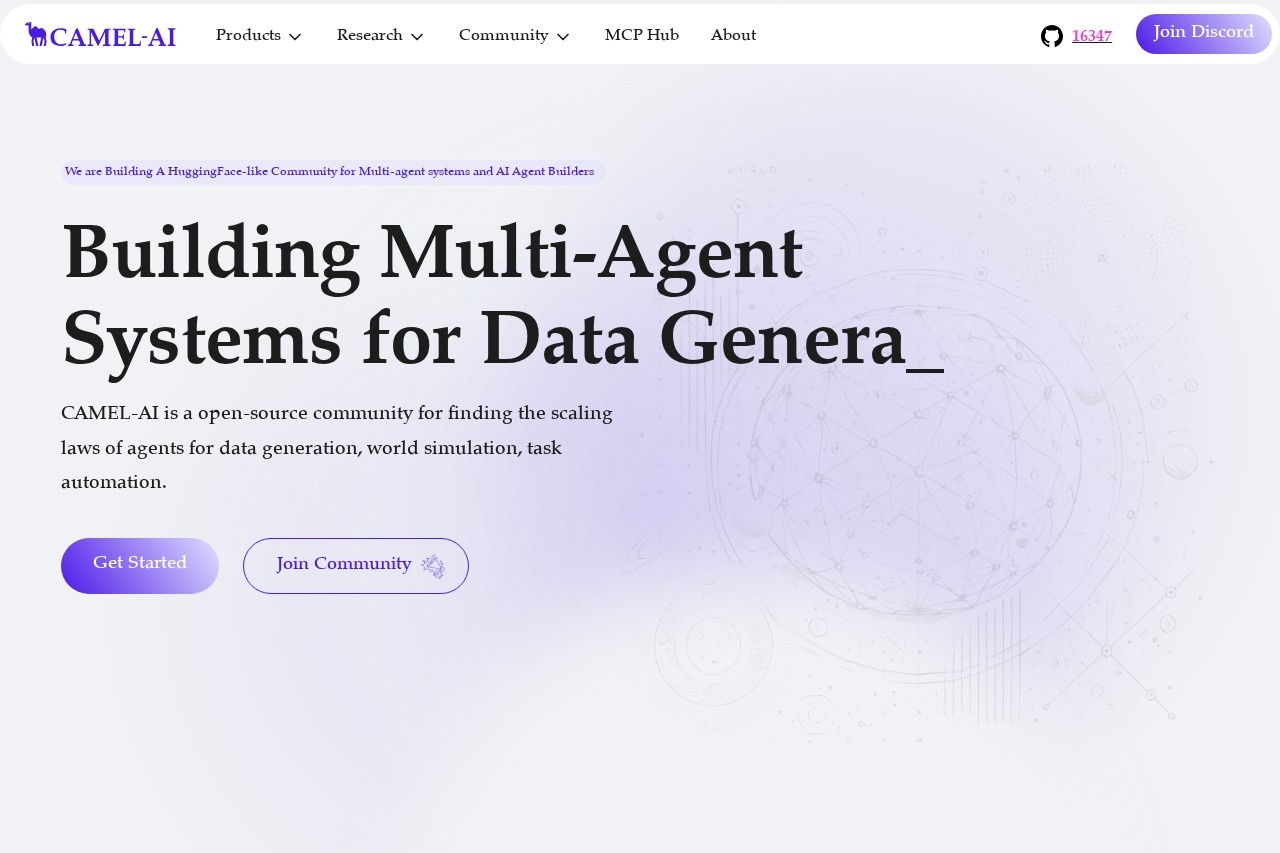
CAMEL-AI.org is a pioneer in the rapidly evolving field of artificial intelligence, focusing on the discovery and establishment of scaling laws for AI agents. As multi-agent collaboration becomes essential to unlocking the full potential of large language models (LLMs), CAMEL-AI stands at the forefront as an open-source multi-agent framework and community dedicated to systematic research. The project aims to uncover the mathematical relationships between the number of agents, their capabilities, and task complexity, laying the theoretical groundwork for the next generation of AI systems.
Key Features
Pricing & Fees
- Pricing: Not publicly listed on the pages we reviewed; check the official site for current plans.
- Open Source: CAMEL-AI is a fully open-source community and framework, installable via pip (`pip install camel-ai`) with documentation, tutorials, and examples available.
- Access Model: There is no paid plan tier on the site; users bring their own model API keys, so actual costs depend on the underlying LLM providers they connect.
- Community-Driven: A community-driven research collective of 100+ researchers contributes code, benchmarks, and findings across projects such as CAMEL, OWL, OASIS, and SETA.
Who It's For
CAMEL-AI serves a broad range of AI enthusiasts and professionals. AI researchers, especially those interested in multi-agent systems, human-machine collaboration, emergent behavior, and the boundaries of LLM capabilities, will find it invaluable. Advanced developers and engineers looking to build complex, automated AI applications—such as autonomous customer service, code generation teams, or research assistants—can leverage the framework for practical deployment. Students and educators will discover an excellent platform for learning cutting-edge multi-agent AI and for use in course projects or thesis work. Finally, technology enthusiasts and forward-thinkers who want hands-on experience with the possible shapes of future AI societies are all welcome to explore and contribute.
Related Tutorials
View all →
Related Tools
View all → Yuxi - RAG Harness for AI Agents Yuxi provides a RAG harness to enhance AI agents with retrieval-augmented generation capabilities.
  omp - A Coding Agent with the IDE Wired In Oh My Pi (omp) is a coding agent that integrates with your IDE, leveraging LSP and DAP for seamless development. Built in Rust for performance.
  DeepEval by Confident AI - LLM Evaluation Framework Open-source LLM evaluation framework with 50+ plug-and-play metrics for AI agents, RAG, chatbots, and more.
  OmniRoute - Free AI Gateway for Multi-Provider LLMs Free, open-source AI router with auto-fallback. 236 providers, one endpoint, 95 MCP tools, 17 routing strategies, A2A protocol, auto-combo engine, semantic cache, memory & skills. Deploy anywhere.
  AgentsView - AI Agent Session Manager Local-first desktop and web app for managing AI agent sessions.