
Speech-to-text API for developers with high accuracy.
About
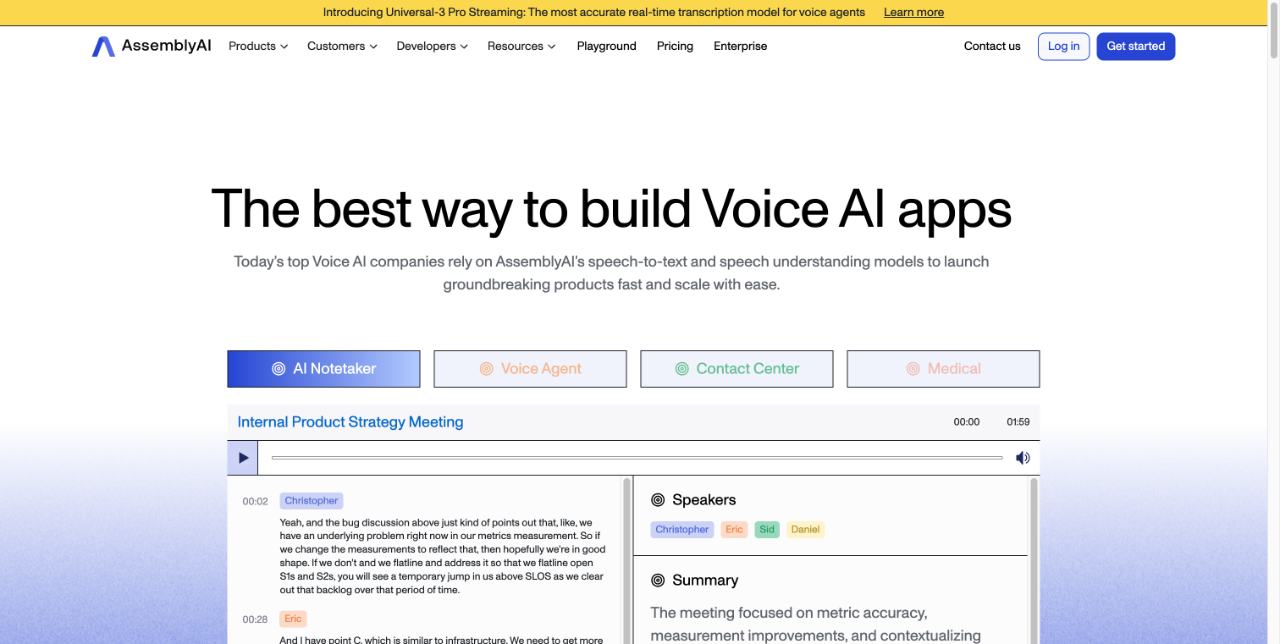
AssemblyAI is a leading company specializing in voice artificial intelligence technology, dedicated to helping users efficiently transcribe and understand spoken content through advanced AI models. Its solutions are widely applied in areas such as meeting documentation, media production, and customer service analytics, providing businesses and developers with accurate, high-speed speech processing capabilities.
Key Features
Pricing & Fees
- Pricing: Not publicly listed on the pages we reviewed; check the official site for current plans. A pricing rate card with billing rules is maintained at assemblyai.com/pricing.
- API-based access: Sold as production-grade APIs (pre-recorded and real-time speech-to-text, Voice Agent, Speech Understanding, Guardrails, LLM Gateway), so costs are typically tied to API usage rather than seat-based subscriptions.
- Developer onboarding: Clean REST API with comprehensive documentation; integration can be completed in as little as five minutes.
- Scalability and privacy: Handles workloads from individual files to large-scale streaming media, with data processing aligned to security standards such as GDPR.
Who It's For
AssemblyAI's services are designed for corporate administrators who need automated meeting notes, media companies generating video captions and performing content analysis, customer service centers optimizing call quality and script evaluation, developers building voice-enabled applications, and academic researchers conducting linguistic or sociological studies.
Related Tutorials
View all →

Related Tools
View all → Spokenly - AI Voice Assistant Spokenly is an AI voice assistant for macOS that enables hands-free control and voice commands, enhancing productivity and accessibility.
 AI Tool - AI-Powered Solutions This AI tool provides intelligent solutions to streamline workflows, enhance productivity, and deliver accurate results across various tasks.
 LiblibAI 2.0 An advanced AI platform offering powerful tools for image generation, editing, and creative workflows.
 Seedance 2.0 - AI Video Generator Create stunning AI-generated videos with Seedance 2.0. Turn text into dynamic visuals effortlessly.
 AI Chat Assistant An AI chat assistant that answers questions, provides recommendations, and assists with tasks using advanced language models.