
About
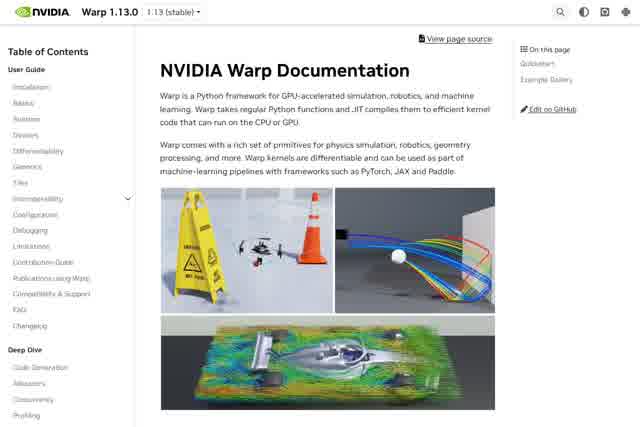
Warp is a high-performance graphics and simulation framework developed by NVIDIA, designed to accelerate next-generation compute graphics, physics simulation, and artificial intelligence workloads. As a key technology component within the NVIDIA ecosystem, Warp provides developers with an efficient, programmable runtime environment that fully leverages GPU parallel computing capabilities for a wide range of scenarios, from real-time rendering to complex scientific simulation. Whether in game development, visual effects, industrial design, or robotics simulation, Warp significantly improves the efficiency of graphics processing and physics computation, helping developers break through traditional performance bottlenecks.
Key Features
Pricing & Fees
- Pricing: Not publicly listed on the pages we reviewed; check the official site for current plans.
- License: Warp is an open-source project hosted on GitHub by NVIDIA, so the code is available without a paid subscription.
- Platform availability: Runs on Windows and Linux, and supports deployment on workstations, data centers, and cloud environments.
- Ecosystem: Integrates with NVIDIA Omniverse and Isaac Sim, and is compatible with common 3D tools such as Blender, Unreal Engine, and Maya.
- Developer resources: Provides sample code, documentation, and debugging tools to help developers get started.
Who It's For
Game developers looking to build high-fidelity, high-frame-rate 3D games or implement complex physical interactions. Film and animation artists pursuing photorealistic rendering and effects simulation while reducing offline render times and boosting production efficiency. Industrial engineers and scientists working on simulation and analysis in fields such as fluid dynamics, structural mechanics, and electromagnetics who need both high accuracy and fast computation. Robotics researchers training and testing robot algorithms in virtual environments for seamless sim-to-real transfer. AI and computer vision developers who need GPU-accelerated neural network inference or want to build hybrid applications combining graphics and AI.
Related Tutorials
View all →
Related Tools
View all → oMLX - LLM Inference Optimized for Mac A native macOS inference server on MLX with paged SSD KV caching, reducing TTFT to under 5s. OpenAI & Anthropic compatible.
 9Router - Free AI Router Free AI routing with smart 3-tier fallback. Maximize subscriptions, auto-switch to cheap/free models. Never stop coding with Claude Code, Codex, Gemini CLI.
 OpenRouter OpenRouter is a unified, OpenAI-compatible API that gives developers pay-as-you-go access to 500+ AI models for text, image, video, and audio from 80+ providers.
 OmniRoute - Free AI Gateway for Multi-Provider LLMs Free, open-source AI router with auto-fallback. 236 providers, one endpoint, 95 MCP tools, 17 routing strategies, A2A protocol, auto-combo engine, semantic cache, memory & skills. Deploy anywhere.
 LangChain LangChain provides a comprehensive suite of products to support developers throughout their entire development workflow.