
Vana is an open data network that lets individuals control, port and permission their personal data for AI apps, with every read recorded and value flowing back to them.
About
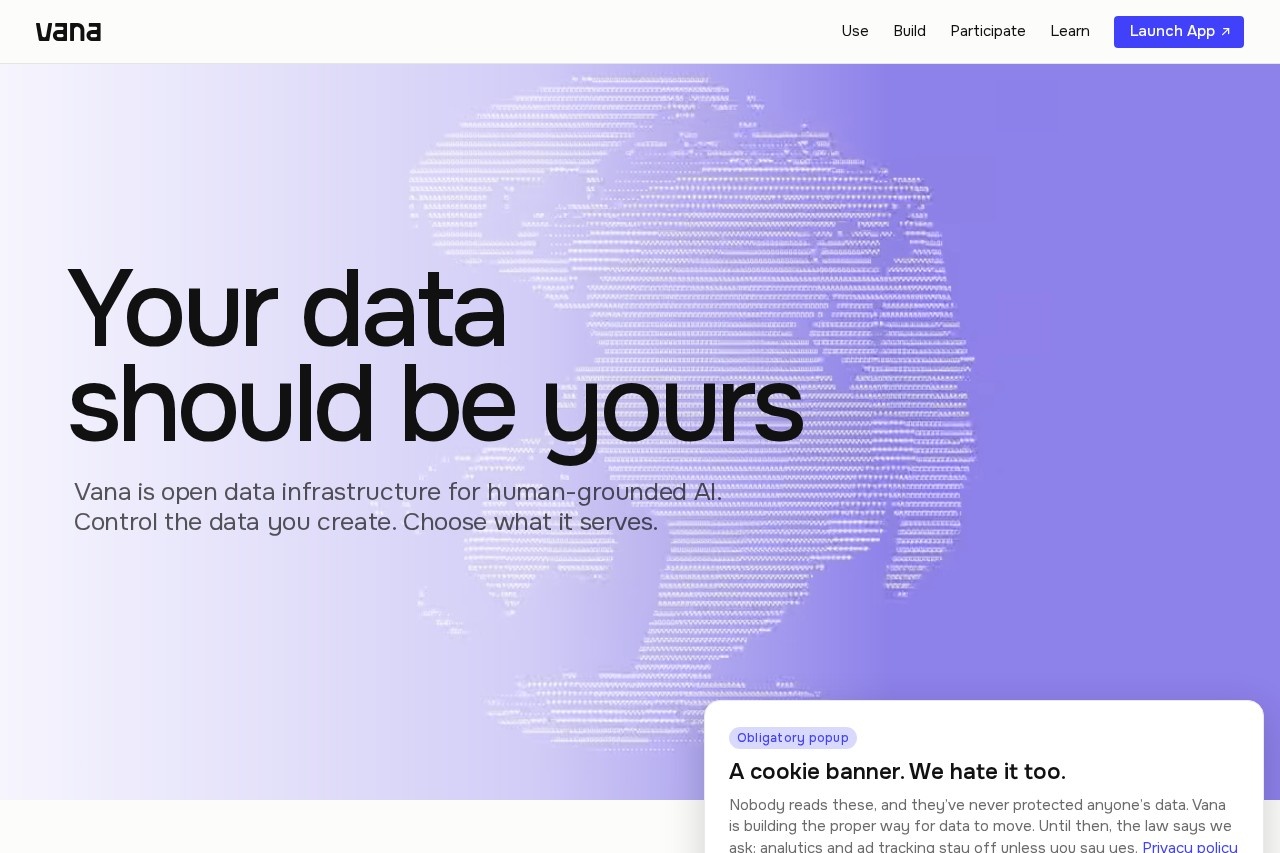
Vana is open data infrastructure for what it calls human-grounded AI: a network over which personal data moves only with the permission of the person it belongs to, and with a record of every access. The project addresses a familiar imbalance — the data people generate online creates value for platforms and AI systems, but rarely for the people who produced it. Vana lets a person connect the accounts that hold their data, grant specific apps or AI systems the right to read specific records, revoke that right at any time, and receive the value their data generates.
The project grew out of the MIT Media Lab and shares the data-ownership principles that Tim Berners-Lee brought to MIT with the Solid project. Vana Foundation is the neutral steward of the network, while OpenDataLabs, led by co-founder and CEO Anna Kazlauskas, is the core contributor that builds and operates the products governments and industry run on it. Vana is also known for Data Collectives, where people pool data into sets that AI developers could not assemble elsewhere and share in what those sets earn.
Key Features
Pricing & Fees
- Pricing: Individual use of the network is mediated by apps, which may sponsor fees so users pay nothing directly; reads under live grants carry fees paid in VANA or stablecoins such as USDC. Check the official site for current details.
- Network scale: The project reports 1.5 million users, more than 20 million transactions, and over 100 community-built apps and Data Collectives.
- Open standard: The PDPP specification is published at pdpp.dev, with Vana Foundation as steward and a member of Linux Foundation Decentralized Trust.
- Documentation: The whitepaper (December 2024), the Vega upgrade addendum (September 2026), and developer docs are available at vana.org and docs.vana.org.
Who It's For
Vana is built for three main groups. Individuals who want to reclaim control of the data they generate and potentially earn from it can use the Vana App to move their data between services with permission and a record. Developers building AI applications can start from user-consented data instead of beginning from zero, using grants and operations to access it responsibly. Organizations — including governments, AI labs, and enterprises, served through OpenDataLabs' products such as Context Gateway — can build against the PDPP standard for trusted data access.
FAQ
What is Vana?Vana is an open network for data portability that lets personal data move between apps and AI systems only under the permission of the person it belongs to, with every read recorded.
Is Vana free to use?Apps built on Vana can sponsor network fees for their users, so individuals can use them without holding tokens or paying per read; underlying network fees are paid in VANA or stablecoins like USDC.
Who built and governs Vana?Vana Foundation, co-founded by Art Abal as Managing Director, stewards the network and the PDPP standard, while core contributor OpenDataLabs, led by CEO Anna Kazlauskas, builds the products governments and industry run on it.
How does Vana protect privacy?Data is protected by protocol-governed encryption that prevents decryption without a valid grant, and apps can receive computed answers called operations without ever holding the raw data.
What is the VANA token used for?VANA is the network's token; each read of a person's data under a live grant carries a fee, and stakers who back data-carrying operators are paid from the fees the network earns.
Related Tutorials
View all →
Related Tools
View all → W.AI W.AI is a decentralized AI supercomputer that pools idle GPU power from devices worldwide, letting contributors run AI workloads and earn W COIN rewards.
 Talent Protocol Talent Protocol's Builder Score turns public GitHub and multi-chain blockchain activity into a transparent, onchain-attested reputation score for builders in web3.
 oMLX - LLM Inference Optimized for Mac A native macOS inference server on MLX with paged SSD KV caching, reducing TTFT to under 5s. OpenAI & Anthropic compatible.
 9Router - Free AI Router Free AI routing with smart 3-tier fallback. Maximize subscriptions, auto-switch to cheap/free models. Never stop coding with Claude Code, Codex, Gemini CLI.
 OpenRouter OpenRouter is a unified, OpenAI-compatible API that gives developers pay-as-you-go access to 500+ AI models for text, image, video, and audio from 80+ providers.