
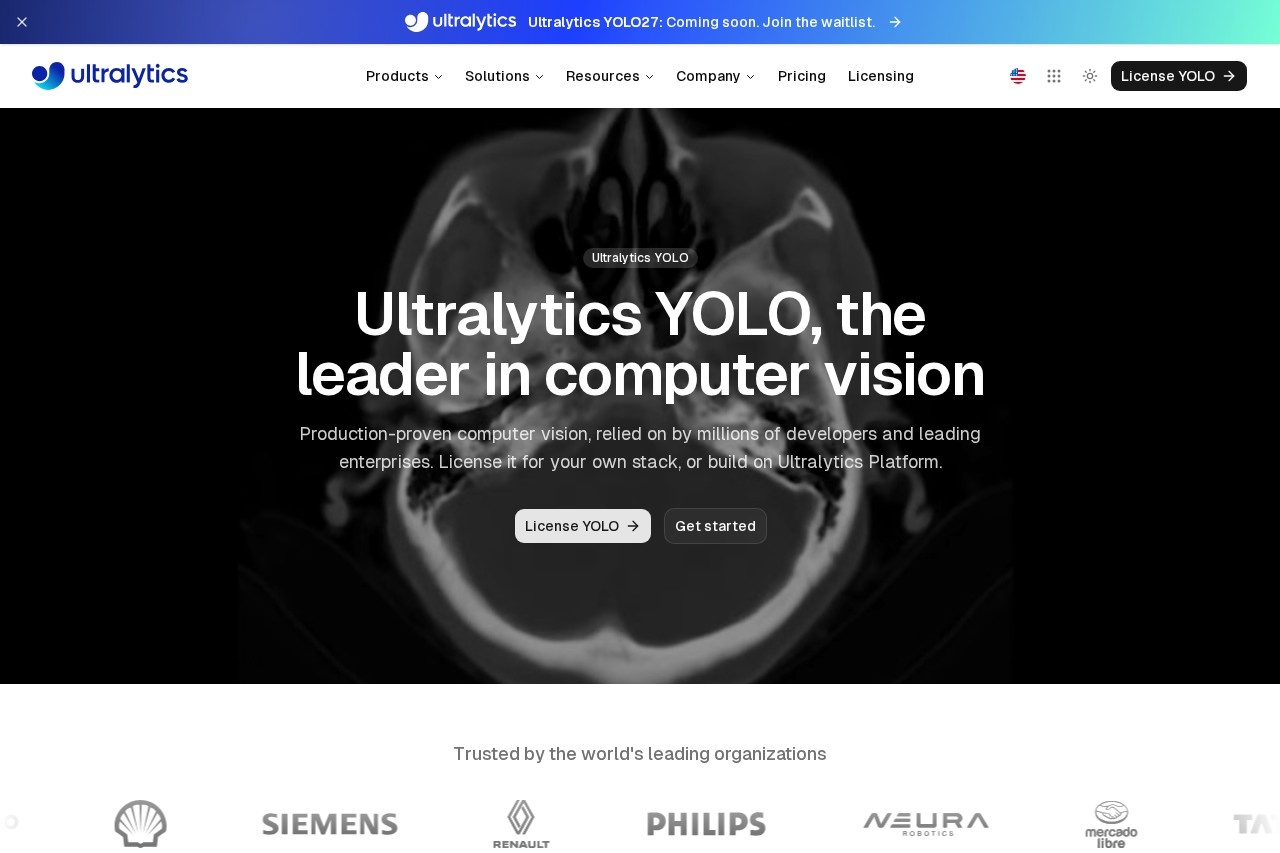
Ultralytics offers the YOLO family of real-time computer vision models plus a cloud platform to annotate, train, and deploy vision AI from cloud to edge.
About
Ultralytics builds real-time computer vision tools centered on its YOLO model family, which the company describes as widely used for tasks such as object detection, segmentation, and image classification. Developers and enterprises can license YOLO models for their own products or run an end-to-end workflow — annotating data, training models on cloud GPUs, and deploying them globally — on the Ultralytics Platform. The models cover seven vision tasks within a single model family and are designed to run everywhere from large cloud infrastructure to low-power edge devices.
The company pairs an open-source codebase (over 1.2K contributors and 138.8K+ GitHub stars, per its own site) with commercial licensing and a hosted platform, so teams can start free under AGPL-3.0 and move to an Enterprise License for closed-source commercial use. Ultralytics reports billions of YOLO usages per day across customers in manufacturing, security, healthcare, retail, and logistics.
Key Features
Pricing & Fees
- Pricing: Free plan at $0 (with $25 one-time credits, 100 GB storage); Pro at $29 per seat/month (or $30/seat/month billed yearly is higher — yearly billing saves 17%); Enterprise is custom-priced. Cloud GPUs start at $0.24/hr.
- Free tier: The Free plan includes 3 concurrent cloud training jobs, 3 cloud deployments, 100 models, and export to all 22 formats under the AGPL-3.0 license.
- Licensing: Free and Pro plans use AGPL-3.0; closed-source commercial use requires the Enterprise License, which includes on-premise deployment options, SSO/SAML, and custom SLAs on top of ISO 27001 and SOC 2 compliance.
- Upcoming model: Ultralytics YOLO27 is in final R&D, planned in four sizes across seven vision tasks, with no launch date set.
Who It's For
Ultralytics suits machine learning engineers and developers building production computer vision systems, from defect detection on factory lines to safety monitoring on job sites. Industrial automation teams use it for quality control and PPE compliance; robotics builders use it for navigation and perception. The case studies listed on its site span mining conveyor inspection, rail data collection, underwater monitoring, food inspection, and sports analytics, indicating broad applicability for any team needing real-time image understanding on cloud or edge hardware.
FAQ
What is Ultralytics?Ultralytics is a computer vision company that develops the YOLO family of real-time vision models and a cloud platform for annotating data, training models, and deploying them across global regions.
Is there a free plan?Yes, the Free plan costs $0 and includes 100 GB of storage, 3 concurrent cloud training jobs, 3 cloud deployments, and model export to all 22 formats, distributed under the AGPL-3.0 license.
Can Ultralytics YOLO be used commercially?Commercial closed-source use requires an Enterprise License, which removes AGPL-3.0 obligations and adds dedicated support, custom SLAs, and on-premise deployment options.
Which platforms and formats does it support?Models can run on-premise, at the edge, or in a user's own cloud, and export to 22 formats including ONNX, TensorRT, and CoreML; the platform manages deployments across 42 global regions.
What GPUs are available for cloud training?The platform offers 26 NVIDIA GPU types by the hour with no markup or minimums, from RTX 2000 Ada at $0.24/hr to Blackwell B300 at $7.39/hr.
Related Tutorials
View all →
Related Tools
View all → AI Tools Directory Find the best AI tools and resources to boost your productivity and creativity.
 Roboflow Roboflow is an end-to-end computer vision platform that lets teams annotate images, train models, and deploy vision AI in the cloud or at the edge.
 AI OCR Extract text from images and convert to editable Word documents with AI-powered OCR.
 Leonardo.Ai Leonardo.Ai is an AI image generation platform that helps designers, marketers, and artists create production-ready visual assets with consistent style control.
 OYMotion OYMotion offers advanced motion control solutions, enabling precise and intuitive interaction for various applications.