
Roboflow is an end-to-end computer vision platform that lets teams annotate images, train models, and deploy vision AI in the cloud or at the edge.
About
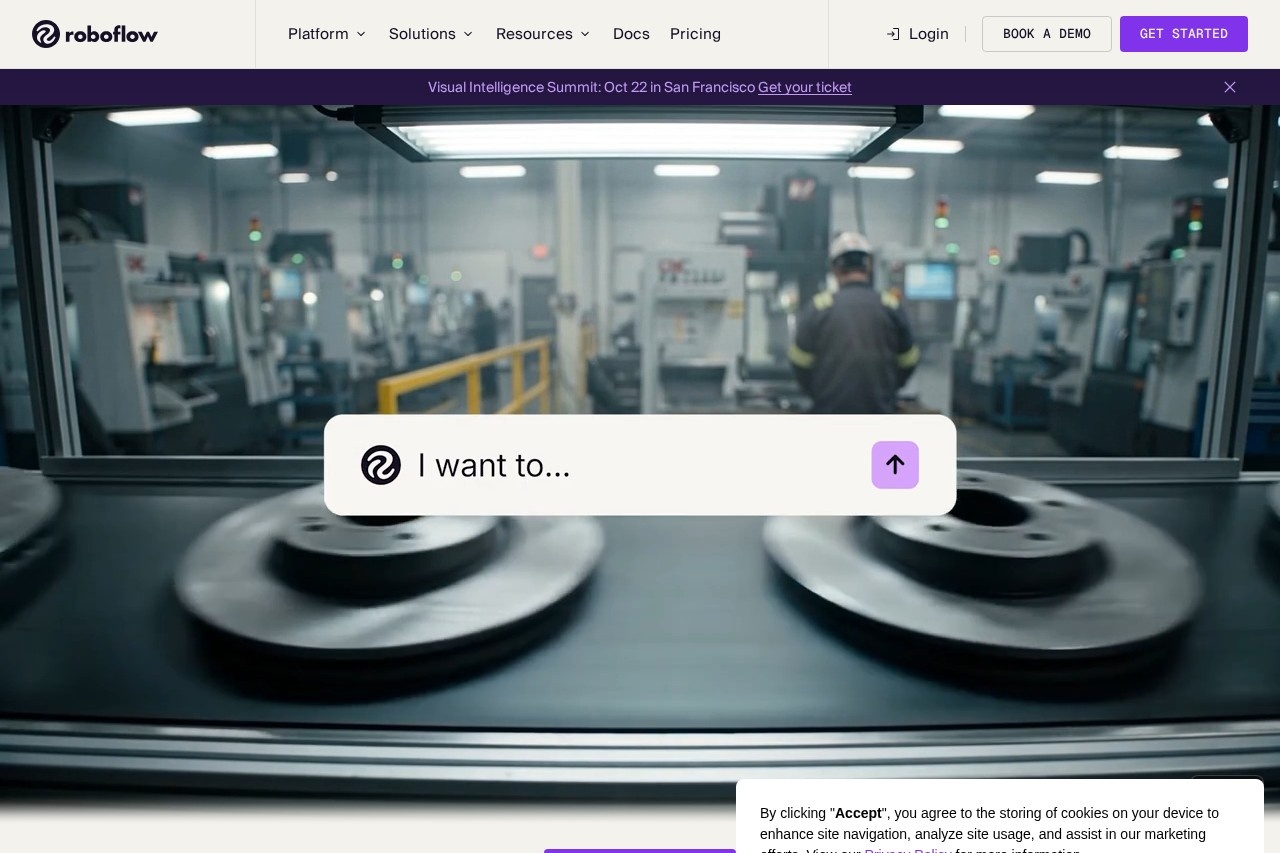
Roboflow is a computer vision platform for organizations that operate in the physical world, such as factories, railways, warehouses, and hospitals. It addresses a common bottleneck in vision AI: moving from a raw collection of images or video streams to a working, monitored model in production without assembling an entire internal machine learning stack. The company states that over 80,000 organizations, including more than half of the Fortune 100, use the platform.
At a high level, Roboflow covers the full lifecycle of a vision project in one place. Users label datasets with AI-assisted annotation tools, train models from dozens of supported architectures, and assemble them into multi-step pipelines called Workflows that can trigger actions, update databases, or connect to industrial systems like PLCs and MQTT. Models can run on Roboflow's hosted GPUs or be deployed on-device through the open-source Roboflow Inference library on hardware such as NVIDIA Jetson, Raspberry Pi, or a local GPU server. The company also maintains widely used open-source projects on GitHub, including supervision, Inference, and RF-DETR.
Key Features
Pricing & Fees
- Pricing: A Free Tier at $0 includes 10 credits per month (roughly 30 model trainings or 80,000 inferences). The paid Core plan starts at $39 per month with 20 total credits, and larger monthly credit packs scale up to $1,399 per month for 500 credits. Enterprise plans use custom pricing through sales.
- Usage-based inference: Serverless model inference is billed per image, for example 0.0001875 credits per image for RF-DETR Medium and 0.0005 credits for SAM 3; self-hosted inference on your own hardware is included.
- Data labeling services: Enterprise add-on human labeling starts at $0.10 per bounding box, $0.20 per polygon, and $0.05 per classification or keypoint annotation.
- Enterprise controls: Enterprise plans add an uptime SLA, data sovereignty guarantees (US or EU), priority GPU access, audit logs, Active Directory sync, and SIEM log exports.
Who It's For
Roboflow is aimed at engineers, data scientists, and operations teams that need vision AI in real facilities rather than demos. Typical users include manufacturing quality teams detecting product defects, logistics and railway operators tracking inventory in motion, warehousing staff monitoring safety, energy companies inspecting infrastructure, and robotics builders who need perception for machines. Developers also use it through coding agents such as Claude Code, Cursor, and Codex to build deployable vision applications. The free tier and open-source tools make it practical for students and independent developers learning computer vision, while Enterprise features target large production deployments.
FAQ
What is Roboflow?Roboflow is an end-to-end computer vision platform for annotating images, training models, building vision pipelines, and deploying them in the cloud or on edge devices.
Does Roboflow have a free plan?Yes, a Free Tier costs $0 and includes 10 credits per month, which the company estimates covers about 30 model trainings or 80,000 inferences; paid plans start at $39 per month.
Where can Roboflow models run?Models can run on Roboflow's hosted, autoscaling GPUs or be self-hosted through the open-source Roboflow Inference library on NVIDIA Jetson, Raspberry Pi, or a GPU server.
Does Roboflow work with industrial systems and coding agents?Yes, it integrates with plant-floor systems such as PLCs, OPC UA, and MQTT, and it connects to coding agents including Claude Code, Cursor, Codex, ChatGPT, and Gemini CLI via an MCP server.
Is data kept private in Roboflow?Workspaces and models are private on all plans, Enterprise plans add data sovereignty guarantees for US or EU storage, and sharing to the public Roboflow Universe is optional.
Related Tutorials
View all →
Related Tools
View all → AI OCR Extract text from images and convert to editable Word documents with AI-powered OCR.
 Leonardo.Ai Leonardo.Ai is an AI image generation platform that helps designers, marketers, and artists create production-ready visual assets with consistent style control.
 Canva Canva is a versatile graphic design platform offering templates and tools for creating stunning visuals. It's user-friendly for both beginners and professionals.
 AI Tools Directory Find the best AI tools and resources to boost your productivity and creativity.
 PicReword Picreword is an online AI image text editor for fixing typos, replacing headlines, and updating image copy without needing the original design files.