
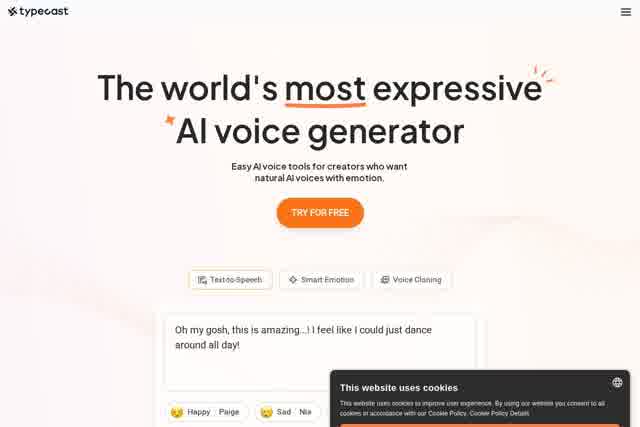
Typecast AI enables realistic AI voiceovers and text-to-speech for videos, podcasts, and more.
About
Typecast is an AI-powered online voice generation tool that quickly converts text into natural-sounding speech. Using advanced deep learning algorithms, we deliver text-to-speech synthesis that rivals the quality of real human voices, meeting your voiceover needs across a wide range of scenarios.
Key Features
Pricing & Fees
- Pricing: The API plans start at $0 (Free, 15k credits/month), Lite at $15/month (200k credits), Plus at $280/month (4M credits), and a custom-priced Enterprise tier. Studio (web) plans are billed separately from API plans.
- Free tier: A free API plan includes 15k credits per month (1 credit = 1 character), but generated audio cannot be used commercially and requires attribution. A free web signup with no payment info is also offered.
- Overage billing: Extra usage beyond included credits is billed pay-as-you-go — $0.09/1k credits on Lite and $0.08/1k credits on Plus — charged automatically in fixed increments ($9 for 100k credits on Lite; $100 for 1.25M credits on Plus).
- Plan limits: Concurrency limits scale by tier (2 on Free, 5 on Lite, 15 on Plus), and custom voice slots range from 50 (Lite) to unlimited (Enterprise), with Professional Cloning capped at 2–5 slots depending on the plan.
- Platform availability: Available via web app, an iOS/Android mobile app, and a TTS API supporting 600+ voices across 35+ languages with SDKs in Python, JavaScript, C#, Java, Kotlin, and Rust.
Who It's For
Typecast is designed for anyone with voice generation needs: content creators producing voiceovers for videos and podcasts, educators creating audio teaching materials, businesses integrating voice into customer service systems and navigation, developers adding speech functionality to their applications, and individual users generating voice for e-books, games, and more.
Related Tutorials
View all →

Related Tools
View all → Listnr AI Listnr AI converts text to speech with over 1000 voices in 140 languages, ideal for podcasts and voiceovers.
 LOVO - AI Voice Generator and Text to Speech LOVO offers 500+ voices in 100+ languages, making it easy to generate realistic AI voiceovers for any project.
 Voicemaker Voicemaker is a powerful online text-to-speech tool that converts written content into natural-sounding speech, suitable for both personal and commercial use.
 NaturalReader NaturalReader is an AI text-to-speech platform that converts documents, webpages and scanned text into natural-sounding audio for personal, commercial and educational use.
 Qwen TTS Online Qwen TTS Online converts text to natural-sounding speech using advanced AI technology.