
Memory API for the AI era. Store, retrieve, and manage AI memories effortlessly.
About
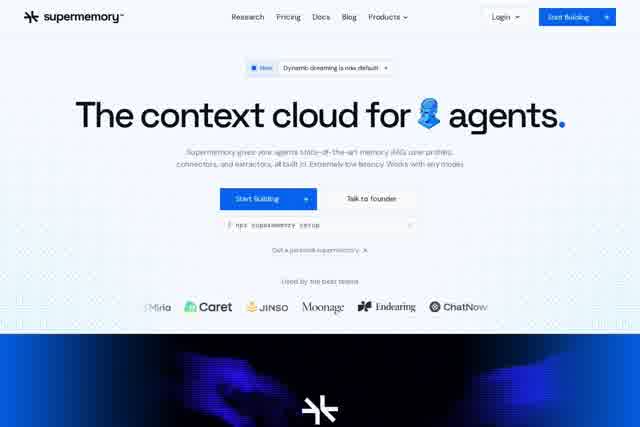
Supermemory is a smart memory API service built specifically for the AI era. As AI applications grow increasingly complex, efficiently managing and retrieving contextual information has become a core challenge for developers and businesses alike. Supermemory offers a lightweight, highly available solution that enables persistent, structured memory storage and fast retrieval for a wide range of AI applications. Whether you are building intelligent assistants, personalized recommendation systems, or chatbots for long-conversation scenarios, Supermemory lets your AI application truly "remember" user preferences, historical interactions, and critical data—dramatically improving both user experience and overall system intelligence.
Key Features
Pricing & Fees
- Pricing: Plans include Free ($0/month with $5 of monthly credits), Pro at $19/month, Max at $100/month, Scale at $399/month, and custom Enterprise pricing; each paid plan includes a monthly credit balance ($20 for Pro, $130 for Max, $600 for Scale).
- Usage-based billing: Usage is metered in SM tokens, the unique tokens actually ingested — repeated or unchanged content is billed at $0, and rates are identical across plans (e.g. Memory plain text at $5/1M SM tokens, rich content at $10/1M).
- Free tier: The Free plan renews $5 of credits every month at no cost, with standard PDF extraction.
- Plan limits and features: Pro adds 3 team seats and auto top-up; Max adds 6.5× the Pro credits plus a Gmail connector; Scale adds advanced PDF extraction, S3/web crawler connectors, unlimited team seats, and SOC 2/HIPAA BAA compliance options.
- Integration: Available via RESTful API with TypeScript and Python SDKs, plus plugins and MCP support for frameworks such as LangChain and LlamaIndex.
Who It's For
AI application developers who need to add long-term memory to chatbots, virtual assistants, or customer service systems to improve conversational coherence and personalization. Product managers and entrepreneurs building next-generation intelligent products who want to quickly validate "user memory" scenarios and shorten development cycles. Data scientists and researchers exploring context-augmented generative AI applications who need a stable, efficient memory layer to support experiments and prototyping. Enterprise IT teams looking to integrate persistent memory capabilities into internal knowledge bases, intelligent search, or employee assistant systems while meeting data security and compliance requirements.
Related Tutorials
View all →
Related Tools
View all → Agent-Native Apps Framework Build agentic apps where AI agents and UI share the same database and state. Open source framework with ready-to-fork templates.
 CopilotKit - AI Agent Frontend Stack The enterprise-ready frontend stack for agents. CopilotKit lets you integrate LLMs or agents with real-time context, UI control, and full flexibility.
 Model Context Protocol Model Context Protocol (MCP) is an open standard that standardizes how applications provide context to AI models, enabling seamless integration and interoperability.
 You.com You.com provides web search, content extraction, and research APIs that give AI agents and LLM applications real-time access to web data with cited answers.
 oMLX - LLM Inference Optimized for Mac A native macOS inference server on MLX with paged SSD KV caching, reducing TTFT to under 5s. OpenAI & Anthropic compatible.