
slime is THUDM's open-source framework for LLM reinforcement learning, supporting GLM-4.5 and GLM-5.2. Integrates with Megatron and SGLang for Agentic RL.
About
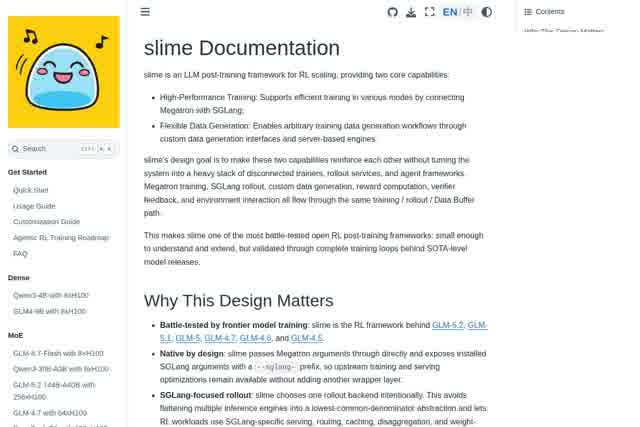
slime is an open-source LLM post-training reinforcement learning framework developed by the THUDM team at Zhipu AI. It serves as the RL training infrastructure behind the GLM family of models, from GLM-4.5 through GLM-5.2. At its core, slime seamlessly connects the Megatron training engine with the SGLang inference framework, so training, inference, data generation, reward computation, and environment interaction all share a single unified pipeline. The key philosophy behind slime is to avoid turning the system into a heavy stack of separate trainers, inference services, and agent frameworks — instead, every component collaborates through a unified training/inference/data buffer path, keeping the system simple and scalable.
Key Features
Pricing & Fees
- Pricing: Not publicly listed on the pages we reviewed; check the official site for current plans.
- Free tier: slime is an open-source framework; the code is available on GitHub and can be self-hosted at no license cost.
- Installation options: A prepared Docker image (with Megatron, SGLang and slime patches) or a conda source build can be used; Linux x86_64 GPU hosts with NVIDIA drivers are required.
- Hardware requirements: The recommended image targets Hopper / Blackwell GPUs with CUDA 13.0, so users should budget for their own GPU compute rather than framework fees.
- Platform availability: Runs as a self-hosted training stack connecting Megatron with SGLang; companion projects (straw, sunabako) extend rollout data handling and Linux agent sandboxes.
Who It's For
slime is built for LLM post-training — applying RL alignment training to pretrained models. It is also well suited for Agentic RL research, where developers explore reinforcement learning for tool calling and multi-step reasoning. Additionally, it supports model fine-tuning and compression workflows by leveraging the combination of FP8 inference and BF16 training to reduce resource requirements.
Related Tutorials
View all →