
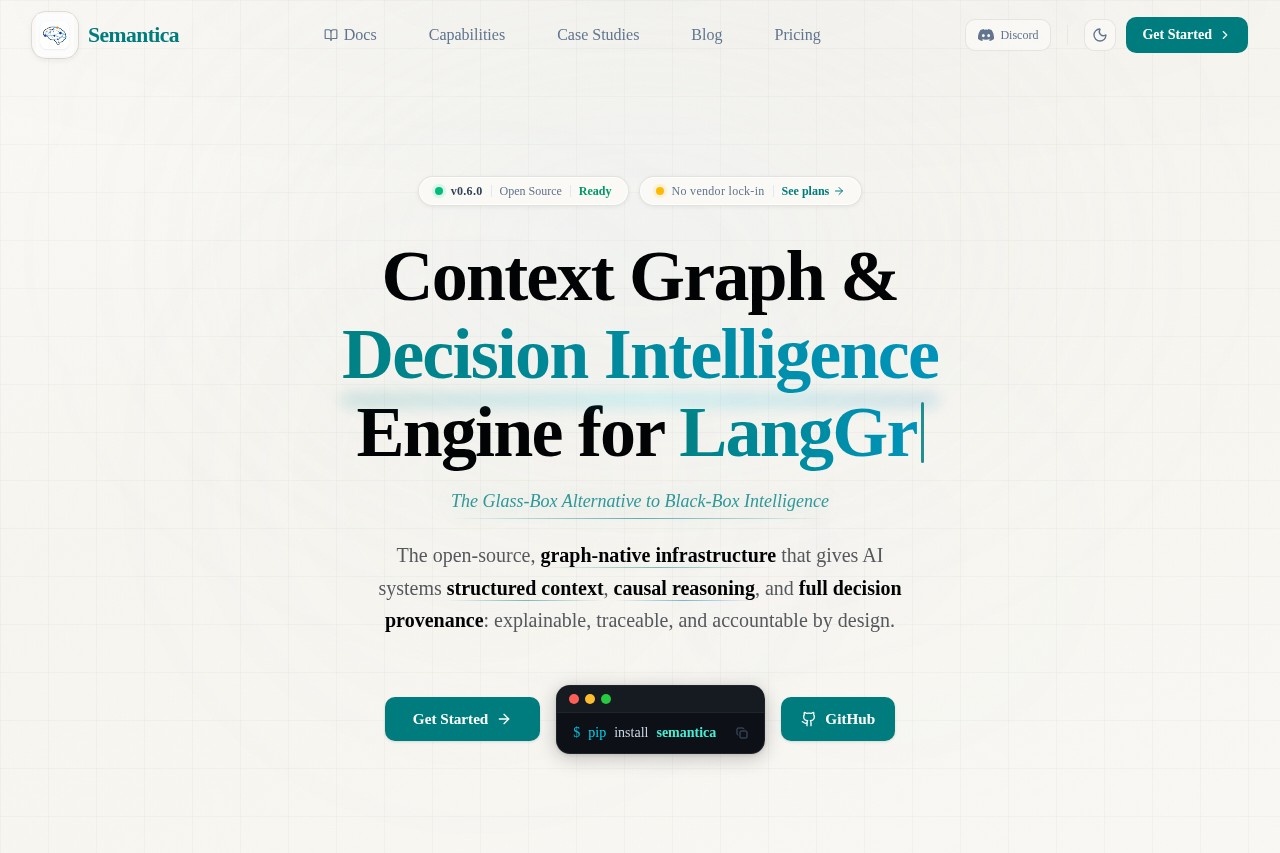
Semantica is an open-source Python library that equips AI agents with long-term memory, context graph building, and decision provenance for deeper cognitive capabilities.
About
In today's increasingly complex AI landscape, developers face core challenges in enabling AI systems to possess long-term memory, understand contextual relationships, and clearly trace the origins of every decision. Semantica is an open-source Python library designed to address these very issues. It focuses on providing memory management, context graph construction, and decision provenance for AI agents, allowing developers to effortlessly inject deeper cognitive capabilities into existing AI frameworks. As an MIT-licensed project, Semantica is completely free and permanently open, aiming to lower the barrier to adopting advanced AI technologies.
Key Features
Pricing & Fees
- Pricing: Semantica offers a free forever open-source Starter plan, plus Custom pricing tiers — Paid Pilot, Managed Cloud (in development), and Self-Hosted Enterprise (in development).
- Free tier: The open-source Starter plan is free forever and includes governed context, decision intelligence, provenance, audit trails, and connectors via CLI, REST API, and MCP.
- Custom plans: Paid Pilot lets teams validate a use case with their own data, end-to-end integrations, and expert deployment guidance; pricing is scoped per use case.
- Enterprise options: Managed Cloud provides managed infrastructure with a dedicated environment per organization, while Self-Hosted Enterprise supports private VPC or on-prem deployment for data sovereignty; both are in development with early access or design partner programs.
- Availability: Installable via pip (PyPI, v0.7.0, MIT License, requires Python 3.10+), with connectors for Databricks, Snowflake, SAP, Salesforce, PostgreSQL, and more.
Who It's For
Semantica is aimed at a broad range of AI developers and researchers:
- AI Application Developers: Those looking to add long-term memory and knowledge graph capabilities to their agents, improving answer accuracy and contextual coherence.
- Data Scientists: Individuals needing causal analysis or result validation of model reasoning to enhance experiment interpretability.
- Enterprise Architects: Those building internal knowledge assistants or automated workflows that require strict decision audit logs to meet regulatory requirements.
- Open Source Enthusiasts and Academic Researchers: Individuals interested in understanding the implementation of GraphRAG or causal reasoning and willing to contribute code or suggest improvements.
Whether you are refining a smart customer service bot or building a complex enterprise-grade AI platform, Semantica provides a solid and flexible foundation. Visit getsemantica.ai for documentation and a quick start guide.
Related Tutorials
View all →

Related Tools
View all → Codebase-memory-mcp - Persistent Code Memory for AI Agents Codebase-memory-mcp provides persistent memory for AI agents via MCP. Supports 120+ languages, 158 file types, and LSP integration. Works with Claude Code, Codex CLI, and Gemini CLI on Linux.
 Memtrace - One Graph, Many Agents Memtrace provides a unified graph for managing multiple AI agents, simplifying coordination and data flow.
 Biomni - AI-Powered Business Intelligence Biomni delivers AI-driven business intelligence, helping you make data-informed decisions with ease.
 Code-review-graph - Local Code Intelligence for MCP Persistent local code graph for token-efficient AI code review through MCP and CLI. 8.2x avg context reduction, 30 MCP tools, local-first by default.
 LLMQuant Data - AI-Native Finance Knowledge The knowledge harness for AI-native finance.