
Rayyan is an AI-assisted web platform for conducting systematic literature reviews, covering screening, deduplication, data extraction, risk of bias, and team collaboration for researchers.
About
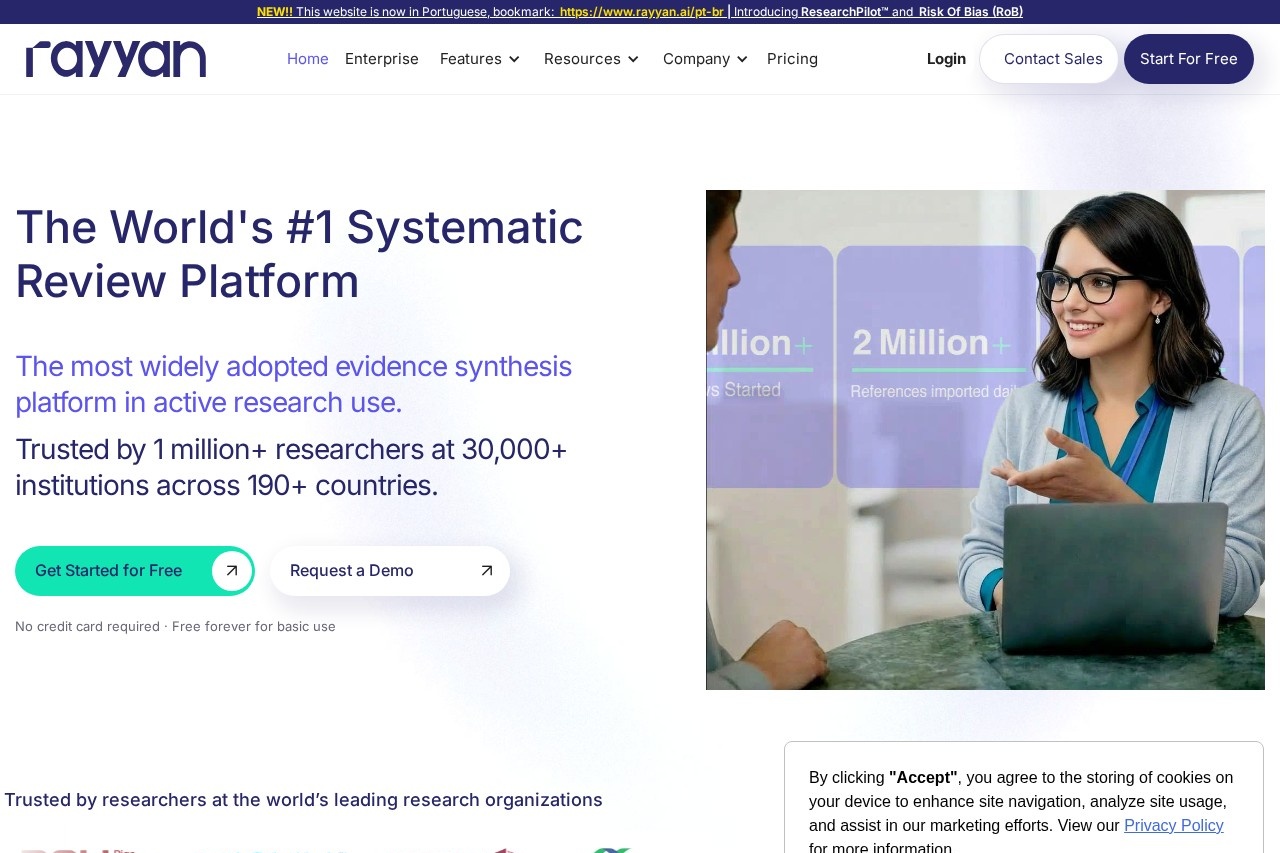
Rayyan is a web-based platform for conducting systematic and scoping literature reviews. Systematic reviews traditionally require teams to screen thousands of citations by hand, a process that can take months; Rayyan applies AI relevance predictions, automated deduplication, and shared workflows to compress that timeline substantially.
The platform covers the full review lifecycle: importing and organizing references, inviting collaborators, deduplicating records, title/abstract and full-text screening, data extraction, risk of bias assessment, and reporting with an auto-generated PRISMA flow diagram. Rayyan is developed by a company headquartered in Cambridge, Massachusetts, and the company reports more than one million researchers across 30,000+ institutions in over 190 countries have used it, supporting over three million systematic reviews.
Key Features
Pricing & Fees
- Pricing: A Free plan allows 3 active reviews, 2 free reviewers, and 1 sample; Essential costs $8.33/month billed quarterly and Advanced costs $13.33/month billed quarterly. Annual billing saves up to 40%, and higher tiers and institutional plans are sold via sales contact.
- Free tier: The basic plan is free forever and requires no credit card to start.
- Scale: The platform is built to handle libraries ranging from thousands to millions of references.
- Auditability: Decision trails and auto-generated PRISMA diagrams support reproducible, inspection-ready reviews.
Who It's For
Rayyan is aimed at academic researchers, graduate students, and methodologists who run systematic, scoping, or rapid reviews, as well as biopharma and health-economics (HEOR) teams that need documented, reproducible evidence synthesis. It also suits medical librarians and clinical teams supporting guideline work, and any group that must coordinate screening across multiple reviewers while maintaining a defensible audit trail for publication or regulatory review.
FAQ
What is Rayyan?Rayyan is an AI-assisted platform for systematic literature reviews that supports the entire workflow, from importing references and deduplication through screening, data extraction, risk of bias assessment, and PRISMA-based reporting.
Is Rayyan free to use?Yes, Rayyan offers a free plan (3 active reviews, 2 invited reviewers, AI relevance predictions, and duplicate detection), with paid plans starting at $8.33 per month billed quarterly; the vendor also sells institutional options such as ResearchPilot™.
Does Rayyan work on mobile devices?Yes, Rayyan provides a mobile app that supports screening anywhere, including offline use; free plans have limited mobile access while paid plans include unlimited mobile app access.
Can multiple reviewers collaborate in Rayyan?Yes, teams can invite collaborators, assign roles, randomize subsets, divide workloads, and resolve screening conflicts, with every decision recorded for transparency and reproducibility.
Does Rayyan support data extraction and risk of bias assessment?Yes, reviewers can define structured extraction fields, apply the PICO framework, and use the Risk of Bias feature to record study quality evaluations within the platform.
Related Tutorials
View all →
Related Tools
View all → Tongyi DeepResearch An AI research assistant that delivers deep insights and comprehensive analysis.
 SciSpace SciSpace is an AI research assistant that helps researchers, students, and academics read papers, review literature, write, and format citations in thousands of styles.
 Elicit Elicit is an AI research assistant for scientific literature, letting researchers search 138M+ papers, run systematic reviews, and generate cited reports.
 Consensus Consensus is an AI-powered academic search engine that finds, ranks, and synthesizes over 400 million peer-reviewed papers, with answers cited to specific studies.
 Connected Papers Connected Papers is a visual research tool that builds similarity-based graphs of academic papers, helping researchers and applied scientists discover and explore relevant literature.