
Consensus is an AI-powered academic search engine that finds, ranks, and synthesizes over 400 million peer-reviewed papers, with answers cited to specific studies.
About
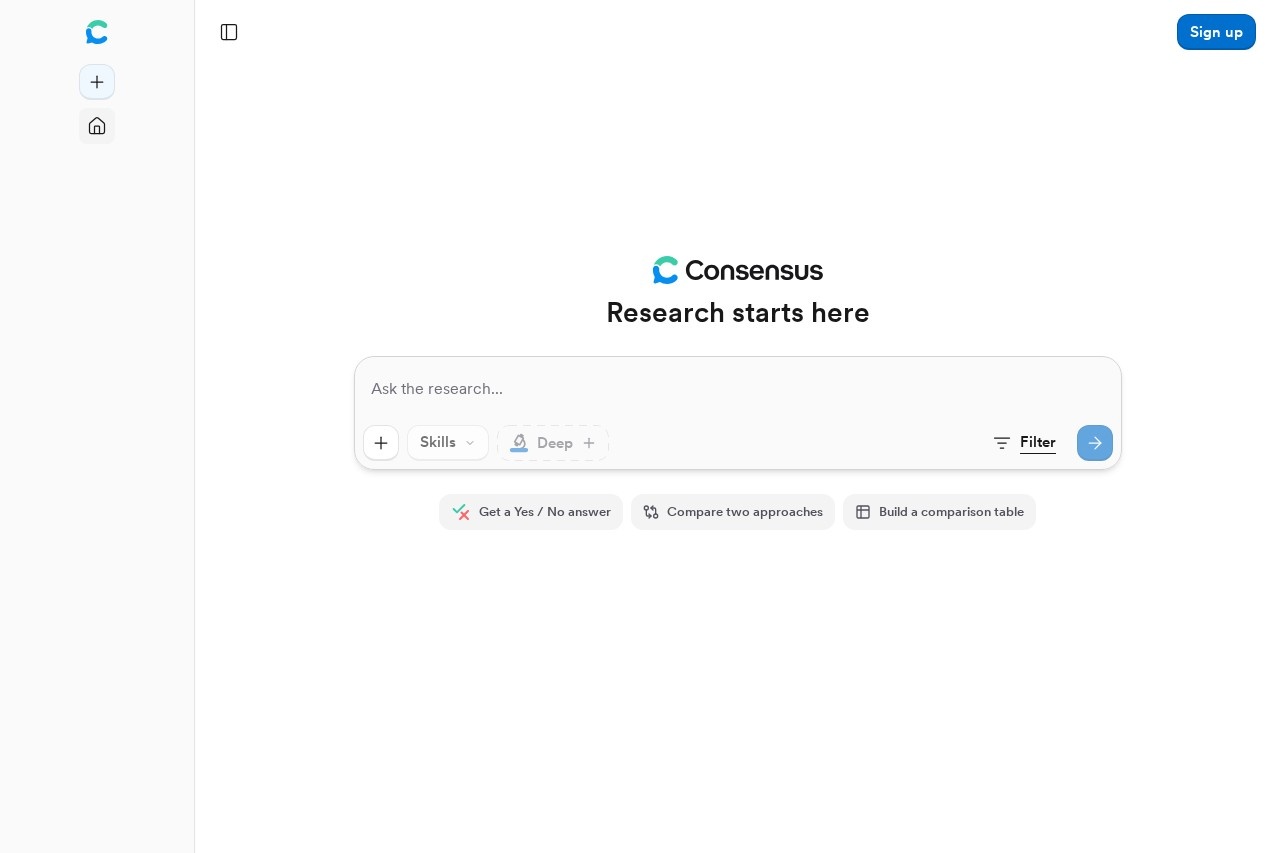
Consensus is an AI academic search engine built for people who need answers grounded in scientific literature rather than general web content. It indexes more than 400 million peer-reviewed papers sourced from Semantic Scholar, OpenAlex, PubMed, and publisher feeds, and it deliberately excludes blogs, encyclopedias, and other non-academic pages from its corpus.
Users type a research question in plain language, and Consensus returns evidence-backed answers with inline citations linking back to the source papers, including DOIs. Results are ranked using signals such as study design, citation count, journal quality (SJR), and recency. The product serves a web app for human researchers as well as a REST API and an MCP server for AI agents, making the same retrieval and synthesis available to both. It is aimed at researchers, clinicians, students, journalists, and developers building agent workflows that need citable scientific sources.
Key Features
Pricing & Fees
- Pricing: Not publicly listed on the pages we reviewed; check the official site for current plans. The product's documentation describes anonymous (limited), Free, Pro, Team, and Enterprise tiers.
- Free access: A limited anonymous mode and a Free tier are available, with rate limits and quotas detailed on the official pricing page.
- Freshness: The index updates continuously, but papers published in the last few weeks may not yet appear.
- Language coverage: Search and AI summarization are optimized for English; non-English papers are indexed only where metadata is available.
Who It's For
Consensus is designed for academic researchers and graduate students conducting literature reviews, clinicians checking the evidence base for a treatment or policy question, and journalists verifying scientific claims. It also serves AI developers building agents that need citable sources, through its REST API and MCP server. Typical questions range from whether intermittent fasting affects cardiovascular health to what studies conclude about caffeine and endurance performance.
FAQ
What is Consensus?Consensus is an AI-powered scientific search engine that finds, ranks, and synthesizes peer-reviewed research, returning evidence-backed answers with inline citations to the source papers.
Does Consensus have a free plan?Yes, Consensus offers a limited anonymous mode and a Free tier, alongside paid Pro, Team, and Enterprise tiers; current quotas are listed on the official pricing page.
Can Consensus be used with AI tools like ChatGPT or Claude?Yes, Consensus provides an MCP server and a REST API, and its documentation covers setup in MCP-compatible clients such as Claude, ChatGPT, Cursor, and Codex.
Do the AI summaries include citations?Yes, every answer links to real papers with DOIs, although summaries are still LLM-generated, so users should consult the underlying paper before quoting verbatim.
Are preprints included in search results?Yes, preprints are indexed and clearly tagged, and API users can exclude them to limit results to peer-reviewed papers only.
Related Tutorials
View all →
Related Tools
View all → K-Dense Web | Research. Analyze. Synthesize. K-Dense Web is an AI agent that autonomously executes complex tasks across science, engineering, healthcare, finance, and beyond. From question to insight, problem to solution.
 Tongyi DeepResearch An AI research assistant that delivers deep insights and comprehensive analysis.
 DeepSearch DeepSearch is an AI people search tool that finds anyone by name and builds sourced profiles from public web data for recruiters, founders, and analysts.
 Connected Papers Connected Papers is a visual research tool that builds similarity-based graphs of academic papers, helping researchers and applied scientists discover and explore relevant literature.
 Semantic Scholar Semantic Scholar is a free, AI-powered research tool from the Allen Institute for AI that helps scholars search and discover relevant scientific literature across all fields.