
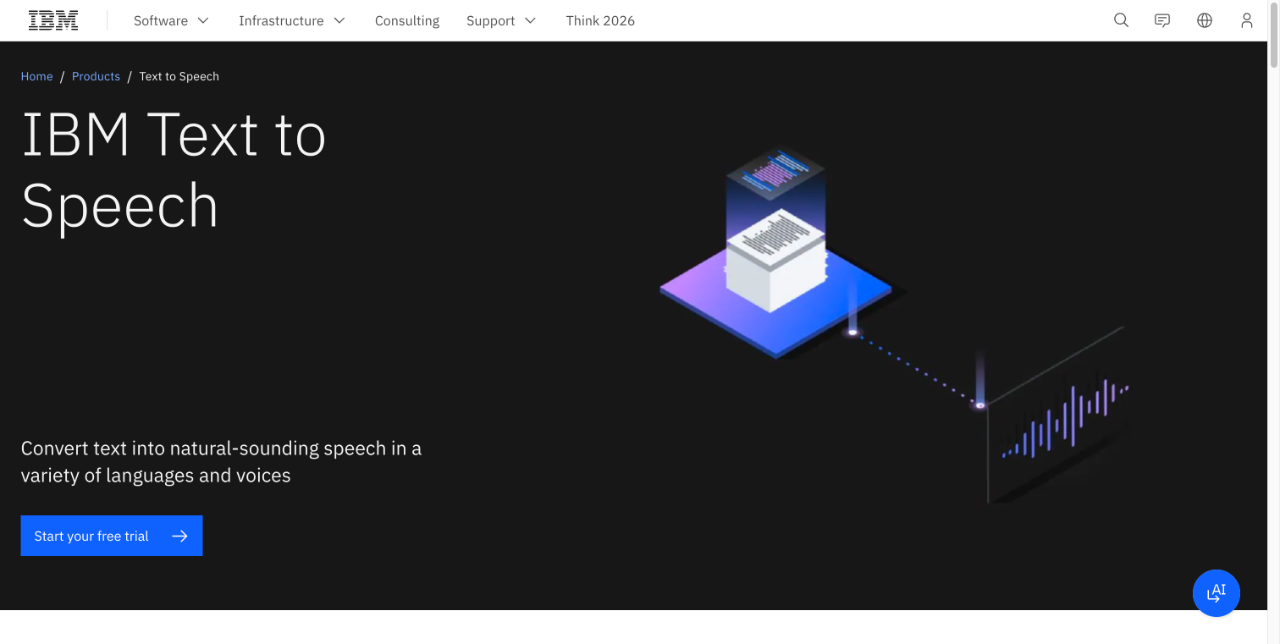
Convert text to natural speech using IBM Watson's API and SaaS.
About
IBM Watson is IBM's artificial intelligence platform, and its Speech to Text technology has become one of the top enterprise-grade voice processing solutions thanks to its outstanding accuracy and multilingual support. Whether delivered as a cloud SaaS service or through on-premises deployment, Watson offers flexible and efficient options that help users quickly convert spoken content into structured text data.
Key Features
Pricing & Fees
- Pricing: Not publicly listed on the pages we reviewed; check the official site for current plans.
- Free trial: IBM offers a free trial of the Text to Speech service, accessible from the official product page.
- Premium features: Custom branded neural voices (modeled from as little as one hour of recordings) and a unique brand voice are available as Premium features.
- Integration: Provided as an API cloud service with REST APIs and SDKs, usable within existing applications or watsonx Assistant.
- Deployment options: Deployable on any cloud—public, private, hybrid, multicloud, or on-premises—and available as a containerized library for IBM partners to embed in commercial applications.
Who It's For
IBM Watson speech services are ideal for call centers that need real-time transcription of customer service calls, healthcare organizations looking to streamline clinical note-taking through voice input, media companies that require captions for video content, multinational enterprises needing multilingual meeting records, and tech companies developing intelligent voice assistants.
Related Tutorials
View all →

Related Tools
View all → AI Translator - Accurate Translation AI Translator provides high-accuracy translations with 98% precision, supporting 1200+ AI models and 100+ languages.
 FunASR - End-to-End Speech Recognition Toolkit Industrial-grade speech recognition toolkit. 170x realtime on GPU, 50+ languages, speaker diarization, emotion detection, OpenAI-compatible API, vLLM acceleration, and agent integration.
 AI Video Generator This AI tool generates videos from text or images, making it easy to create engaging content. It's perfect for marketers, educators, and content creators.
 MP3ToText - Free Online AI Audio to Text Transcription Tool MP3ToText is a free online AI transcription tool that converts MP3, WAV, M4A, and MP4 files into editable, searchable text, supporting 150+ languages, timestamps, speaker identification, and exports like SRT, DOCX, and PDF.
 NaturalReader NaturalReader is an AI text-to-speech platform that converts documents, webpages and scanned text into natural-sounding audio for personal, commercial and educational use.