
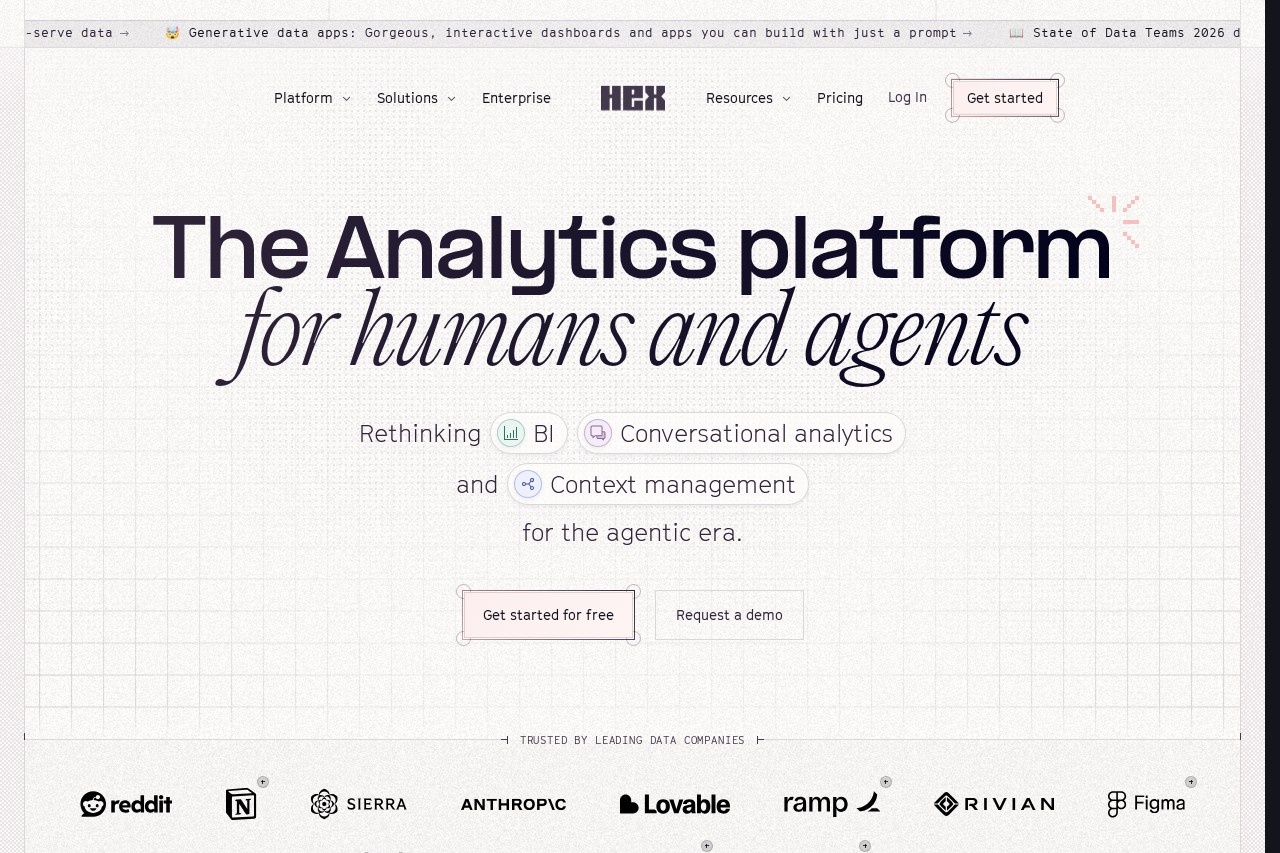
Hex is an AI analytics platform that combines agentic notebooks, conversational analytics, and interactive data apps so data teams and business users can explore governed data together.
About
Hex is an AI analytics platform built for both human analysts and AI agents. It addresses a common problem in modern business intelligence: traditional BI tools, standalone chat apps, and ad-hoc AI coding produce inconsistent answers with weak governance. Hex brings analytics, agentic notebooks, conversational self-service, and interactive data apps into one governed workspace.
The platform works by grounding AI answers in an organization's own context. A component called Context Studio collects business definitions, models, and analytical work so agents can use them across Hex, Slack, MCP-connected tools, and the command line. Data teams can inspect agent activity, evaluate context changes, and fill gaps in answers. Hex supports SQL, Python, and no-code analysis, connects to common warehouses and semantic layers, and is used by companies such as Notion, StubHub, and LangChain. Workspace data is kept private, with enterprise-grade permissions and audit controls available.
Key Features
Pricing & Fees
- Pricing: Community is free; Professional costs $36 per Editor per month; Team costs $75 per Editor per month with a 14-day trial; Enterprise pricing is custom via sales.
- Compute options: Small through Medium compute profiles are free on paid plans; larger profiles (up to 4XL and GPU instances) are billed per minute, with pay-as-you-go available on Team and Enterprise.
- Free tier: The free Community plan includes a Hex agent trial, connections to any data source, and all cell types.
- Plan limits: Professional is capped at 5 published apps and 30-day version history; Team removes those limits and adds scheduled runs, alerts, and shared components.
Who It's For
Hex is aimed at data teams, data scientists, analytics engineers, and business analysts who need to move from ticket-driven reporting to governed self-service. Typical users include teams migrating from traditional BI tools, organizations building a context layer for AI on their data, and companies that want chat interfaces such as Slack to answer data questions reliably. Business users without SQL or Python skills can explore data conversationally, while technical analysts retain full notebook and API access in the same workspace.
FAQ
What is Hex?Hex is an AI analytics platform for trusted data exploration, agentic notebooks, conversational self-serve analytics, and interactive data apps, with shared context and governance managed by data teams.
Is there a free plan?Yes, the Community plan is free and includes a Hex agent trial, connections to any data source, and small compute; paid plans start at $36 per Editor per month.
Which tools and data sources does Hex integrate with?Hex integrates with data warehouses, semantic layers, catalogs, orchestration tools, and Slack, and also offers an MCP server, a CLI, and an authenticated API for developers.
How is Hex different from using a general AI assistant like ChatGPT or Claude directly?Hex grounds AI answers in an organization's endorsed semantic models and shared context, lets data teams evaluate and audit those answers, and applies enterprise permissions, rather than answering from unmanaged general knowledge.
How does Hex handle data privacy?Workspace data is private by default; product API calls require a bearer token, MCP access requires user-authorized OAuth, and Enterprise plans add audit logs and additional security controls.
Related Tutorials
View all →
Related Tools
View all → Hello-Agents - Build AI Agents Datawhale's platform for creating and deploying AI agents with ease.
 Lyrie.ai - AI Antivirus & Cyber Defense Stop ransomware, data theft, and prompt injection with one lightweight agent. Protects all devices across Windows, macOS, Linux, and Android.
 Wren AI | Agentic GenBI for Humans and AI Agents Wren AI is an agentic GenBI platform that enables natural language querying of data, generating SQL and insights in under 20 seconds.
 Agnes AI Agnes AI is a Singapore-built platform that automates research, summarizes content, and completes complex tasks using real-time data and smart tools.
 Voxpopme Voxpopme is a consumer intelligence platform that turns video surveys, live interviews, and AI-moderated conversations into qualitative insights for enterprise research teams.