Herdr is to coding agents what tmux is to terminals: an agent multiplexer that runs where your agents run. Real panes, agent state at a glance, ssh from anywhere, no app.
About
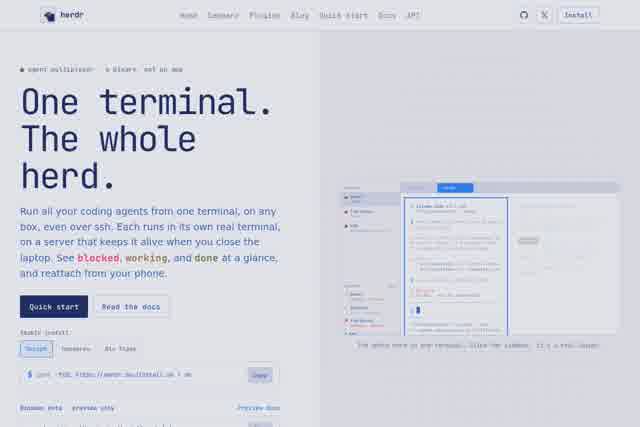
As AI development tools evolve at breakneck speed, efficiently managing multiple coding agents has become a core challenge for developers. Herdr was built to solve exactly this problem—it is an "agent multiplexer" designed specifically for coding agents, playing a role similar to what tmux does for terminal management. Herdr runs right where your agents run, letting you monitor, control, and orchestrate multiple agents from a single unified interface—no desktop app required, and accessible from anywhere over SSH.
Key Features
Pricing & Fees
- Pricing: Not publicly listed on the pages we reviewed; check the official site for current plans.
- License: Herdr is released under the Apache 2.0 open-source license, so the software itself can be used without a paid license.
- Installation: Available via a one-line install script, with Homebrew, Nix, Windows, and manual install options also documented.
- Platform availability: Runs on macOS, Linux, and Windows, on local machines or rented cloud servers.
Who It's For
AI and machine learning engineers who need to run multiple training or inference agents simultaneously and monitor their behavior in real time. DevOps and SRE teams managing large fleets of automation agents who want a unified entry point for remote orchestration and troubleshooting. Independent developers and power users who prefer lightweight toolchains and want to drive multiple coding assistants efficiently on low-spec machines or in pure terminal environments. Research institutions and labs that need to batch-manage experimental agents while maintaining fine-grained control over system resources.
Related Tutorials
View all →


Related Tools
View all → Open SWE: An Open-Source Framework for Internal Coding Agents Open SWE is an open-source framework for building and deploying internal coding agents, leveraging Deep Agents and LangGraph to enhance developer productivity through intelligent automation.
 ImgUpscaler ImgUpscaler is an online AI image upscaler that enlarges photos, anime, product shots, portraits, and old pictures by 2x or 4x for web, print, and creative work.
 Spira AI - 24/7 Social Media AI Assistant Spira is an AI assistant for social media management, trained on TikTok, Meta, CapCut, and Midjourney. Automates content creation and posting across TikTok, Instagram, YouTube, X, and LinkedIn.
 AI OCR Extract text from images and convert to editable Word documents with AI-powered OCR.
 Nano Banana 2 AI Image Editor Generator Browser-based AI image editor and generator. Upload photos, refine scenes, and create 2K/4K visuals with free credits.