
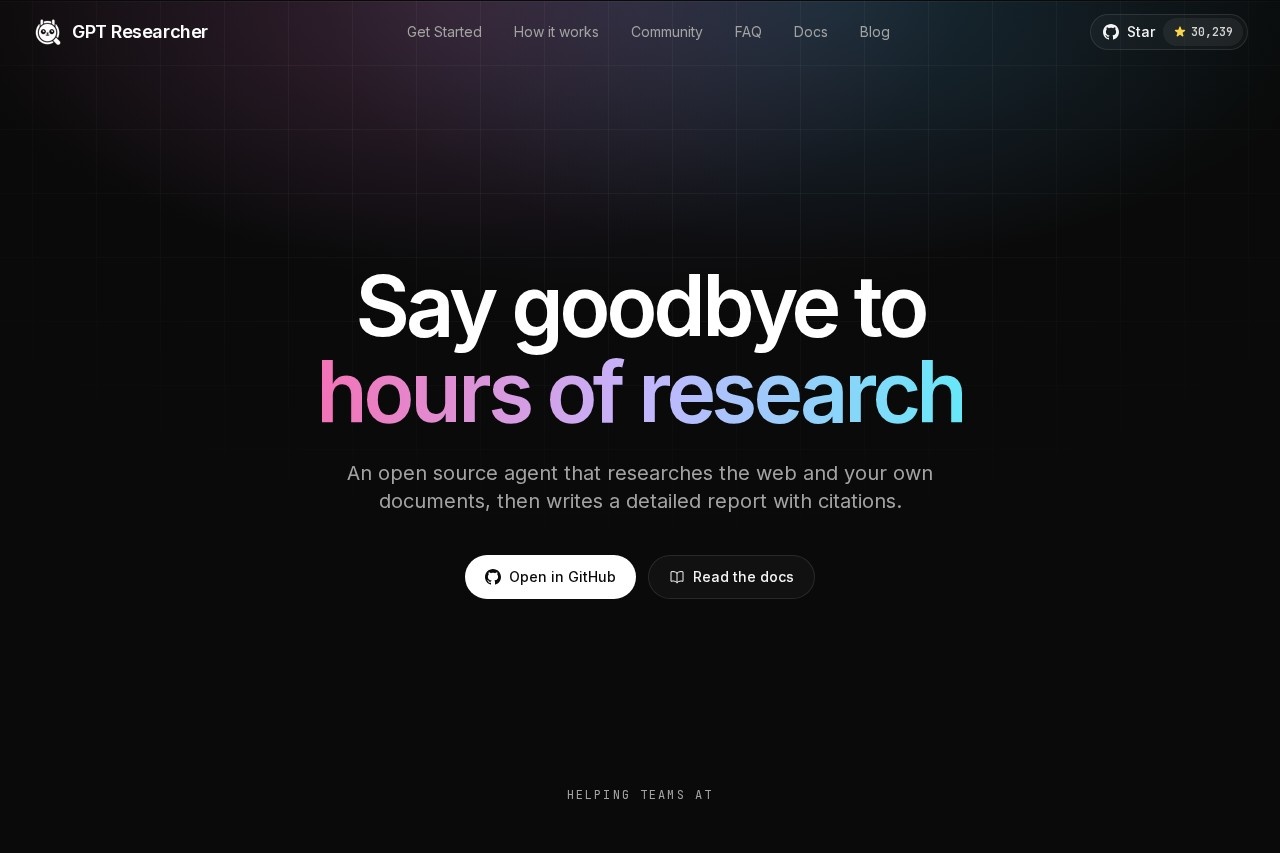
GPT Researcher is a free, open source AI research agent that searches dozens of web and local sources in parallel and writes cited long-form research reports you can run on your own machine.
About
GPT Researcher is an open source autonomous research agent that takes a question, plans a set of research sub-questions, gathers information from many sources simultaneously, and then writes a long-form report with inline citations. It addresses a common limitation of large language models: answering complex questions with shallow, single-pass responses that lack verifiable sources. By chaining planning, parallel retrieval, context filtering, and report writing, GPT Researcher produces grounded documents where every claim traces back to a source.
The project has been open source since 2023 and is MIT licensed, available as a Python package on PyPI, a self-hosted server, a Docker image, and a Model Context Protocol (MCP) server for integration into tools like Claude Desktop, Cursor, and n8n. It is developed by a community of researchers and engineers, led by creator Assaf Elovic, and has been cited in multiple academic papers, including Carnegie Mellon University's DeepResearchGym benchmark study.
Key Features
Pricing & Fees
- Pricing: Free under the MIT License; users host GPT Researcher themselves and pay only their own LLM and search API providers. The project's pricing page notes a typical deep research run with default OpenAI plus Tavily settings costs a few cents to a few dollars in provider spend.
- Benchmark results: GPT Researcher ranked first on Carnegie Mellon's DeepResearchGym benchmark (May 2025), scoring highest among evaluated systems in citation quality, report quality, and information coverage.
- Requirements: Python 3.11 or later, plus at least one LLM API key and one search API key; free search options such as DuckDuckGo and SearXNG are supported.
- Speed trade-off: Deep research runs typically take 30 to 60 seconds per query, the cost of gathering grounded, multi-source results.
Who It's For
GPT Researcher suits analysts, consultants, and investors who need sourced due-diligence briefs and market research, as well as academics conducting literature reviews. Content marketers and journalists can use it to produce background research with verifiable citations, while developers can embed it as a research sub-tool inside agents, IDEs, and automated workflows through its MCP server and API. Organizations that need to keep data on their own infrastructure can pair local LLMs with private document collections.
FAQ
What is GPT Researcher?GPT Researcher is an open source autonomous AI agent that plans research questions, gathers information from many web and local sources in parallel, and writes detailed reports with inline citations.
Is GPT Researcher free?Yes, the software is free and MIT licensed with no subscription or usage limits; users only pay the LLM and search providers they configure, and free options like DuckDuckGo and local models exist.
How do you use GPT Researcher with Claude, Cursor, or ChatGPT?The official gptr-mcp Model Context Protocol server registers as an MCP server in Claude Desktop, Cursor, ChatGPT custom GPTs, and n8n, exposing tools such as deep_research and quick_search.
What are its main limitations?Deep research runs typically take 30 to 60 seconds per query, results depend on the chosen LLM and retriever, and users remain responsible for final fact-checking of cited output.
Does my data leave my machine?Data only travels to the LLM and retriever providers the user configures; running a local model with SearXNG keeps everything on the user's own infrastructure.
Related Tutorials
View all →
Related Tools
View all → Goover Goover is an AI research agent that combines personalized, domain-specific knowledge with search to help users investigate topics and answer complex questions.
 Iris.ai Iris.ai is an enterprise AI platform that controls what language models read and measures how they answer, for industries where accuracy is critical.
 Patsnap Eureka Patsnap Eureka is an AI-native platform for R&D, IP, life sciences, and materials teams, combining AI agents with 2B+ connected patent and scientific records.
 Yuxi - RAG Harness for AI Agents Yuxi provides a RAG harness to enhance AI agents with retrieval-augmented generation capabilities.
 omp - A Coding Agent with the IDE Wired In Oh My Pi (omp) is a coding agent that integrates with your IDE, leveraging LSP and DAP for seamless development. Built in Rust for performance.