
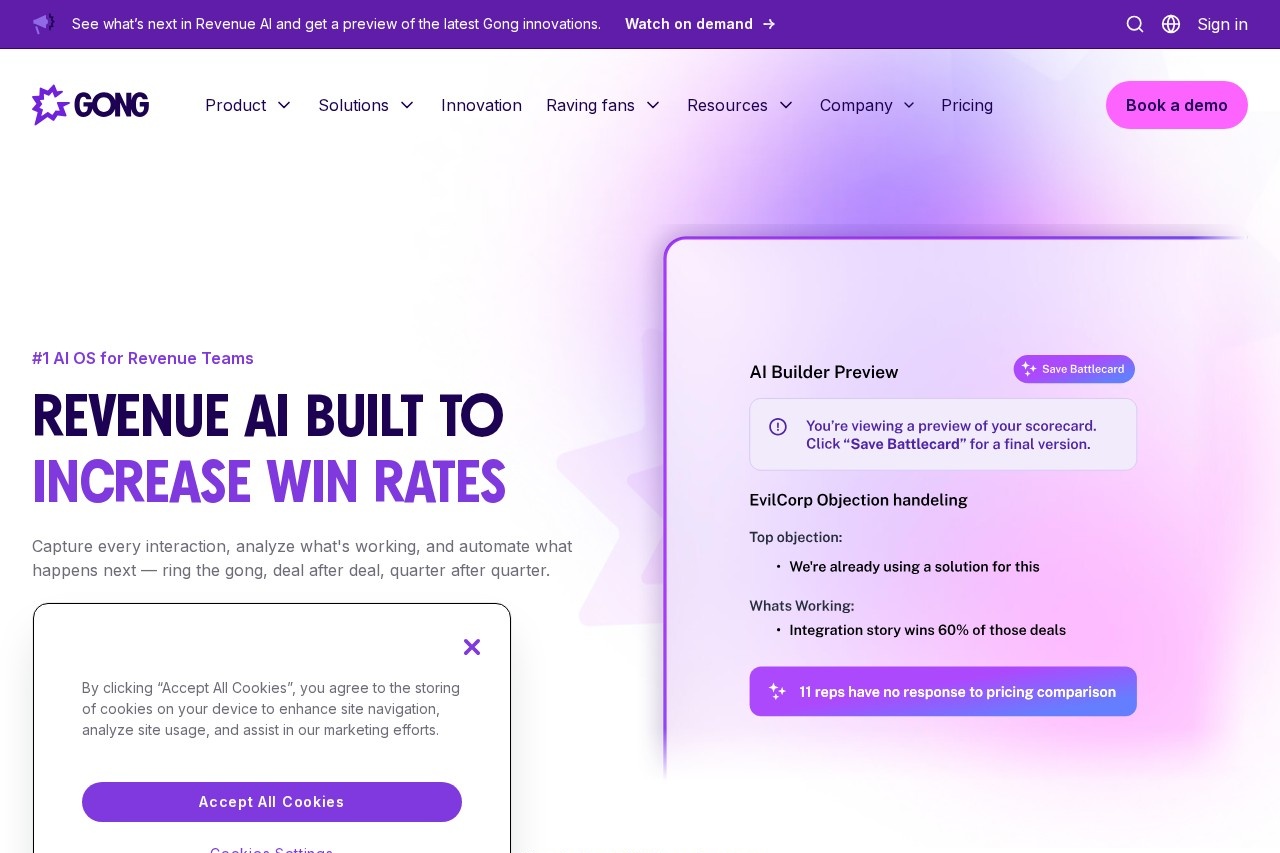
Gong is a Revenue AI Operating System that captures and analyzes B2B customer interactions to help sales, revenue operations, and enablement teams close deals and forecast accurately.
About
Gong is a revenue intelligence and AI platform, positioned by its vendor as a Revenue AI Operating System for B2B go-to-market teams. It addresses a common problem in sales organizations: leaders and reps make decisions based on incomplete information rather than on what customers actually say across calls, emails, and meetings. Gong records, transcribes, and analyzes these interactions, then turns them into insights and automated actions that support coaching, forecasting, and deal execution. The company was co-founded by CEO Amit Bendov and CPO Eilon Reshef, and Gong says it pioneered the revenue intelligence category in 2019.
At a high level, the platform automatically captures customer touchpoints and connects them into what Gong calls the Revenue Graph, a structured network of a company's revenue data. Proprietary AI models — the company cites more than 20 in-house models trained on billions of sales interactions — analyze that data, surface deal risks and coaching opportunities, and power specialized AI agents that handle follow-ups, pipeline edits, and similar tasks. Humans and agents work together inside applications built specifically for revenue workflows, such as engagement, forecasting, and enablement products.
Key Features
Pricing & Fees
- Pricing: Gong uses per-user license pricing plus a platform fee based on the number of users supported; specific prices are not publicly listed on the pages reviewed, and the company prepares custom proposals through its pricing page.
- Integrations: Existing tech-stack integrations are available at no additional cost, and Gong Collective offers 250+ integrations.
- Customer base: Gong reports more than 5,000 customers, including Fortune 10 companies, across industries such as technology, financial services, healthcare, and manufacturing.
- Recognition: The company states it is a Leader in the Gartner Magic Quadrant for Revenue Action Orchestration and in the Forrester Wave for Revenue Orchestration Platforms.
- Security: Gong publishes a trust and security page covering enterprise-grade security, compliance standards, and privacy controls.
Who It's For
Gong is built for B2B revenue teams: sales representatives who want call summaries and follow-up automation, sales leaders who need accurate forecasts and pipeline visibility, revenue operations teams that maintain CRM data quality, and enablement teams that onboard and coach reps using real call recordings. It is used across technology and SaaS, financial services, healthcare, and manufacturing. Typical use cases include shortening rep ramp time, identifying pipeline risk earlier, improving win rates on enterprise deals, and reducing manual work in call prep, CRM updates, and follow-ups.
FAQ
What is Gong?Gong is a Revenue AI Operating System that captures and analyzes customer interactions across calls, emails, and meetings, then uses AI agents and applications to help revenue teams improve execution, forecasting, and coaching.
How much does Gong cost?Gong prices licenses per user with an additional platform fee based on the number of users; exact figures are not publicly listed on the pages reviewed, so prospective buyers should request a customized proposal on the official site.
Does Gong offer a free plan or free trial?No free tier or trial is mentioned on the pages reviewed; the primary way to evaluate the product appears to be booking a demo or taking the self-guided product tour on gong.io.
Which tools does Gong integrate with?Gong integrates with more than 250 tools through the Gong Collective ecosystem, including Salesforce, HubSpot, Microsoft Teams, Zoom, and Slack, and existing tech-stack integrations are included at no extra cost.
How does Gong handle security and data privacy?Gong maintains a dedicated Trust & Security page describing enterprise-grade security, globally recognized compliance standards, and privacy controls for customer interaction data.
Related Tutorials
View all →
Related Tools
View all → Copy.ai Copy.ai is an AI-native go-to-market (GTM) platform that automates sales prospecting, lead processing, content creation, and localization workflows for marketing, sales, and operations teams.
 Seismic Seismic is an AI-powered revenue enablement platform that helps sales, marketing, and customer-facing teams manage content, train sellers, and engage buyers.
 HubSpot HubSpot is an AI-powered customer platform combining marketing, sales, service, content, and payment tools around a shared Smart CRM for growing businesses.
 Yuxi - RAG Harness for AI Agents Yuxi provides a RAG harness to enhance AI agents with retrieval-augmented generation capabilities.
 omp - A Coding Agent with the IDE Wired In Oh My Pi (omp) is a coding agent that integrates with your IDE, leveraging LSP and DAP for seamless development. Built in Rust for performance.