
Gladia is a speech-to-text API platform that records, transcribes and enriches audio in 100+ languages, helping developers build meeting assistants, voice agents and contact-center products.
About
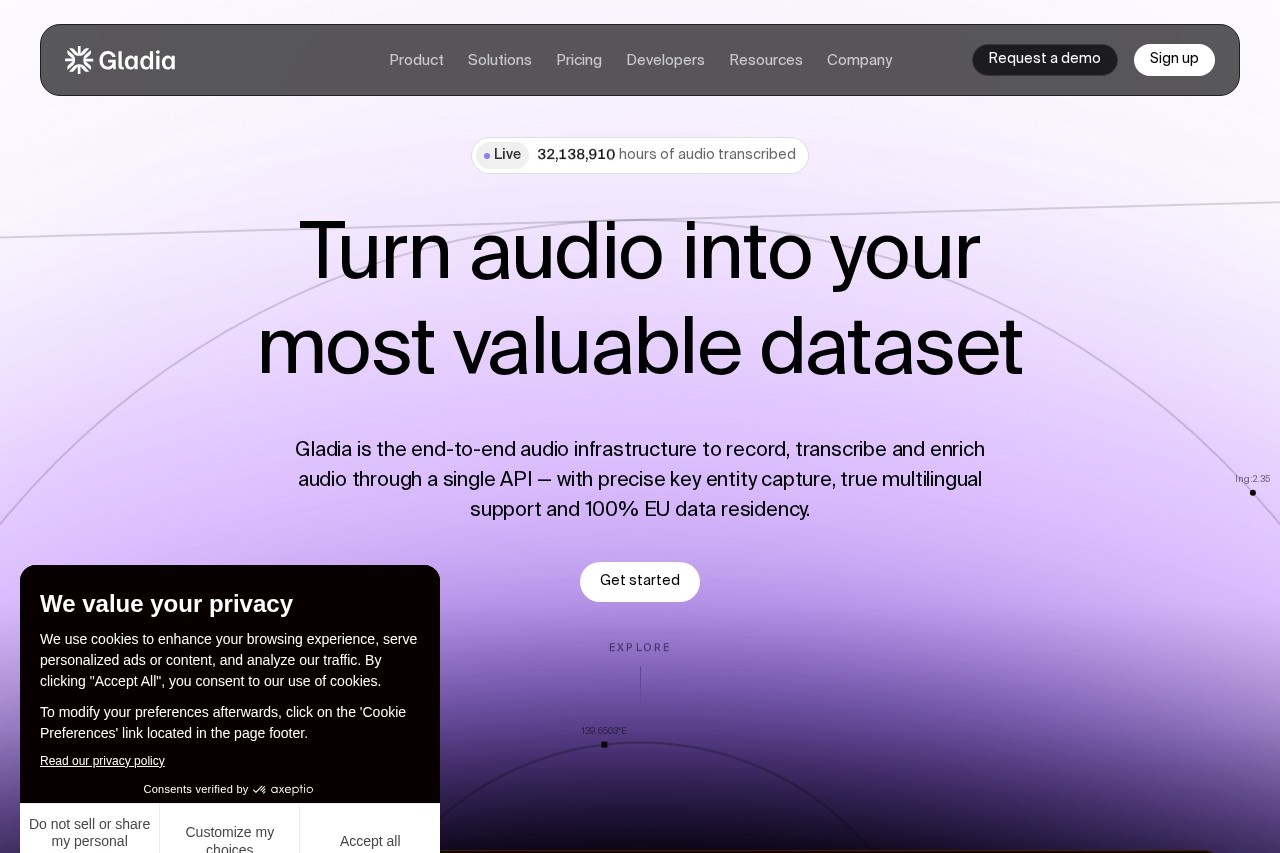
Gladia is an audio infrastructure platform that converts spoken conversations into structured, usable data through a single API. It addresses a common problem for teams building voice products: inaccurate transcription corrupts everything built on top of it, from meeting notes to CRM records. Gladia handles the full pipeline — capturing audio, transcribing it, enriching the transcript, and routing the results to other systems.
The platform supports both asynchronous batch transcription and real-time streaming, covering more than 100 languages with automatic language detection. Developers send audio via WebSocket streaming, REST upload, or live microphone input, using SDKs for Python and Node.js or direct API calls. Beyond raw transcription, Gladia offers speaker diarization, entity detection, sentiment analysis, PII redaction, and an audio-to-LLM pipeline, plus native integrations with tools such as Zoom, Google Meet and Microsoft Teams. The company reports over 26 million hours of audio transcribed and serves more than 300,000 developers and 2,000 enterprise teams.
Key Features
Pricing & Fees
- Pricing: Usage-based, prepaid credits with no subscription. Async transcription starts at €0.16/hour and real-time at €0.68/hour on the self-serve plan; Enterprise plans are custom-priced. New accounts start with €50 in free credits.
- Self-serve limits: The async self-serve tier allows 25 concurrent requests and real-time allows 30, with rates decreasing as volume grows; Enterprise removes concurrency limits.
- Enterprise extras: Fine-tuning, custom models, zero data retention, custom hosting, SLAs and dedicated support are available on annual Enterprise plans.
- Free trial: €50 of free credits lets developers test both async and real-time APIs before committing.
Who It's For
Gladia is built primarily for developers and product teams adding voice capabilities to software. Typical users include teams building AI meeting assistants and note-takers, contact-center-as-a-service (CCaaS) platforms, voice agents, and content or media workflows that need searchable transcripts. It also suits startups — a Startup Studio program offers $3,000 in credits over 12 months plus a dedicated field developer engineer — and enterprises that need EU data residency, compliance certifications and custom models for large transcription volumes.
FAQ
What is Gladia?Gladia is a speech-to-text and audio intelligence platform that records, transcribes and enriches conversations through a single API, available in real-time and asynchronous modes.
How much does Gladia cost?Pricing is usage-based with prepaid credits: async transcription starts at €0.16/hour and real-time at €0.68/hour, with custom Enterprise pricing and €50 in free starting credits.
Which platforms and integrations does Gladia support?It offers Python and Node.js SDKs, WebSocket and REST interfaces, native meeting bots for Zoom, Google Meet and Microsoft Teams, and 50+ integrations including webhooks and Zapier.
How does Gladia compare to alternatives like Deepgram or AssemblyAI?Gladia publishes its own benchmark comparisons against Deepgram, AssemblyAI, Speechmatics and ElevenLabs, and offers a blind-test tool where users can compare transcripts from unnamed models.
Is Gladia compliant with GDPR and other data regulations?Yes, Gladia is SOC 2 Type II certified and GDPR compliant, with full EU data residency, HIPAA support listed on paid plans, and zero data retention available on Enterprise plans.
Related Tutorials
View all →
Related Tools
View all → AI Translator - Accurate Translation AI Translator provides high-accuracy translations with 98% precision, supporting 1200+ AI models and 100+ languages.
 FunASR - End-to-End Speech Recognition Toolkit Industrial-grade speech recognition toolkit. 170x realtime on GPU, 50+ languages, speaker diarization, emotion detection, OpenAI-compatible API, vLLM acceleration, and agent integration.
 AI Interview Copilot An AI assistant that provides real-time help during job interviews, transcribing speech in 57 languages, recognizing screenshots, and generating answers to technical and algorithmic questions. TurboScribe TurboScribe is an AI transcription service that converts audio and video files into text, supporting transcription in dozens of languages for professionals and creators.
 Transkriptor Transkriptor is an AI transcription and meeting assistant that converts audio and video files into editable, searchable text in 100+ languages, with AI summaries and chat.