
Dust is an enterprise AI platform for human-agent collaboration, letting teams build and run AI agents with company knowledge, 20+ models, and governance controls.
About
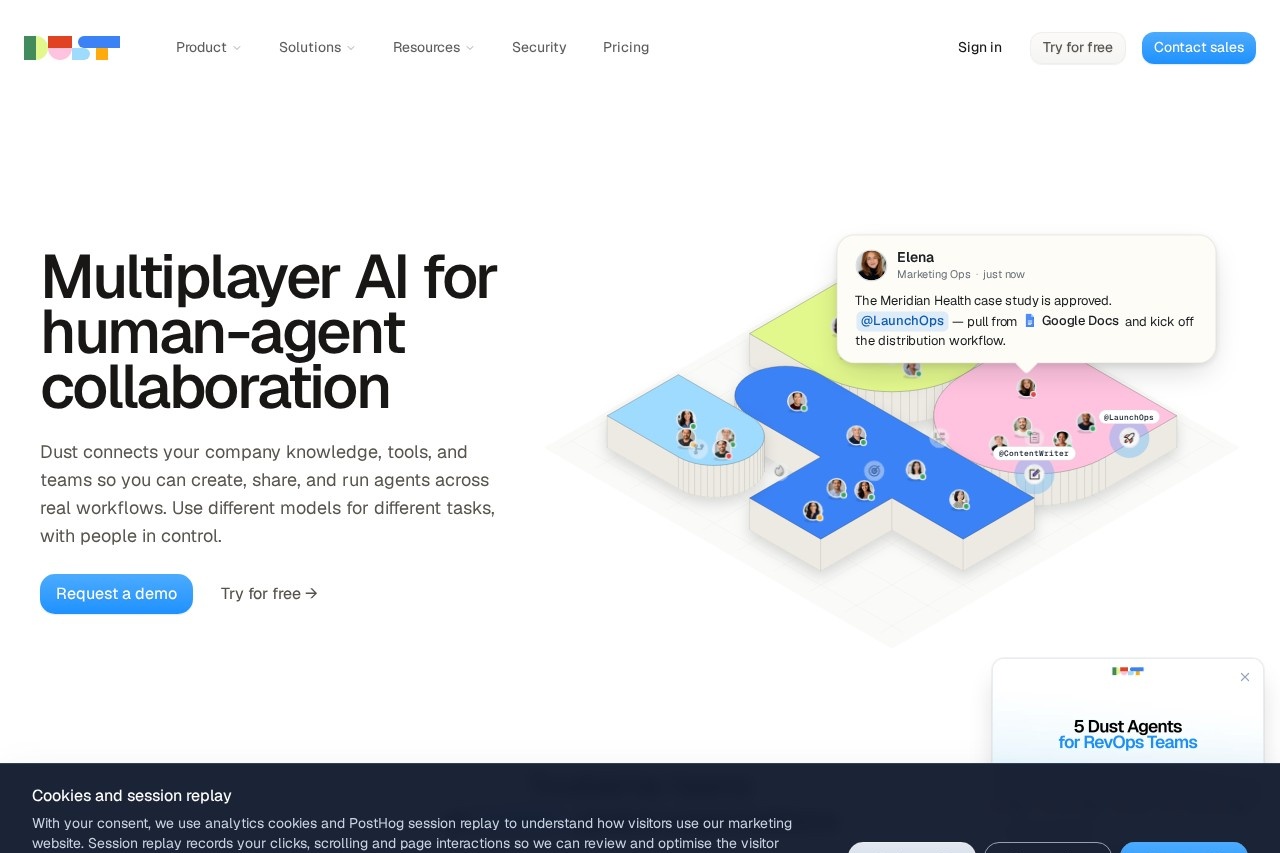
Dust is a platform for building, sharing, and running AI agents inside a company. It addresses a common workplace problem: generic AI tools can pull a single message from Slack or a CRM record, but they lack the full company context needed to answer questions accurately or take real action. Dust connects company knowledge, tools, and teams so agents can work across actual workflows.
The product positions itself as "multiplayer AI," meaning people and agents share access to the same knowledge, connected tools, conversations, and notifications. Teams connect Dust to more than 70 data sources, build agents on a choice of over 20 frontier and open-source models from providers such as OpenAI, Anthropic, Google, and Mistral, and coordinate work across departments with shared context and human review. According to its website, Dust is used by teams at more than 3,000 organizations worldwide.
Key Features
Pricing & Fees
- Pricing: Business plans include a Free tier (500 credits, lifetime), Pro at €24 per seat/month with 8,000 credits, and Max at €120 per seat/month with 40,000 credits (yearly billing saves 20%; prices exclude VAT). Enterprise plans are quoted through sales.
- Free tier: A lifetime free plan with 500 credits is available for individuals and small teams.
- Security and compliance: SOC 2 Type II certified, with data residency in the US or EU and optional single-tenant deployment on Enterprise plans.
- Deployment options: Self-serve for teams up to 100 people; Enterprise adds unlimited connectors, SCIM, audit logs, custom data retention, an SLA, and a dedicated CSM.
- Programmatic usage: Developer APIs and automation platforms (Zapier, Make, n8n, Power Automate) are supported; programmatic usage costs $0.01 per credit on Business plans.
Who It's For
Dust targets cross-functional teams within mid-size and large organizations. Customer support teams use it for ticket triage, drafting responses, and turning resolved tickets into reusable documentation. Sales teams use it for account research, lead qualification, proposal drafting, and CRM logging. Marketing and content teams generate briefs, localize content, and draft social posts. Engineering teams use it for code review, incident response, and doc generation, while data teams enable self-service analytics and report drafting. The company also lists industry solutions for B2B SaaS, consulting, financial services, insurance, marketplaces, and retail.
FAQ
What is Dust?Dust is an AI platform for human-agent collaboration that connects company knowledge, tools, and teams so organizations can build, share, and run AI agents across real workflows.
Is Dust free to use?Yes, Dust offers a free lifetime plan with 500 credits; paid Business plans start at €24 per seat per month, and Enterprise pricing is available by contacting sales.
Which tools and models does Dust integrate with?Dust connects to 70+ sources including Slack, Notion, Google Drive, GitHub, Salesforce, and Zendesk, and supports 20+ models from OpenAI, Anthropic, Google, Mistral, DeepSeek, and others, plus MCP servers.
How does Dust handle data security?Dust is SOC 2 Type II certified, offers US or EU data residency, supports SSO and SCIM provisioning, and uses a dual-layer permission model with audit logs; single-tenant deployment is available on Enterprise plans.
What is a credit in Dust pricing?A credit is Dust's unit for measuring AI usage; credits are charged per message and consumption varies by model, task complexity, and any tools the agent uses such as search or actions in connected apps.
Related Tutorials
View all →
Related Tools
View all → OfoxAI One API for all LLMs. Access OpenAI, Claude, Gemini & 100+ models through a unified endpoint. OpenAI SDK compatible.
 MiniMax Agent: Smart Planning, Easy Travel - AI Travel Tool MiniMax is an AI chatbot that offers multimodal intelligent conversations to boost productivity and creativity.
 Yuxi - RAG Harness for AI Agents Yuxi provides a RAG harness to enhance AI agents with retrieval-augmented generation capabilities.
 Dograh - Voice Assistant Workflow Builder Open Source Voice Assistant Workflow Builder.
 Teable - The AI Database Agent Teable is an AI-powered database agent that simplifies data management and analysis.