
DeepInfra is a serverless GPU inference cloud that lets you run open-source LLMs through a simple API at highly affordable prices.
Last Updated Nov 10, 2026
About
DeepInfra is a serverless GPU inference cloud built for open-source large language models, delivering production-grade performance at affordable prices. Instead of purchasing and maintaining expensive GPU hardware, developers can run popular open models such as Llama, Mistral, Qwen, and DeepSeek through simple API calls, dramatically lowering the barrier to building AI-powered applications.
Key Features
A broad library of open-source models covering text generation, chat, embeddings, image generation, and speech recognition
OpenAI-compatible API, so existing code can be migrated with minimal changes
Pay-per-token serverless deployment alongside dedicated GPU instances
Automatic scaling that allocates compute based on real-time traffic
Fine-tuning and private custom model hosting
Pricing & Fees
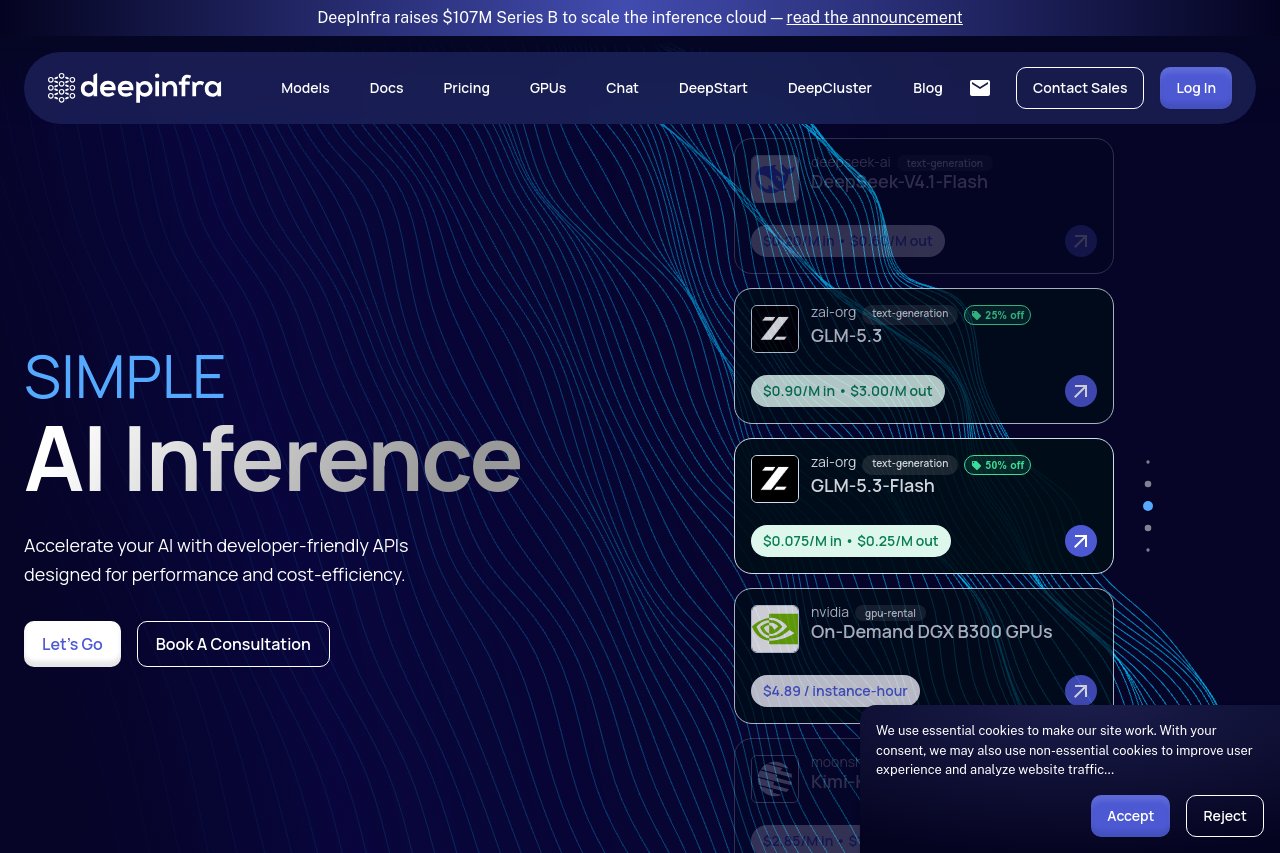
- Pricing: DeepInfra uses usage-based pay-as-you-go pricing with no long-term contracts or upfront costs. Language models are billed per token (e.g., DeepSeek-V4-Flash at $0.09 per 1M input / $0.18 per 1M output tokens; Kimi-K3 at $2.85 / $14.25), while most other models are billed by inference execution time.
- Token pricing example: The featured model DeepSeek-V4-Flash-Vision-Exp costs $0.2156 per 1M input tokens ($0.0069 cached) and $0.6468 per 1M output tokens, with a 51% discount listed.
- Cached input discounts: Many language models offer significantly cheaper cached input token rates, such as $0.015 per 1M cached for DeepSeek-V4-Flash-0731 versus $0.06 uncached.
- Promotional discounts: Selected models carry limited-time discounts, including 5–10% off Xiaomi MiMo models, 30% off DeepSeek-V4.1-Flash, and 38% off GLM-5.3.
- GPU rental: On-demand DGX B300 GPU instances are available at $5.89 per instance-hour.
Who It's For
- Application developers and startups integrating LLM capabilities
- Product teams validating AI ideas on a limited budget
- Small and medium businesses seeking strong inference performance without infrastructure overhead
- Students and researchers experimenting with open-source models
Related Tutorials
View all →
AOYii AI Daily - Nov. 10, 2026 Read more →

Anthropic Releases Claude Fable 5.2 and Mythos 5.2: Beating Opus 5.5 Across Coding, Reasoning and Vision Read more →
AOYii AI Daily - Nov. 9, 2026 Read more →
B
Best AI Tools for Students in 2026: 10 Picks for Studying, Writing and Research Read more →
AOYii AI Daily - Nov 8, 2026 Read more →
Related Tools
View all → OmniRoute - Free AI Gateway for Multi-Provider LLMs Free, open-source AI router with auto-fallback. 236 providers, one endpoint, 95 MCP tools, 17 routing strategies, A2A protocol, auto-combo engine, semantic cache, memory & skills. Deploy anywhere.
 LangChain LangChain provides a comprehensive suite of products to support developers throughout their entire development workflow.
 OpenHands Open-source, model-agnostic platform for building and deploying cloud coding agents. Automate real engineering work securely with full transparency and control.
 Agent-Native Apps Framework Build agentic apps where AI agents and UI share the same database and state. Open source framework with ready-to-fork templates.
 DeepSeek V4.1 Flash DeepSeek V4.1 Flash is DeepSeek's new-generation flagship: a 552B MoE with an asymmetric CED architecture offering native vision, 1M-token context and V4-Pro-beating performance at lower cost.