
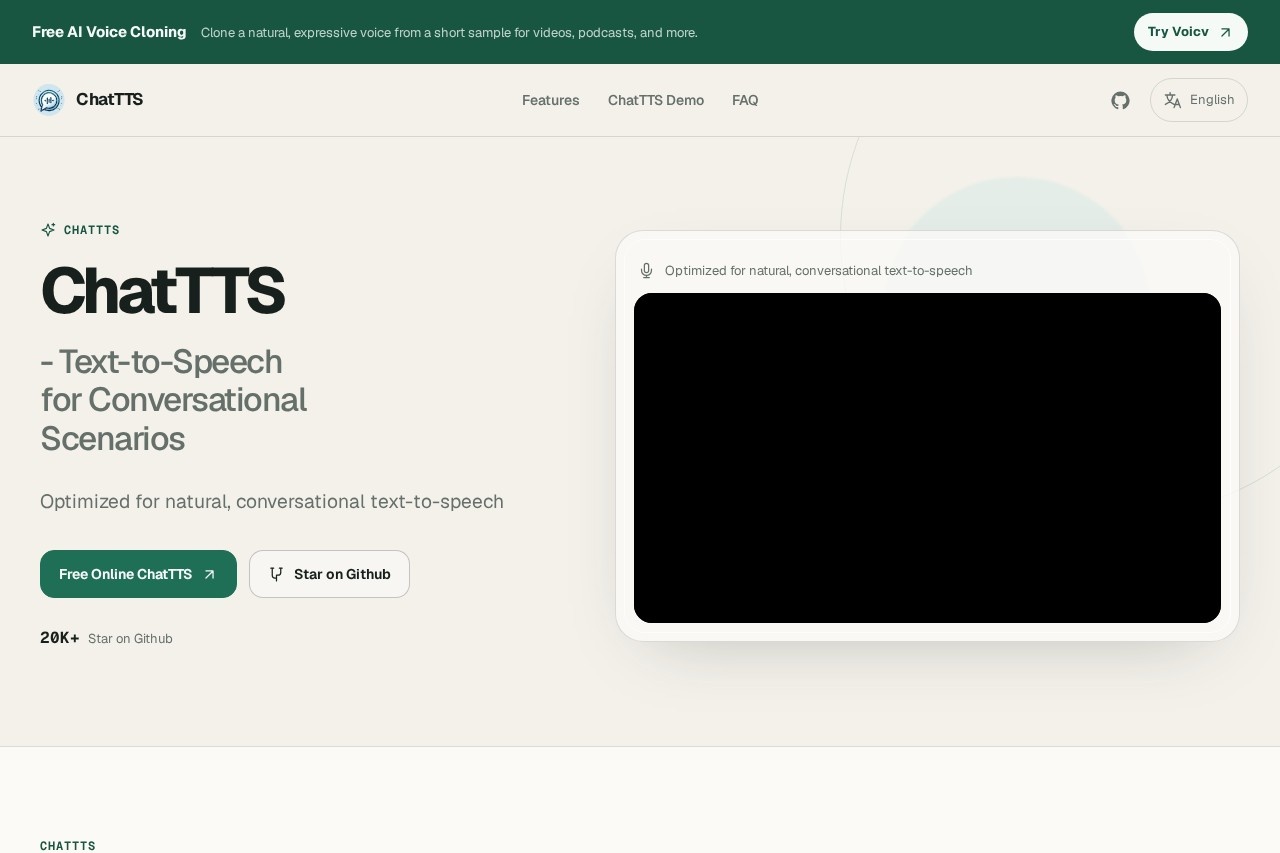
ChatTTS is an open-source text-to-speech model built for conversational scenarios, generating natural Chinese and English speech for LLM assistants and dialogue applications.
About
ChatTTS is a voice generation model built specifically for conversational text-to-speech. Rather than targeting narration or long-form reading, it is designed to render dialogue naturally, which makes it a fit for the spoken responses of large language model assistants and for conversational audio and video introductions.
The model supports both Chinese and English and was trained on roughly 100,000 hours of speech data in those two languages, which the project credits for the naturalness of its output. The code is distributed through GitHub under the 2noise/ChatTTS repository, and the project team has stated plans to release an open-source base model so academic researchers and developers can study and extend the technology. The official site also hosts a free online demo where visitors can hear the model generate speech from sample text without installing anything.
Key Features
Pricing & Fees
- Pricing: Not publicly listed on the pages we reviewed; check the official site for current plans.
- Free online demo: The official site offers a browser demo with example texts, though it can display a "service is busy" message under load.
- Self-hosted code: The full pipeline is available on GitHub, so developers can run it locally with PyTorch.
- Audio output: Example scripts play generated audio at a 24,000 Hz sample rate.
Who It's For
ChatTTS is aimed primarily at developers and researchers building conversational applications, especially those adding spoken output to large language model assistants. It also suits teams producing dialogue-heavy audio content, such as video introductions, educational and training narration, and any service that needs text converted into natural Chinese or English speech. Because the code lives on GitHub and the team plans an open base model, academics studying speech synthesis can inspect and build on it directly rather than treating it as a closed black-box service.
FAQ
What is ChatTTS?ChatTTS is a text-to-speech model designed for conversational scenarios, trained on approximately 100,000 hours of Chinese and English speech data.
Is ChatTTS free to use?The code is publicly available on GitHub and the official site offers a free online demo; commercial pricing is not publicly listed on the pages reviewed, so check the official site for current terms.
Which languages does ChatTTS support?It supports Chinese and English, generating speech in both languages from the same model.
How do developers use ChatTTS?They clone the GitHub repository, install the package with pip alongside PyTorch, initialize the model, and call the infer method on input text to produce audio.
What sets ChatTTS apart from other text-to-speech models?It is specifically optimized for dialogue tasks rather than general narration, and the team is adding watermarks and controllability features with LLM integration in mind.
Related Tutorials
View all →

Related Tools
View all → LOVO - AI Voice Generator and Text to Speech LOVO offers 500+ voices in 100+ languages, making it easy to generate realistic AI voiceovers for any project.
 Murf AI Murf AI is a platform for AI text-to-speech, voiceover production, dubbing, and conversational voice agents, serving developers, creators, and localization teams.
 NaturalReader NaturalReader is an AI text-to-speech platform that converts documents, webpages and scanned text into natural-sounding audio for personal, commercial and educational use.
 Voicebox - Open Source Voice Cloning Desktop App Voicebox is an open-source desktop app for voice cloning and TTS, supporting Mac, Windows, and Linux. It offers high-quality voice synthesis and customization.
 VoxCPM - Voice Cloning & Speech Synthesis VoxCPM generates natural, expressive speech from text. It leverages advanced LLMs to create realistic voiceovers for various applications.