
Angular is Google's open-source TypeScript web application framework for building scalable, high-performance single-page apps, with official docs, tutorials, and tooling at angular.dev.
About
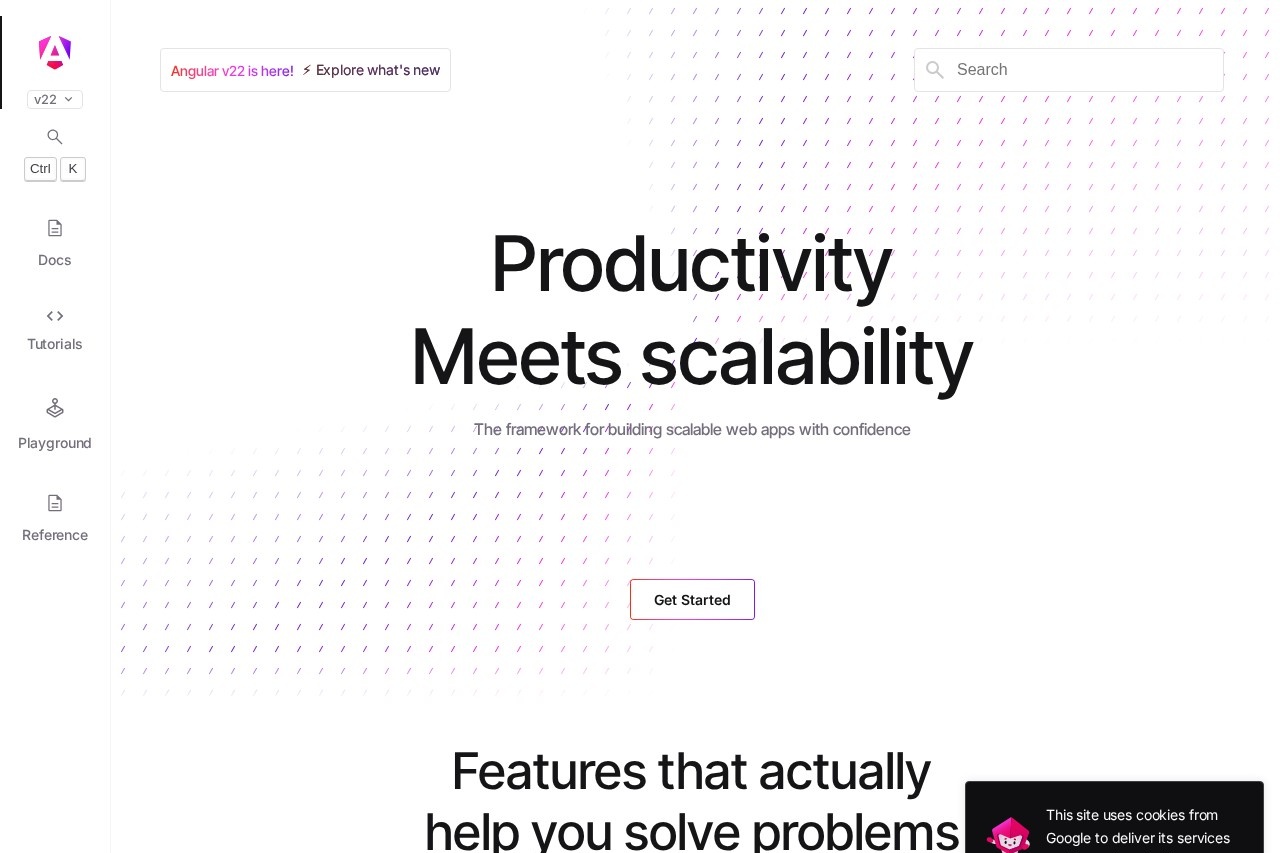
Angular is an open-source web application framework maintained by Google, first released in 2010 and documented today at angular.dev. It exists to solve a common problem in front-end development: keeping large web applications organized, fast, and maintainable as teams and codebases grow. Angular addresses this with an opinionated, fully featured platform where routing, forms, HTTP communication, server-side rendering, and testing are provided as first-party modules that work together out of the box.
Developers write applications in TypeScript using Angular components, templates, and dependency injection, and manage reactive state with Angular Signals for fine-grained, fast updates. The framework ships with its own CLI for scaffolding and building projects, along with in-browser tutorials, an interactive playground, and reference documentation. The current release is Angular v22, and the project's code is available under an MIT-style license, with documentation licensed under CC BY 4.0.
Key Features
Pricing & Fees
- Pricing: Angular is free and open source; its code is licensed under an MIT-style license, so there are no paid plans.
- Learning resources: angular.dev offers in-browser tutorial lessons, short essentials guides, and a playground for hands-on practice without local setup.
- Community and support: The project is maintained with public contributions on GitHub, a published roadmap, a blog, X and Bluesky accounts, a Discord server, and community translations in languages including Spanish, Turkish, Korean, Japanese, and Chinese.
- Current version: Angular v22 is the latest major release highlighted on the official site.
Who It's For
Angular is aimed at front-end and full-stack developers who build large, long-lived web applications, particularly teams that want a complete framework rather than an assembly of separate libraries. Enterprise web teams benefit from its opinionated structure, dependency injection, and first-party modules for forms and routing. Developers working with AI-assisted workflows can use the framework's AI guidance and MCP integration, while newcomers can learn through the official in-browser tutorials. It suits anyone prioritizing performance features such as signals, hydration, and deferrable views in production apps.
FAQ
What is Angular?Angular is an open-source TypeScript-based web application framework maintained by Google for building scalable, modern web applications, with official documentation at angular.dev.
Is Angular free to use?Yes, Angular is free and open source; its code is licensed under an MIT-style license and its documentation under CC BY 4.0, so there is no cost to use it.
What is the latest version of Angular?The current major release is Angular v22, which the official site highlights alongside release notes describing what is new.
Does Angular support server-side rendering?Yes, Angular provides server-side and hybrid rendering along with hydration and incremental hydration features documented in its official guides.
Does Angular offer AI-related features or resources?Yes, angular.dev includes a dedicated AI section with prompts, strategies, and examples, and an Angular MCP server providing tools such as best-practice guidance, an AI tutor, and example lookup.
Related Tutorials
View all →
Related Tools
View all → Code Arena Code Arena is a platform for testing leading AI coding models by building web apps and websites in real time while comparing their accuracy and logic.
 8080.AI 8080.AI is an agentic software-building platform where teams of specialized AI agents turn a one-sentence idea into deployed, Kubernetes-hosted production applications.
 HeroUI Pro HeroUI Pro is a paid library of premium React and React Native UI components, templates, design systems, and AI coding tools for teams building production web and mobile apps.
 Google Antigravity Google Antigravity is Google's agentic development platform that lets developers build, automate, and verify software with AI agents across an IDE, desktop app, CLI, and SDK.
 Orca Orca is a free, open-source Agent Development Environment that runs CLI coding agents like Claude Code, Codex, and Gemini in parallel across isolated git worktrees.