
Build agentic apps where AI agents and UI share the same database and state. Open source framework with ready-to-fork templates.
About
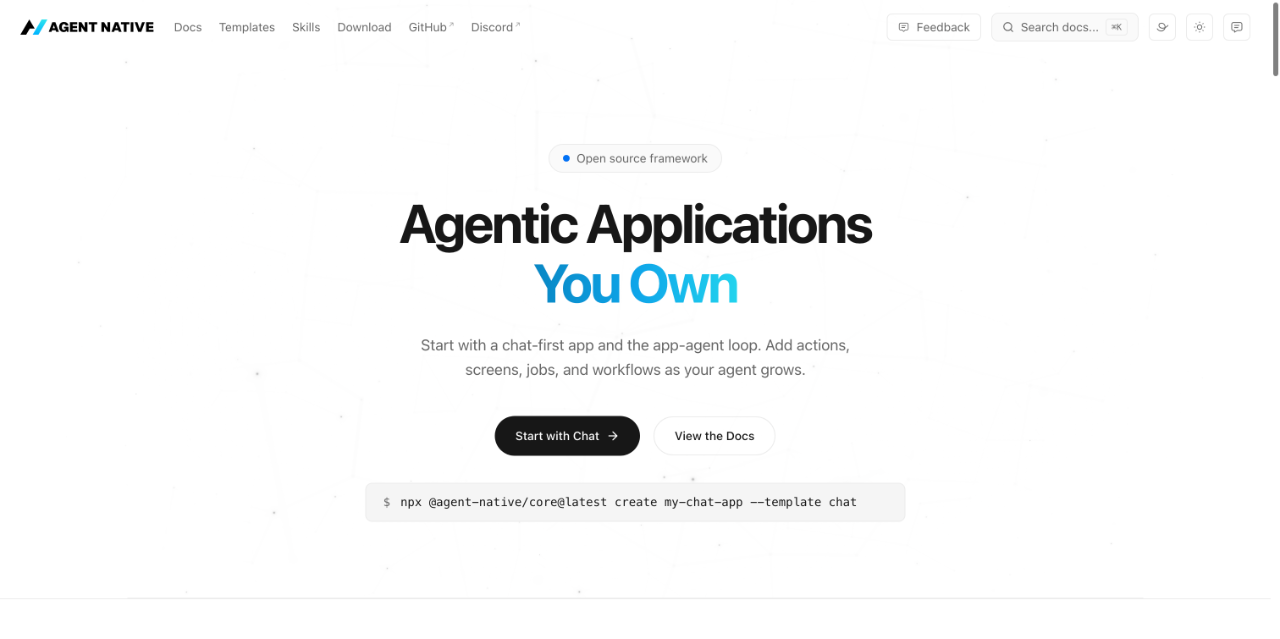
Agent-Native is an open-source application framework designed specifically for building agent-native applications. Unlike traditional AI applications, the core innovation of the Agent-Native framework lies in the fact that AI agents and the user interface (UI) share the same database and state. This means developers no longer need to handle complex data synchronization or state management between agent logic and frontend presentation. Whether you are building automated workflows, intelligent assistants, or data-driven interactive applications, Agent-Native allows AI agents to read and write application state directly, just like operating on local variables, delivering a true "what you see is what you get" and "what you do is what gets saved" experience.
Key Features
Pricing & Fees
- Pricing: Not publicly listed on the pages we reviewed; check the official site for current plans. Agent-Native itself is presented as an open-source TypeScript framework, and its example apps are described as free to use or customize.
- Open source: The framework is open-source TypeScript, installed via `npx @agent-native/core@latest`, with source available on GitHub (about 7.5k stars shown on the site).
- Bring your own LLM: You connect your own LLM provider, so model usage costs are billed separately by that provider rather than by Agent-Native.
- Build options: You can build locally with the framework guide or build online with Builder.io at no stated charge.
Who It's For
AI application developers who want to rapidly build SaaS products, tools, or internal systems with intelligent interaction capabilities while reducing backend development overhead. Product managers and entrepreneurs who need to quickly create interactive AI product prototypes to validate market assumptions and iterate on features. Open-source contributors and researchers interested in agent architecture, state management, or human-agent collaboration interfaces who want to experiment and innovate on a flexible open-source foundation. Educators and trainers who need to demonstrate how AI agents and frontend interfaces work together in real-world applications for teaching purposes.
Related Tutorials
View all →

Related Tools
View all → OmniRoute - Free AI Gateway for Multi-Provider LLMs Free, open-source AI router with auto-fallback. 236 providers, one endpoint, 95 MCP tools, 17 routing strategies, A2A protocol, auto-combo engine, semantic cache, memory & skills. Deploy anywhere.
 OpenHands Open-source, model-agnostic platform for building and deploying cloud coding agents. Automate real engineering work securely with full transparency and control.
 goose | Your Open Source AI Agent goose is your open source AI agent.
 Pi Coding Agent Pi is a minimal coding agent harness for the terminal. Customize it with extensions, skills and themes, switch between 15+ model providers mid-session, and branch or share session trees. Works interactively, in scripts, via RPC or SDK.
 Dograh - Voice Assistant Workflow Builder Open Source Voice Assistant Workflow Builder.