
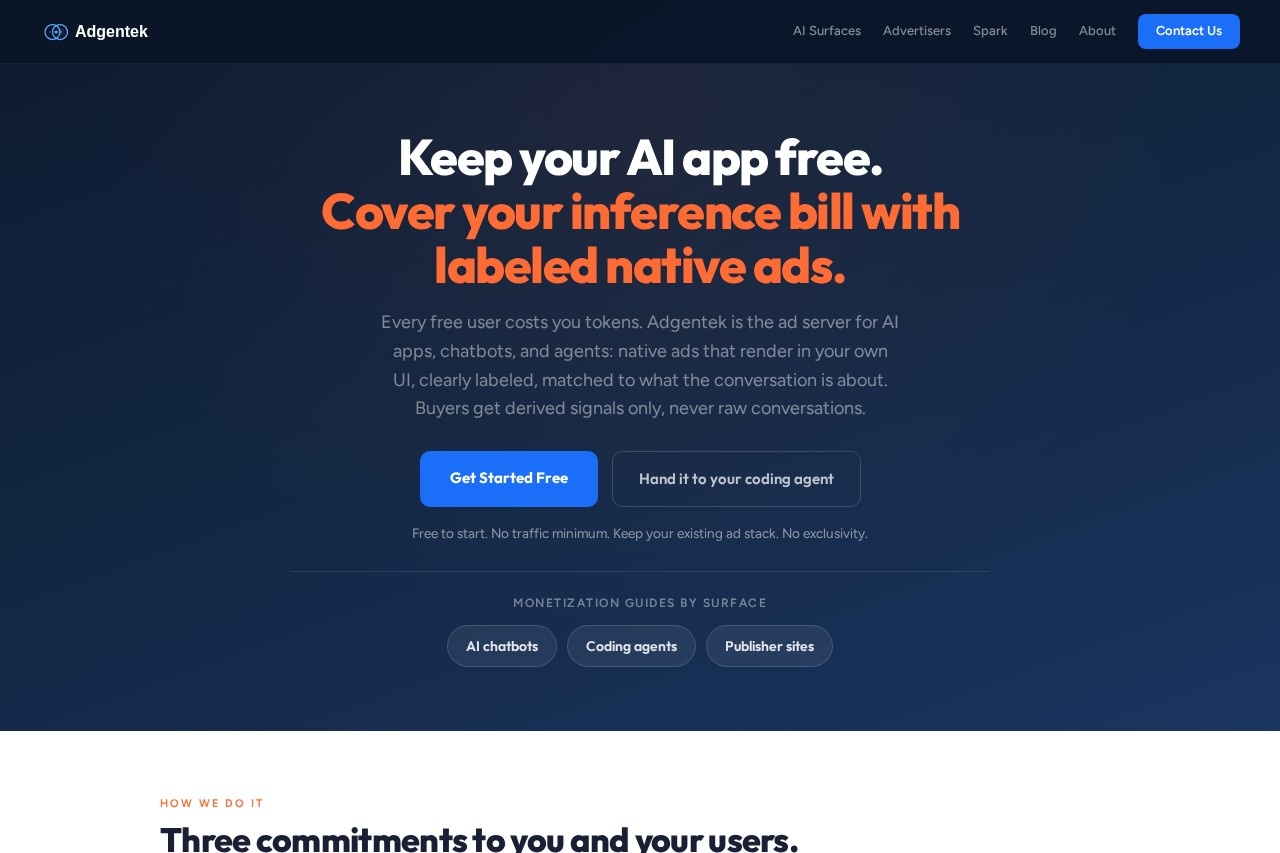
Adgentek Ad Server is a native ad server for AI apps, chatbots, and agents that places clearly labeled contextual ads in your own UI so ad revenue can offset inference costs.
About
Adgentek Ad Server is an advertising server built specifically for AI products: chatbots, AI apps, AI search engines, and autonomous agents. It addresses a problem unique to AI publishers: every free user consumes model tokens on each turn, and only a small fraction of users convert to paid plans. Adgentek lets publishers place native, clearly labeled ads inside their own interface so that advertising revenue can offset the cost of running the model.
The product works by classifying each conversation in real time into a topic, an intent category, and a decision stage, then sending only those derived signals to advertising demand — never raw transcripts. Four tiers of demand compete for each request: direct campaigns, programmatic buyers, CPC feeds, and outcome-priced budgets. If a request does not clear the top tier, it falls through until it finds a buyer. Ads render in a slot the publisher places in their own DOM, with a visible Sponsored label, and nothing is injected into the model's output. Integration is available through a JavaScript SDK, a Python SDK, a REST API, or an MCP endpoint for agents.
Key Features
Pricing & Fees
- Pricing: Not publicly listed on the pages we reviewed; check the official site for current plans.
- Free to start: The publisher page states there is no traffic minimum, no exclusivity requirement, and publishers can keep their existing ad stack.
- Integration options: JavaScript Web SDK, Python SDK, direct REST API, and an MCP endpoint at mcp.adgentek.ai for agent-based integrations.
- Best-fit and non-fit uses: Adgentek is designed for conversational AI surfaces; it is not intended for standard display banner serving, DSP seat management, or search engine marketing.
Who It's For
Adgentek Ad Server is aimed at developers and operators of AI products that carry free-user traffic: AI chatbots and assistants, coding agents, AI search engines, and autonomous agents. Indie founders who want to keep a free tier without a hard paywall can use it to recover inference costs, while larger AI publishers can run it alongside their existing ad stack. It also serves conversational publishers adding chat widgets to article pages. Advertisers and agencies reach the same inventory through Adgentek's advertiser side or its ORCA offering.
FAQ
What is Adgentek Ad Server?It is an ad server built for AI apps, chatbots, and agents that serves native, labeled ads matched to conversational context, with revenue intended to offset model inference costs.
Is there a free plan?Yes, publishers can start with a free account, and the site states there are no traffic minimums and no exclusivity requirements; full pricing details are not publicly listed.
How do you integrate it?Integration is via a few lines of JavaScript, a Python SDK, a REST API, or a single install prompt handed to a coding agent such as Claude Code, Cursor, or Codex using the docs at docs.adgentek.ai.
Does it slow down the AI response?No, the ad request runs in parallel with the model call, and if no ad decision returns in time the slot stays empty, leaving the conversation unchanged.
What data do advertisers receive?Advertisers only get derived signals — an intent category, decision stage, topic, and aggregate performance — and never raw conversations, prompts, PII, or user profiles.
Related Tutorials
View all →
Related Tools
View all → AdControlCenter AdControlCenter is an AI ad management platform that builds complete campaigns across Google, Meta, TikTok, LinkedIn, X and Reddit and publishes them paused to your own ad accounts.
 zMaticoo zMaticoo is a mobile advertising and monetization platform that helps app developers and publishers in APAC earn revenue from in-app ad inventory.
 GetHookd GetHookd is an ad intelligence platform that gives marketers access to over 22 million live Meta ads, plus brand spying, shop analytics, and AI-powered ad cloning.
 Yuxi - RAG Harness for AI Agents Yuxi provides a RAG harness to enhance AI agents with retrieval-augmented generation capabilities.
 omp - A Coding Agent with the IDE Wired In Oh My Pi (omp) is a coding agent that integrates with your IDE, leveraging LSP and DAP for seamless development. Built in Rust for performance.