
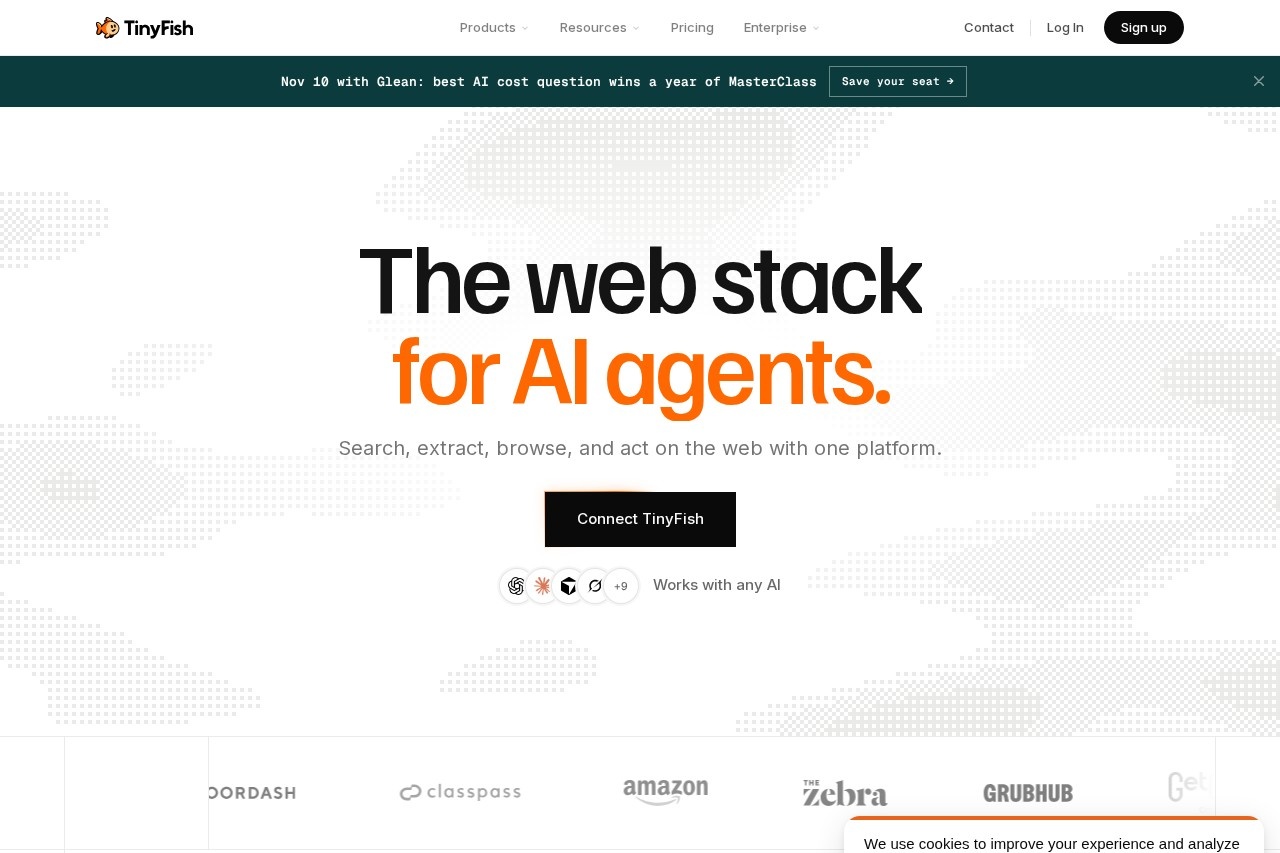
TinyFish is web infrastructure for AI agents that combines live web search, page fetching, cloud browser sessions, and multi-step automation behind a single API.
About
TinyFish is a platform that gives AI agents practical access to the live web. Instead of an agent being limited to cached search results or static text, TinyFish lets it search current pages, fetch rendered content, drive real cloud browsers, log into sites, fill forms, and return structured data — all through one API and a single API key.
The product is built around five main components: TinySearch (live browser-rendered search returning structured JSON), TinyFetch (URL-to-clean-content conversion in Markdown, JSON, or HTML), TinyBrowser (cloud browser sessions driven with Playwright, Puppeteer, or CDP), TinyAgent (goal-oriented multi-step web automation), and Mako, a web-native model for live workflows. TinyFish also handles residential proxy routing and anti-bot checks at the infrastructure layer. The company publishes benchmarks comparing its Search, Fetch, and Agent components against alternatives such as Tavily, Exa, Firecrawl, and Parallel on tests including SimpleQA, WebVoyager, and Online-Mind2Web.
Key Features
Pricing & Fees
- Pricing: Usage-based with no subscription or monthly minimum. Search and Fetch are free within rate limits; Agent costs $0.016 per step; Browser costs $0.002 per minute; Monitor costs $0.005 per check. Paid usage draws from a prepaid Wallet with a $10.00 minimum deposit, and new accounts start with $8 in Wallet funds.
- Free tier: Search and Fetch remain free even at a $0 Wallet balance, and no credit card is required to start.
- Enterprise plan: Adds custom rate limits and concurrency, ISO 27001, enterprise SSO, audit logs, VPC deployment, and a 99.99% uptime SLA.
- Integrations: Works with ChatGPT, Claude, Cursor, and other tools via MCP, plus SDKs and a CLI; all products share one API key.
Who It's For
TinyFish is aimed at developers and teams building AI agents or automated workflows that need real web access. Typical users include data engineers monitoring pages at scale, analysts enriching CRM records against live sources, and automation teams that must log into supplier or partner portals to fill forms and pull files. The company highlights production use cases at ClassPass, DoorDash, Grubhub, Google Hotels Japan, and The Zebra, spanning schedule accuracy, web intelligence, and insurance quote workflows. Enterprise offerings target industries such as retail, travel, financial services, and healthcare.
FAQ
What is TinyFish?TinyFish is web infrastructure for AI agents that provides live search, page fetching, cloud browser sessions, and multi-step automation, including authenticated access to websites, through a single API.
Is TinyFish free to use?Search and Fetch are free within rate limits, and new accounts receive $8 in Wallet funds; Agent, Browser, and Monitor are metered against a prepaid Wallet balance with no subscription or monthly minimum.
Can TinyFish agents log into websites?Yes. Agents can authenticate using the customer's own credentials stored in 1Password or Bitwarden via TinyVault, and the model itself never sees the passwords; every authenticated run is recorded step by step.
How does TinyFish compare with alternatives?The company publishes benchmarks claiming, for example, 49.2% top-result search accuracy versus Tavily's 45.6%, and 93% live fetch coverage versus 62% for Firecrawl; independent verification of these figures has not been reviewed here.
What developer tools does TinyFish provide?TinyFish offers SDKs, a CLI, MCP connections for tools like Claude Code and Cursor, and open-source examples in its Cookbook, with cloud browsers drivable through Playwright, Puppeteer, or CDP.
Related Tutorials
View all →
Related Tools
View all → OmniRoute - Free AI Gateway for Multi-Provider LLMs Free, open-source AI router with auto-fallback. 236 providers, one endpoint, 95 MCP tools, 17 routing strategies, A2A protocol, auto-combo engine, semantic cache, memory & skills. Deploy anywhere.
 OpenHands Open-source, model-agnostic platform for building and deploying cloud coding agents. Automate real engineering work securely with full transparency and control.
 Agent-Native Apps Framework Build agentic apps where AI agents and UI share the same database and state. Open source framework with ready-to-fork templates.
 DeerFlow - Agent Framework A LangChain-based framework for building super agents. Streamlines the development of advanced AI agents with ease.
 FunASR - End-to-End Speech Recognition Toolkit Industrial-grade speech recognition toolkit. 170x realtime on GPU, 50+ languages, speaker diarization, emotion detection, OpenAI-compatible API, vLLM acceleration, and agent integration.