Documentation for Sana - High-quality Diffusion Models for Images and Videos.
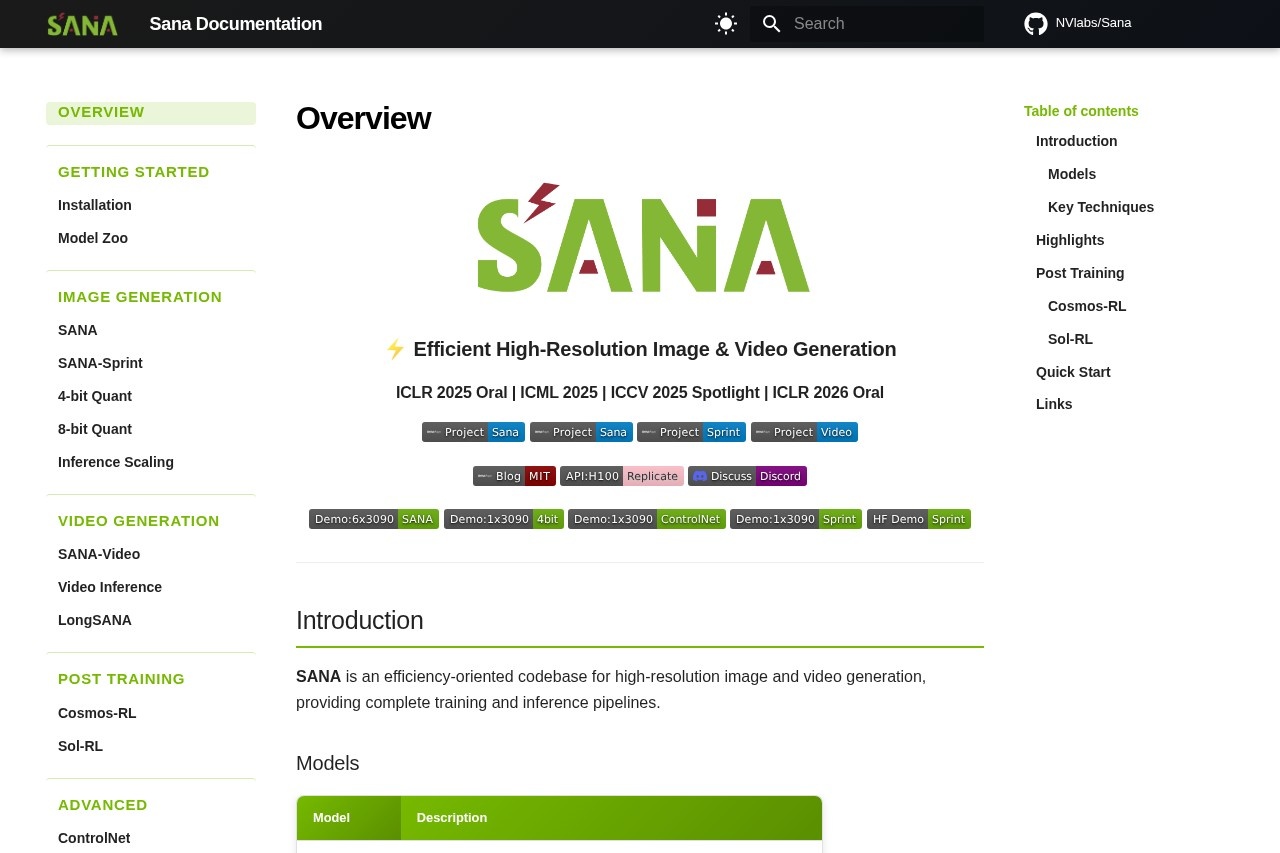
About
Sana Documentation is a professional technical documentation and toolset for diffusion models in the image and video generation domain. Built on the latest diffusion model architectures, Sana is designed to deliver high-quality, high-efficiency image and video generation capabilities for developers, researchers, and creative professionals. Whether generating photorealistic images from text or synthesizing coherent video frames, Sana leverages advanced algorithms and optimized design to lower the barrier to entry for generative AI while maintaining industry-leading visual quality.
Key Features
Pricing & Fees
- Pricing: Not publicly listed on the pages we reviewed; check the official site for current plans. The codebase and pretrained model weights are available via the NVIDIA Labs GitHub repository.
- Open-source access: Sana is an open-source efficiency-oriented codebase for high-resolution image and video generation, with complete training and inference pipelines provided.
- Model variants: Includes Sana (up to 4K text-to-image), Sana-1.5, Sana-Sprint (one/few-step generation), Sana-Video, Sana-Video 2.0 (5B/14B), and LongSana for minute-length video.
- Low hardware requirements: Runs in under 8GB VRAM with 4-bit quantization, with 8-bit quantization and inference-scaling options also documented.
- Integrations: Official documentation covers ComfyUI and SGLang integrations, plus post-training options such as LoRA, DreamBooth, ControlNet, and RL (Cosmos-RL, Sol-RL).
Who It's For
Sana Documentation is designed for AI researchers and algorithm engineers who want to study diffusion model principles, reproduce cutting-edge results, or conduct innovative experiments; creative designers and content creators who need to rapidly generate visual assets, concept sketches, or short video content with AI tools; product managers and entrepreneurs exploring ways to integrate generative AI capabilities into applications such as design tools, marketing platforms, and social apps; and educators and students who need a hands-on platform and teaching cases for computer vision and generative AI courses.
Related Tutorials
View all →


Related Tools
View all → AI Best - Create Anything with AI Create stunning AI images and videos with AI Best. Generate images from text, transform images, edit images, and create videos with 9+ AI models. Fast, reliable, affordable.
 LoRA AI - Create Stunning AI Images in Seconds AI-powered LoRA AI lets you create stunning images in seconds. Transform ideas into high-quality visuals using advanced LoRA technology.
 Animate Image AI Animate an image online with the latest AI models.
 Lora AI Lora AI helps creators generate consistent AI characters, influencers, styles, and product photos with LoRA — browse a curated model directory, train custom LoRAs, and create repeatable images and videos.
 Goglo AI Goglo AI is a multi-model AI creative studio that brings image and video generation, editing tools, prompt tools, and API access together in one platform.