
Salad is a distributed GPU cloud that runs AI inference, containers, and batch workloads on 16,000+ daily active consumer GPUs across 190+ countries at low cost.
About
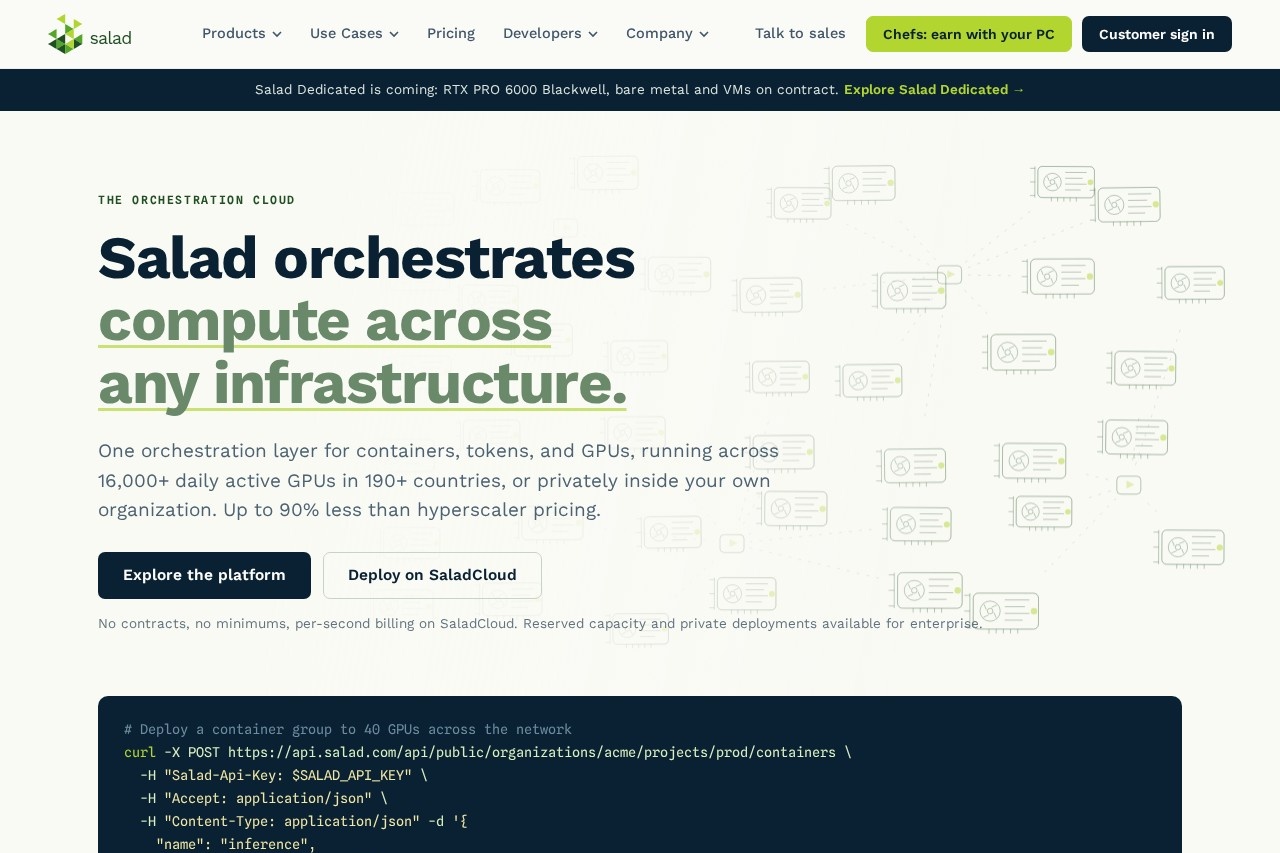
Salad is a distributed GPU cloud that coordinates idle consumer graphics hardware into a pool developers can use for AI and compute workloads. Instead of renting capacity from traditional data-center providers, customers tap a network of more than 16,000 daily active GPUs spread across 190+ countries, which Salad says can cost up to 90% less than hyperscaler pricing. The company has operated since 2018, and over 450,000 GPUs have contributed to the network in that time.
The platform, marketed as SaladCloud, provides a single orchestration layer for containers, token-based AI inference, and GPU scheduling. Developers deploy Docker containers through the Salad Container Engine, call an OpenAI-compatible API for open-weight language models, or reserve dedicated hardware such as RTX PRO 6000 Blackwell machines. Organizations can also run the same orchestration stack privately on their own workstations and servers.
Key Features
Pricing & Fees
- Pricing: Community Cloud GPU capacity starts at $0.015 per GPU-hour with per-second billing, no contracts, and no minimums; Salad advertises savings of up to 90% versus hyperscalers. Reserved capacity and private deployments are priced through sales.
- Scale: More than 16,000 daily active GPUs across 190+ countries, with 450,000+ GPUs having contributed since 2018.
- Enterprise options: Enterprise support includes security review, procurement assistance, and a named team for large deployments.
- Trust and reliability: A proprietary trust rating scores node performance and availability, and priority pricing matches interruptible supply to workloads designed for it.
Who It's For
Salad is aimed at ML engineers, backend developers, and AI startups that need inexpensive GPU capacity for inference, image generation, transcription, voice AI, computer vision, or batch processing. It suits teams running interruptible, containerized workloads where low cost matters more than dedicated hardware. Organizations with their own idle workstation fleets can use Private Cloud to build an internal GPU service. Production customers named on the site include Civitai, Blend, Klyne.ai, Undetectable AI, Pareto, and Datasembly.
FAQ
What is Salad?Salad is a distributed GPU cloud that orchestrates AI and container workloads across a global network of more than 16,000 daily active consumer GPUs in 190+ countries.
How much does Salad cost?Community Cloud pricing starts at $0.015 per GPU-hour with per-second billing and no contracts; Salad advertises savings of up to 90% compared with hyperscaler pricing, and dedicated or private deployments are quoted through sales.
Does Salad work with existing AI tools and Kubernetes?Yes, the AI Gateway is an OpenAI-compatible endpoint for open-weight models, and a Virtual Kubelet lets teams schedule Kubernetes pods onto SaladCloud.
Can Salad run on our own hardware?Yes, Salad Private Cloud runs the same orchestration stack inside an organization, pooling idle GPUs in owned workstations and servers so company data never leaves company devices.
Is Salad reliable enough for production?The Salad Container Engine verifies nodes, isolates containers behind a hypervisor, streams logs, and reallocates work when a node disappears, and production customers work directly with Salad engineers.
Related Tutorials
View all →
Related Tools
View all → LangChain LangChain provides a comprehensive suite of products to support developers throughout their entire development workflow.
 Llama Llama 4 is a powerful AI model family with Scout and Maverick versions. Experience advanced AI capabilities.
 Runpod Runpod is a GPU cloud platform where developers launch on-demand GPU pods, run serverless AI inference endpoints, and manage multi-node clusters for training and deployment.
 OpenRouter OpenRouter is a unified, OpenAI-compatible API that gives developers pay-as-you-go access to 500+ AI models for text, image, video, and audio from 80+ providers.
 OmniRoute - Free AI Gateway for Multi-Provider LLMs Free, open-source AI router with auto-fallback. 236 providers, one endpoint, 95 MCP tools, 17 routing strategies, A2A protocol, auto-combo engine, semantic cache, memory & skills. Deploy anywhere.