
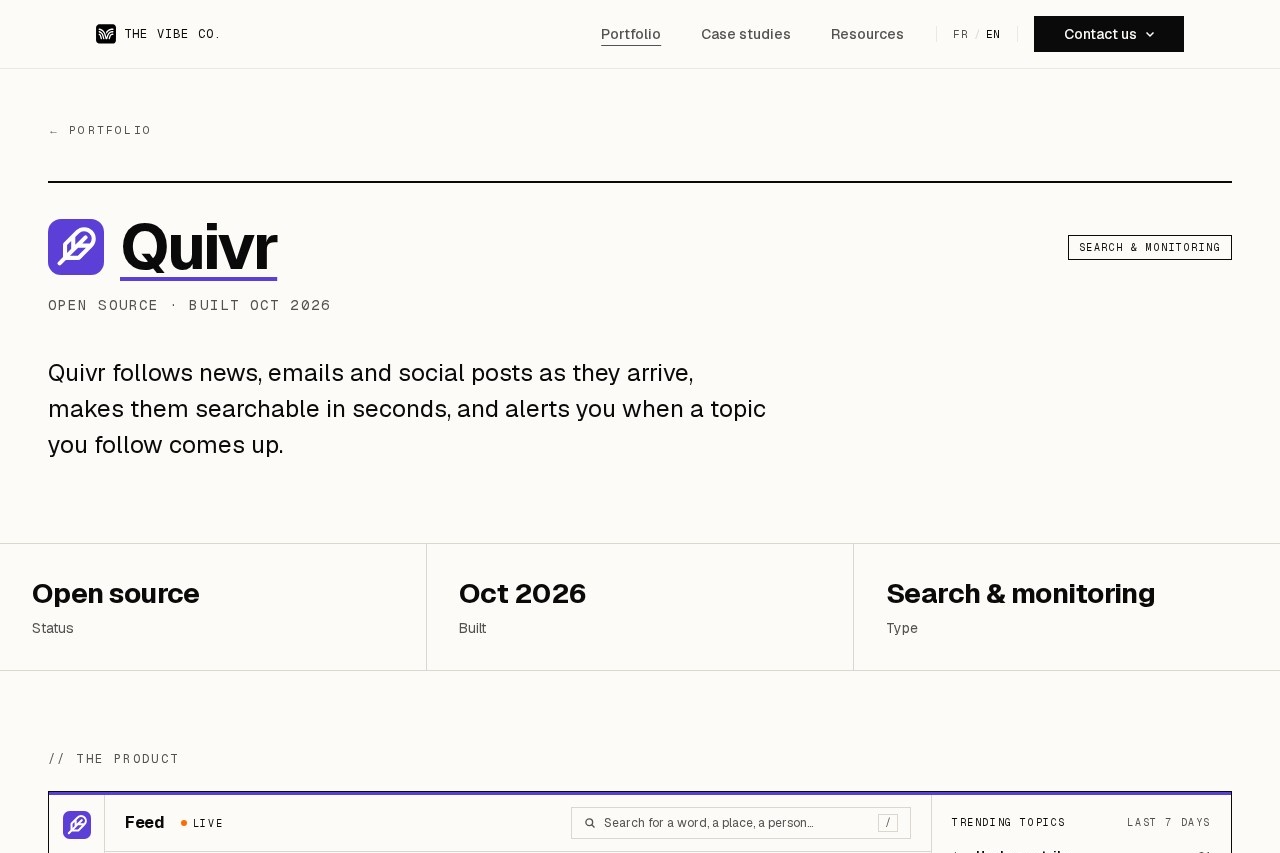
Quivr is a free, open-source news search and monitoring engine that ingests news feeds, mailboxes and social posts, keeps every version, and alerts teams when a followed topic appears.
About
Quivr is an open-source engine, built by The Vibe Company (a Y Combinator W24 agency based in Paris), that follows news feeds, mailboxes, X lists and application data as it arrives. It solves a common monitoring problem: information arrives in bursts across many sources, articles get corrected or disappear, and relevant items slip past human reviewers. Quivr keeps every article, email and post — including earlier versions when content is corrected — and makes it searchable within seconds.
At a high level, Quivr stores incoming content, indexes it for keyword and meaning-based search, and watches for topics the user has described. When a new item matches a followed topic, it raises an alert and can notify other systems through signed webhooks, a change feed or an MCP interface for AI agents. Under the hood, it is a single Go binary running the API, worker and migrations on PostgreSQL, S3-compatible storage, Temporal and Weaviate vector search with multilingual E5 embeddings.
Key Features
Pricing & Fees
- Pricing: The software itself is free under the MIT license; paid services such as business plugins, production rollouts and HDS-compliant hosting are quoted individually and not publicly listed on the pages we reviewed.
- Open source: Licensed under MIT, free to use, modify and self-host; some plugins depend on third-party libraries with their own licenses, such as pypdf (BSD-3-Clause).
- Self-hostable deployment options: One machine with Docker Compose is enough for evaluation, with a larger setup of separate workers and a dedicated vector host also supported.
- Early-stage API: Quivr V2 is at the evaluation stage with a version-0 HTTP API that may change without notice, so production use is not yet recommended.
- V1 availability: The earlier Quivr V1 code base is preserved at the `v1-final` Git tag and can still be read, forked or run.
Who It's For
Quivr suits teams that need to track news and social coverage without missing items: communications and PR staff running press reviews, journalists and newsroom editors monitoring beats, analysts doing competitive or market intelligence, and developers building monitoring into their own applications. It also fits organizations with strict data-residency needs, since it is self-hostable and The Vibe Company offers deployments aligned with French HDS requirements for health data.
FAQ
What does Quivr do?Quivr continuously collects articles, emails and social posts, keeps every version even when a service goes down or content is corrected, makes it searchable by keyword and meaning, and alerts the user when a followed topic comes up.
Is Quivr free?Yes, Quivr is open source under the MIT license and free to use, modify and self-host; The Vibe Company sells optional services such as business plugins, production rollouts and HDS-compliant hosting.
Can Quivr be hosted on my own servers?Yes, Quivr can run on servers the user controls, from a single Docker Compose machine for evaluation to a deployment with separate workers and a dedicated vector host, and by default it sends document text nowhere outside the installation.
Can Quivr V2 be used in production?Not yet — Quivr V2 is at the evaluation stage and its v0 API may change without notice, though interested teams can contact The Vibe Company to plan a production rollout.
Where can users get help with Quivr?Questions and bug reports go through the GitHub repository's issues and discussions, and business inquiries can be directed to The Vibe Company via [email protected].
Related Tutorials
View all →
Related Tools
View all → iDox.ai Guardrail iDox.ai Guardrail is an on-device AI security app that blocks sensitive data from reaching ChatGPT and stops unsafe AI agent actions in real time.
 Zetik Zetik is a personal AI intelligence agent that tracks any topic you name across news, podcasts, papers and code, and delivers condensed briefings via feed, push, newsletter, RSS or audio.
 ALIagents.ai A decentralized dApp that combines expressive AI agents and swarm behavior with blockchain, including an AI News Swarm for real-time automated journalism.
 viAct Job Hazard Analysis (JHA) Software AI-powered Job Hazard Analysis and Job Safety Analysis software from viAct that automates risk assessments, standardizes JHA workflows and supports EHS compliance.
 Yuxi - RAG Harness for AI Agents Yuxi provides a RAG harness to enhance AI agents with retrieval-augmented generation capabilities.