
Pollinations is an open AI infrastructure platform that provides text, image, audio, video, 3D and embedding models through a single API, CLI, and MCP server.
About
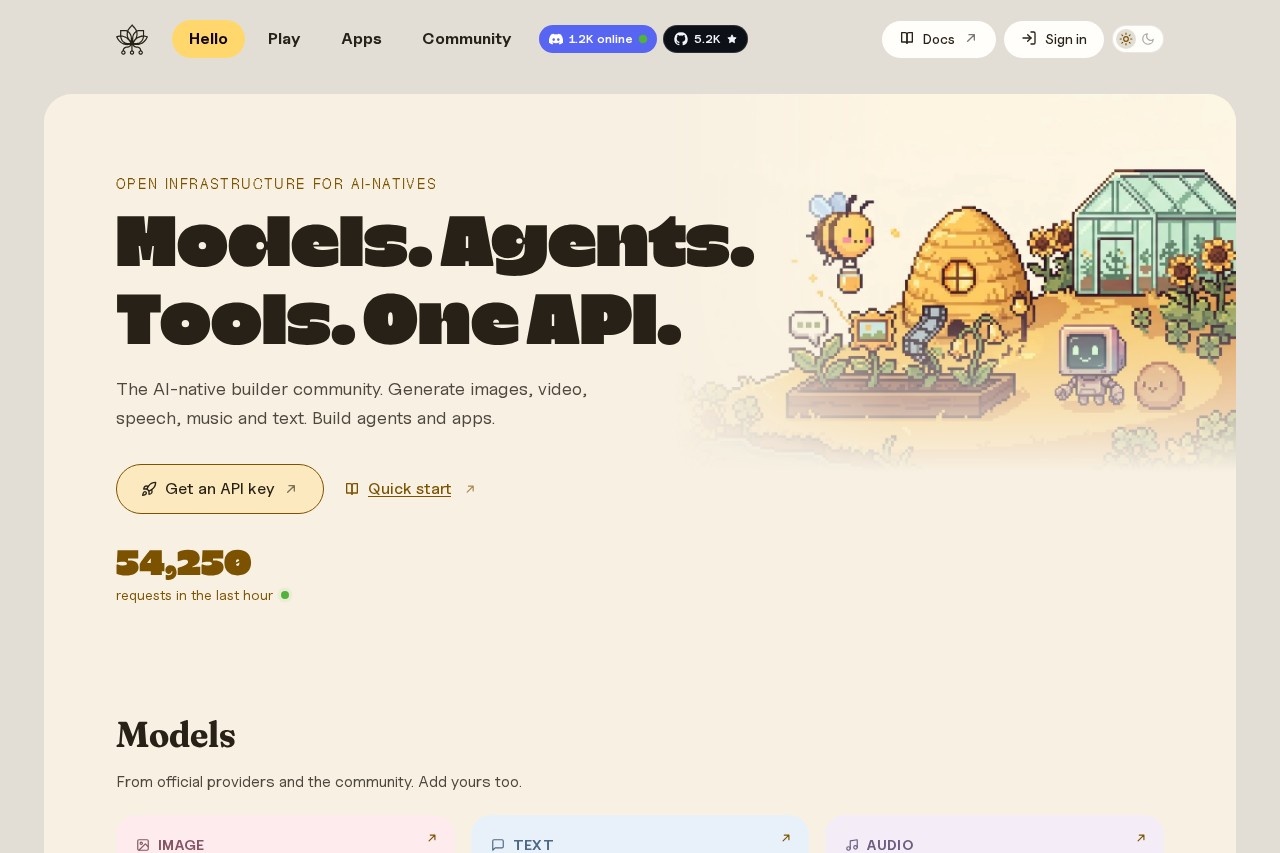
Pollinations is an open infrastructure platform for AI-native builders that packages text, image, audio, video, 3D, and embedding models behind one API. It addresses a common developer pain point: stitching together separate vendors and credentials for each modality. With Pollinations, a single service covers generation across media types, so teams can build agents and applications without managing multiple integrations.
The platform describes itself as a community for AI-native builders who create images, video, speech, music, and text, as well as agents and apps on top of those capabilities. Access is provided through three routes: an HTTP API, a command-line interface (CLI), and an MCP (Model Context Protocol) server, letting both traditional applications and autonomous agents call the same underlying models. Documentation includes an interactive API reference, task recipes, an OpenAPI schema, and a key-management portal where users sign in to create secret keys for authenticated requests.
Key Features
Pricing & Fees
- Pricing: Not publicly listed on the pages we reviewed; check the official site for current plans.
- Access methods: Available through an API, a CLI, and an MCP server, covering web apps, scripts, and agent frameworks.
- Modalities: Supports text, image, audio, video, 3D, and embedding generation from a single service.
Who It's For
Pollinations is aimed at developers and technical creators who need programmatic access to generative models across multiple media types. Typical users include backend and full-stack engineers adding image or audio generation to applications, agent builders connecting LLMs to generation tools through MCP, and indie makers prototyping creative apps without negotiating several vendor APIs. It also suits teams that value open infrastructure and standardized documentation, such as startups building AI-powered content features and hobbyists experimenting with multimodal generation pipelines.
FAQ
What is Pollinations?Pollinations is an open AI infrastructure platform that offers text, image, audio, video, 3D, and embedding models through a single API, along with a CLI and an MCP server.
Is Pollinations free to use?Pricing is not publicly listed on the pages we reviewed; the official site and its key-management portal are the authoritative sources for current plans and access terms.
How do developers authenticate with the Pollinations API?Developers sign in at the official Pollinations key portal and create secret keys, which are then used for authenticated API requests.
Can AI agents use Pollinations directly?Yes. Pollinations ships an MCP server and agent-oriented documentation, so LLM-based agents can call its models without a custom middleware layer.
Where can I find Pollinations API documentation?The project provides an interactive API reference, guides, task recipes, and an OpenAPI schema through its official documentation entry points linked from pollinations.ai.
Related Tutorials
View all →
Related Tools
View all → Hugging Face Hugging Face is an open community platform where machine learning practitioners host, discover, and collaborate on over two million models, datasets, and AI applications.
 Llama Llama 4 is a powerful AI model family with Scout and Maverick versions. Experience advanced AI capabilities.
 LibreChat An open-source chat interface for 2025, offering flexible and customizable AI conversations.
 OpenRouter OpenRouter is a unified, OpenAI-compatible API that gives developers pay-as-you-go access to 500+ AI models for text, image, video, and audio from 80+ providers.
 OmniRoute - Free AI Gateway for Multi-Provider LLMs Free, open-source AI router with auto-fallback. 236 providers, one endpoint, 95 MCP tools, 17 routing strategies, A2A protocol, auto-combo engine, semantic cache, memory & skills. Deploy anywhere.