
Mosi Intelligence builds context-aware foundation models for universal human-computer interaction, enabling next-generation interactive AI.
About
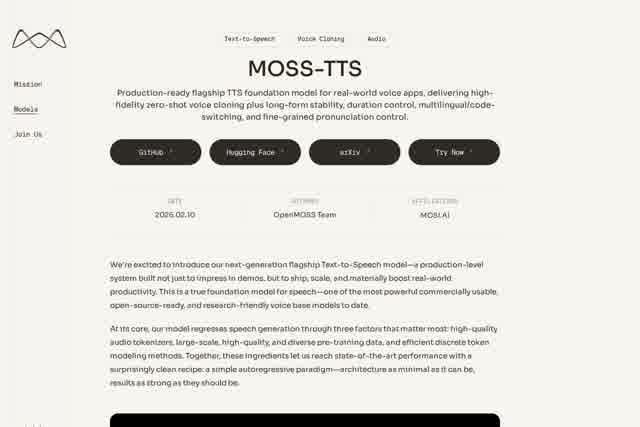
MOSI - MOSS-TTS is a next-generation interactive AI voice synthesis system developed by Mosi Intelligence. As a core component of a new generation of context-aware foundation models, MOSI is designed to redefine the boundaries of human-computer interaction. By deeply integrating deep learning and natural language processing technologies, MOSI not only generates highly natural and emotionally expressive speech but also understands conversational context, enabling truly intelligent voice interaction. Whether for intelligent assistants, virtual characters, or automated broadcasting, MOSI delivers an unprecedented immersive auditory experience.
Key Features
Pricing & Fees
- Industry-leading naturalness: Proprietary acoustic encoders and neural vocoders produce synthesized speech with prosody, pauses, and breath patterns comparable to real human recordings.
- Zero-shot cloning and customization: Clone a specific voice or create entirely new virtual timbres with just a small amount of audio samples, significantly reducing customization costs.
- Deep contextual fusion: Unlike traditional TTS that only processes text, MOSI incorporates dialogue state, user profiles, and environmental information to output speech with greater logical and emotional coherence.
- Flexible deployment options: Cloud API, private deployment, and edge SDKs are available, adapting to everything from large servers to mobile devices.
- Continuous learning and evolution: Based on user feedback and usage data, the model continuously improves under secure and compliant conditions, getting smarter with use.
Who It's For
MOSI is designed for AI application developers who need to integrate high-quality voice capabilities into chatbots, virtual anchors, or smart hardware; content creators and podcasters looking to quickly generate professional narration, audiobooks, or video voiceovers; enterprise customer service teams building intelligent voice support and automated outbound call systems; educators and accessibility professionals providing natural and fluid voice support for learning software, e-books, or assistive tools for the visually impaired; and game and metaverse developers who want to give NPCs and virtual characters authentic, emotionally expressive voices.
Related Tutorials
View all →
Related Tools
View all → AI Tool - AI-Powered Solutions This AI tool provides intelligent solutions to streamline workflows, enhance productivity, and deliver accurate results across various tasks.
 LiblibAI 2.0 An advanced AI platform offering powerful tools for image generation, editing, and creative workflows.
 Seedance 2.0 - AI Video Generator Create stunning AI-generated videos with Seedance 2.0. Turn text into dynamic visuals effortlessly.
 AI Image Generator - AI Art Creation Create stunning AI art with this tool, similar to Midjourney but with 2.5x faster generation. It offers advanced features for generating high-quality images from text prompts.
 OpenRouter OpenRouter is a unified, OpenAI-compatible API that gives developers pay-as-you-go access to 500+ AI models for text, image, video, and audio from 80+ providers.