
Modal is a serverless cloud platform for AI and data teams to run inference, training, and sandboxed code execution on GPUs that scale on demand.
About
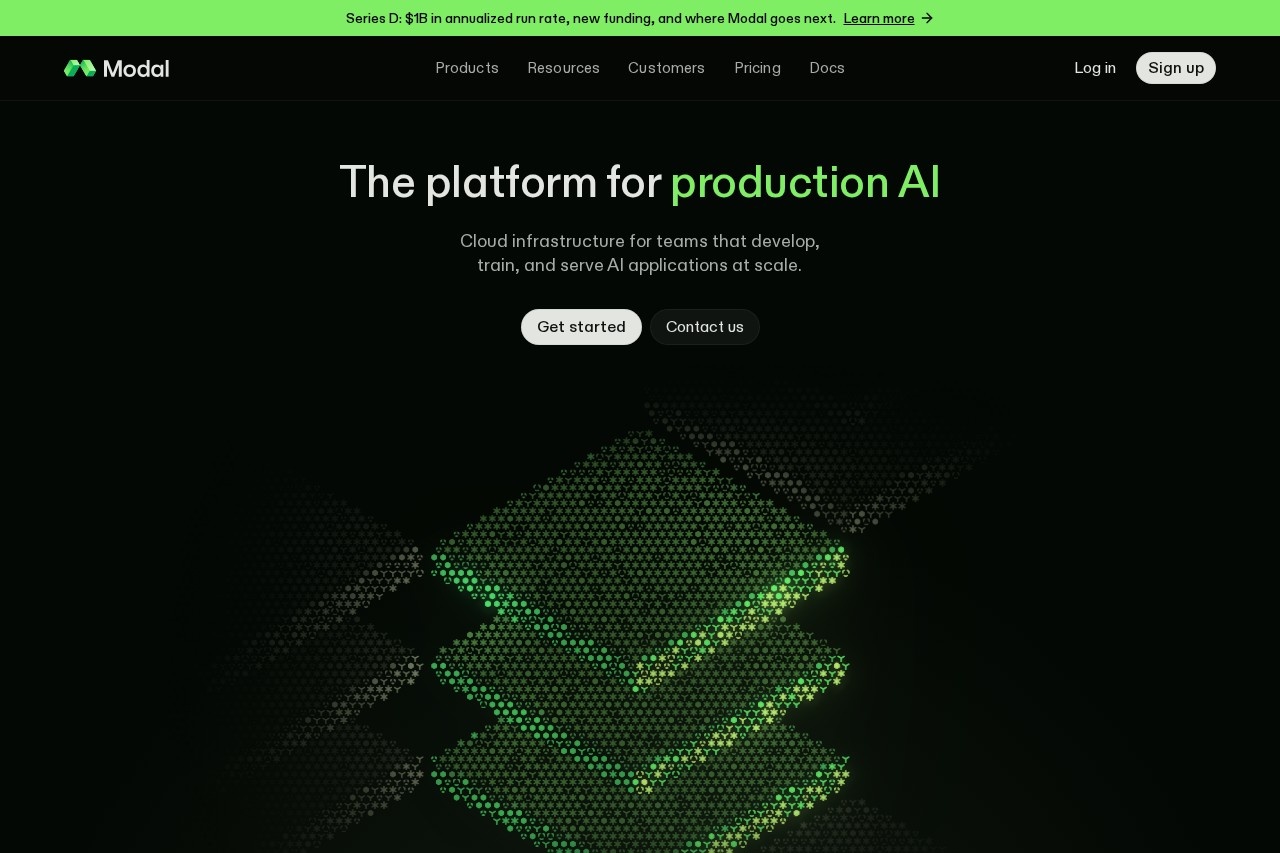
Modal is a cloud infrastructure platform for teams that develop, train, and serve AI applications at scale. It addresses a common problem in machine learning engineering: provisioning GPUs, managing clusters, and keeping inference endpoints running usually requires dedicated infrastructure work that slows down development.
Modal lets engineers write code that runs in the cloud with minimal configuration. Containers boot in seconds, scale to zero when idle, and users are billed only for actual compute time, by the second. The platform is built around primitives such as Functions for serverless compute, Sandboxes for running untrusted code and agent workloads, and Servers for low-latency LLM inference. Modal, made by Modal Labs, offers official SDKs in Python, Go, and JavaScript/TypeScript, plus a CLI, and draws on capacity from more than 20 clouds across many global regions.
Key Features
Pricing & Fees
- Pricing: Usage-based, billed per second. GPU prices range from $0.000164/second (Nvidia T4) to $0.001972/second (Nvidia B300); CPU is $0.0000131 per core per second; memory is $0.00000222 per GiB per second; volumes are $0.09 per GiB per month; network egress is $0.04 per GiB.
- Plans: Starter is free with $30/month in credits, 3 seats, and 10 GPU concurrency; Team is $250/month plus compute with $100/month in credits, unlimited seats, and 50 GPU concurrency; Enterprise is custom-priced with volume discounts.
- Free tier: The Starter plan requires no monthly fee and includes recurring free credits, so users can try the platform at no upfront cost.
- SDKs and tooling: Official SDKs in Python, Go, and JavaScript/TypeScript, a CLI, and a browser-based Playground for exploring the platform.
Who It's For
Modal is aimed at AI and machine learning engineers, infrastructure teams, and researchers who need to run compute-heavy workloads without managing servers. Typical users include teams serving LLM or multimodal inference endpoints, researchers fine-tuning models or running reinforcement-learning rollouts, developers building coding agents that need secure sandboxed execution, and data teams running large parallel batch jobs. It also suits startups and enterprises that want per-second billing and autoscaling to zero instead of maintaining reserved GPU clusters.
FAQ
What is Modal?Modal is a serverless cloud platform for running AI workloads, including model inference, fine-tuning and reinforcement learning, parallel batch compute, and sandboxed execution for coding agents and untrusted code.
Is there a free plan for Modal?Yes. The Starter plan costs $0 per month plus compute and includes $30 per month in free credits, with 3 workspace seats and 10 GPU concurrency.
Which programming languages and tools does Modal support?Modal provides official SDKs in Python, Go, and JavaScript/TypeScript, along with a fully featured CLI and a browser-based Playground.
How does Modal pricing work?Modal bills by the second for actual compute used, with no charge for idle resources; for example, an Nvidia H100 SXM5 costs $0.001097 per second, and CPU costs $0.0000131 per core per second.
How does Modal handle security and isolation?Modal provides workload isolation by design, configurable network and endpoint access, and audit logs, and Sandboxes are designed specifically for running untrusted code safely.
Related Tutorials
View all →
Related Tools
View all → OpenRouter OpenRouter is a unified, OpenAI-compatible API that gives developers pay-as-you-go access to 500+ AI models for text, image, video, and audio from 80+ providers.
 Llama Llama 4 is a powerful AI model family with Scout and Maverick versions. Experience advanced AI capabilities.
 LangChain LangChain provides a comprehensive suite of products to support developers throughout their entire development workflow.
 Hugging Face Hugging Face is an open community platform where machine learning practitioners host, discover, and collaborate on over two million models, datasets, and AI applications.
 LibreChat An open-source chat interface for 2025, offering flexible and customizable AI conversations.