
Kagi Search is a paid, ad-free search engine that blocks trackers, lets users customize results, and offers private AI, translation, and summarization tools.
About
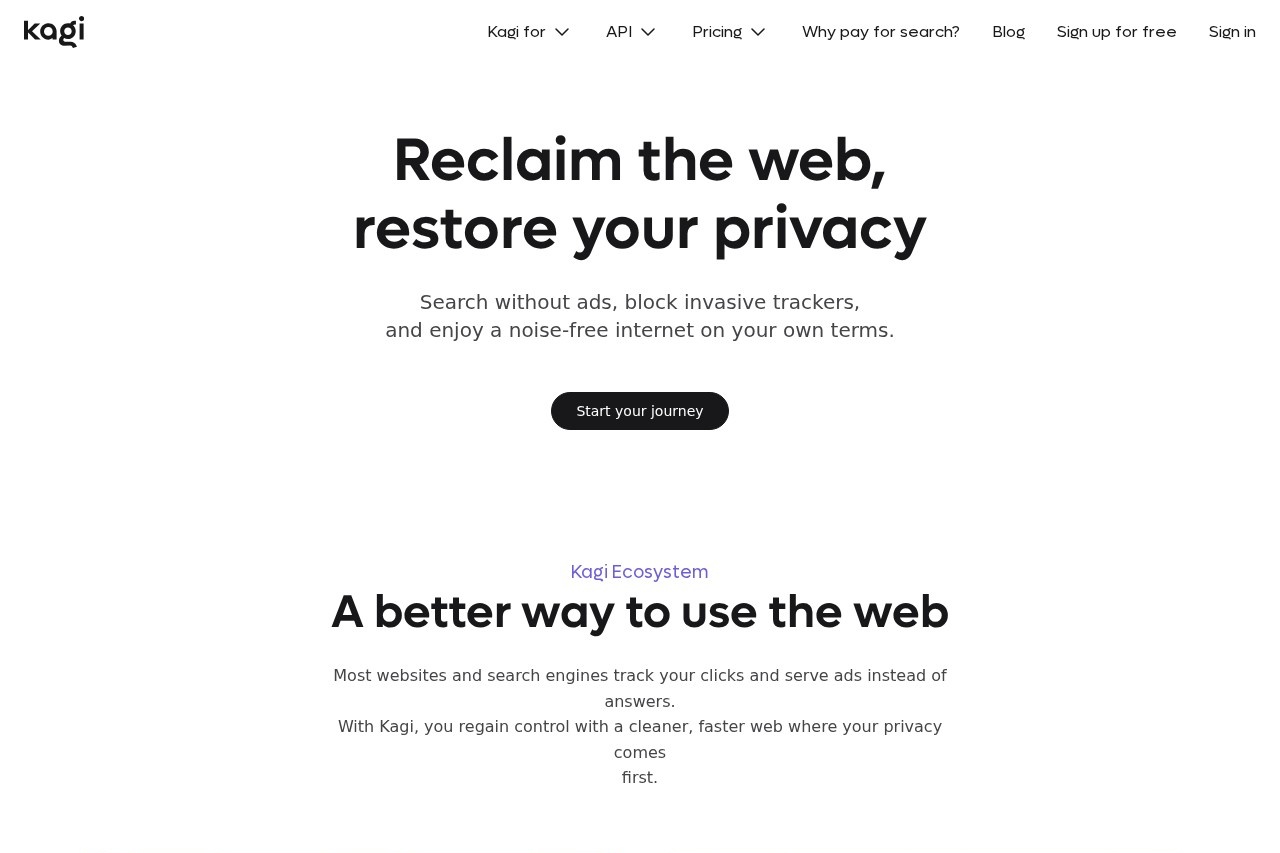
Kagi Search is a subscription-funded web search engine that removes advertisements and trackers from search results. It addresses a common frustration with mainstream search engines: ads mixed into results, click-driven rankings, and constant tracking of user behavior. Kagi instead answers to paying subscribers, which aligns its incentives with result quality rather than ad revenue.
The service is part of a broader ecosystem from Kagi Inc. that includes Kagi Assistant (access to multiple AI language models grounded in Kagi search results), the Orion browser, Kagi Translate, Kagi News, and Kagi Summarize. Beyond consumer plans, Kagi offers options for teams and libraries, plus paid APIs for developers. Users can try search free of charge before committing to a paid subscription.
Key Features
Pricing & Fees
- Pricing: Consumer subscription pricing is not fully listed on the pages reviewed; Kagi's API pricing is published, with Search at $12 per 1,000 requests and Extract at $4 per 1,000 pages. Visit the official site for current plans.
- Free tier: Users can run up to 150 searches for free before subscribing, and Orion Browser, Kagi Translate, and the Small Web are available at no cost.
- Privacy: Kagi retains only the minimum data needed to run a subscription (email and payment details), never sells user data, and offers Privacy Pass tokens for anonymous subscription verification.
- AI data policy: Kagi does not use personal data or prompts to train AI models and does not sell data to third parties.
- Organizational plans: Dedicated offerings exist for teams and for libraries, including enterprise API terms with volume discounts and SLAs.
Who It's For
Kagi Search suits privacy-conscious professionals who want search results without ads or tracking, as well as researchers, students, and writers who value cleaner, more relevant results. Libraries can offer patrons distraction-free search, and teams can combine private search with access to AI models. Developers building applications that need real-time web results or clean page content can use Kagi's Search and Extract APIs. It also appeals to anyone frustrated with ad-heavy search engines who is willing to pay for a user-funded alternative.
FAQ
What is Kagi Search?Kagi Search is a subscription-based, ad-free search engine that blocks trackers and lets users customize and filter their results.
Is Kagi free to use?Yes, up to 150 searches are free; a paid subscription is required beyond that, while Orion Browser, Kagi Translate, and Small Web remain free.
How much does Kagi cost?Individual and family plans start at a low monthly rate, with full details on Kagi's pricing page; API usage costs $12 per 1,000 search requests and $4 per 1,000 extracted pages.
Does Kagi collect or sell my data?Kagi keeps only the data required to manage a subscription, never sells user information, does not build personal profiles, and keeps search history private.
How is Kagi different from using an ad blocker?Ad blockers hide visual ads but do not change rankings, whereas Kagi removes ads and adjusts its algorithm to return faster, more relevant results.
Related Tutorials
View all →
Related Tools
View all → AI Tool - AI-Powered Solutions This AI tool provides intelligent solutions to streamline workflows, enhance productivity, and deliver accurate results across various tasks.
 OmniRoute - Free AI Gateway for Multi-Provider LLMs Free, open-source AI router with auto-fallback. 236 providers, one endpoint, 95 MCP tools, 17 routing strategies, A2A protocol, auto-combo engine, semantic cache, memory & skills. Deploy anywhere.
 wigolo - Local-First Web Intelligence for AI Agents wigolo provides local-first web intelligence for AI agents, covering 18+ data sources. It supports MCP, SDK, and REST APIs for seamless integration.
 Perplexity AI Perplexity AI is an answer engine that combines web search with large language models to deliver sourced, up-to-date answers for researchers, professionals, and everyday users.
 Hermes Agent - Autonomous Problem Solver An autonomous agent that solves complex problems, powered by Nous Research.