
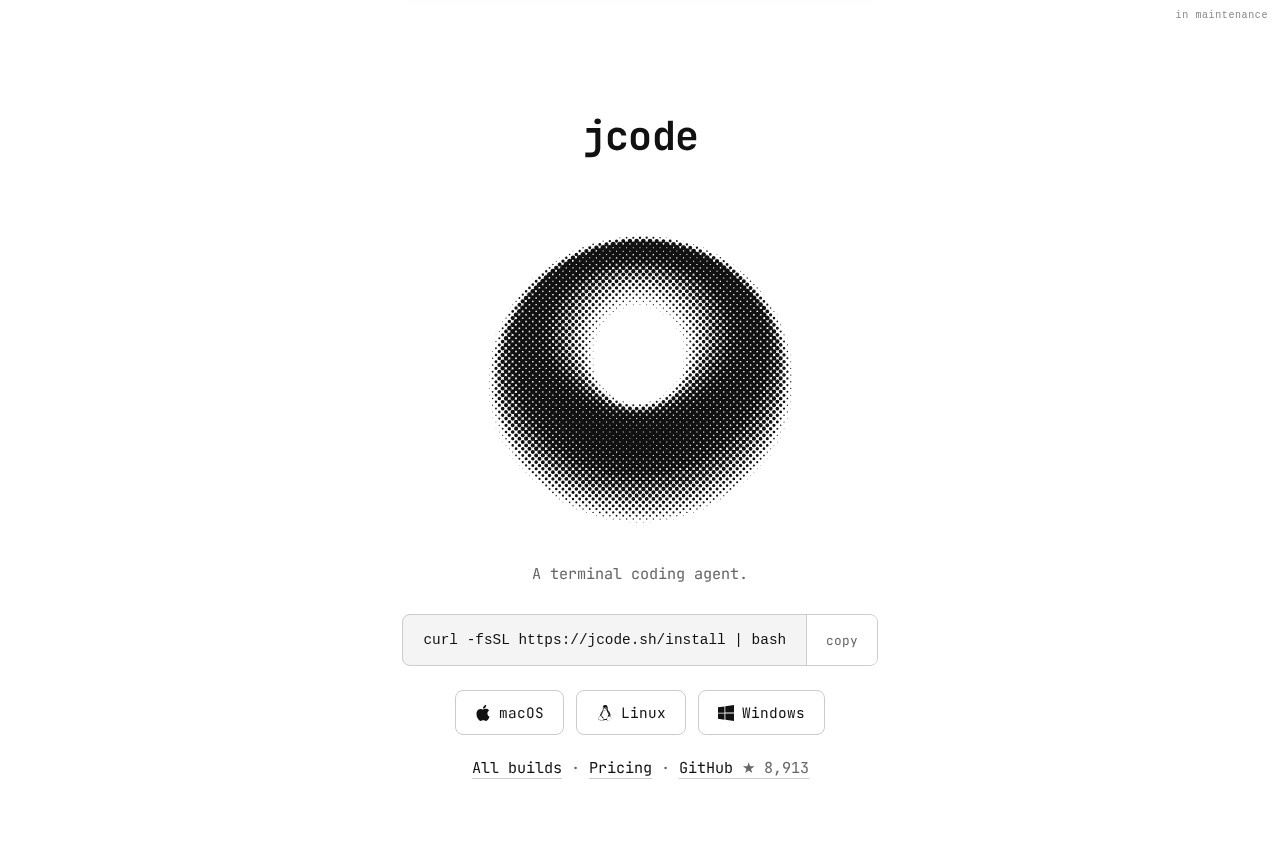
Jcode is an open-source AI coding agent for the terminal by Solo Systems. Fast, memory-equipped, with side panels, background tasks, and swarm coordination.
About
Jcode is an open-source AI coding agent developed by Solo Systems, purpose-built for the terminal environment. It goes far beyond simple code completion, functioning as an intelligent assistant that can independently understand, plan, and execute coding tasks. Equipped with long-term memory, side panels, background task support, and multi-agent swarm coordination, jcode enables developers to complete everything from code generation to project maintenance without ever leaving the command line. As a fully open-source product, jcode gives developers a high degree of control and customization, making it a powerful tool for boosting coding productivity.
Key Features
Pricing & Fees
- Pricing: Monthly token plans from $10 to $1,000; each plan grants double its price in inference credit (e.g., $20 of credit on the $10 plan) plus Jcode Cloud access. The agent itself is open source and free to self-run with your own models.
- Free use: The open-source agent can be used at no cost if you bring your own model API keys; hosted inference and cloud features are optional paid extras.
- Free trial: The first month of the $20 plan is free and includes 5,000 remote Rust builds; a card is required and it renews at $20/month unless canceled. Inference credit starts with the first paid month.
- Plan details: Every $10 of plan value includes 50 Jcode Cloud machine hours per month; remote Rust builds start at the $20 plan (2,500 builds per $10, so $20 gets 5,000/month). Extra builds cost $0.10 each.
- Billing quirks: Monthly credit does not accumulate, and inference beyond credit is billed at provider API prices only if you raise the extra usage limit, which defaults to $0 per month.
Who It's For
Jcode is ideal for independent developers who want to cut down on repetitive coding work and focus on core logic; full-stack engineers juggling frontend, backend, and database modules who need parallel task handling; open-source contributors who need help with code review, test generation, and documentation maintenance on large projects; and DevOps engineers who can leverage background tasks and swarm coordination to automate deployment, monitoring, and infrastructure management workflows.
Related Tutorials
View all →
Related Tools
View all → DeepSeek V4.1 Flash DeepSeek V4.1 Flash is DeepSeek's new-generation flagship: a 552B MoE with an asymmetric CED architecture offering native vision, 1M-token context and V4-Pro-beating performance at lower cost.
 Continue An AI coding assistant for VS Code and JetBrains IDE, boosting developer efficiency.
 OpenHands An AI-powered tool that automates tasks and enhances productivity with intelligent assistance.
 Cody - Sourcegraph AI Cody by Sourcegraph is an AI coding assistant that provides contextual code intelligence.
 Code Snippets AI Code Snippets AI helps developers generate and manage code snippets with AI assistance.