
PageIndex is a vectorless, reasoning-based RAG engine that mirrors how humans read documents. Achieve 98.7% accuracy on FinanceBench with traceable, explainable retrieval.
About
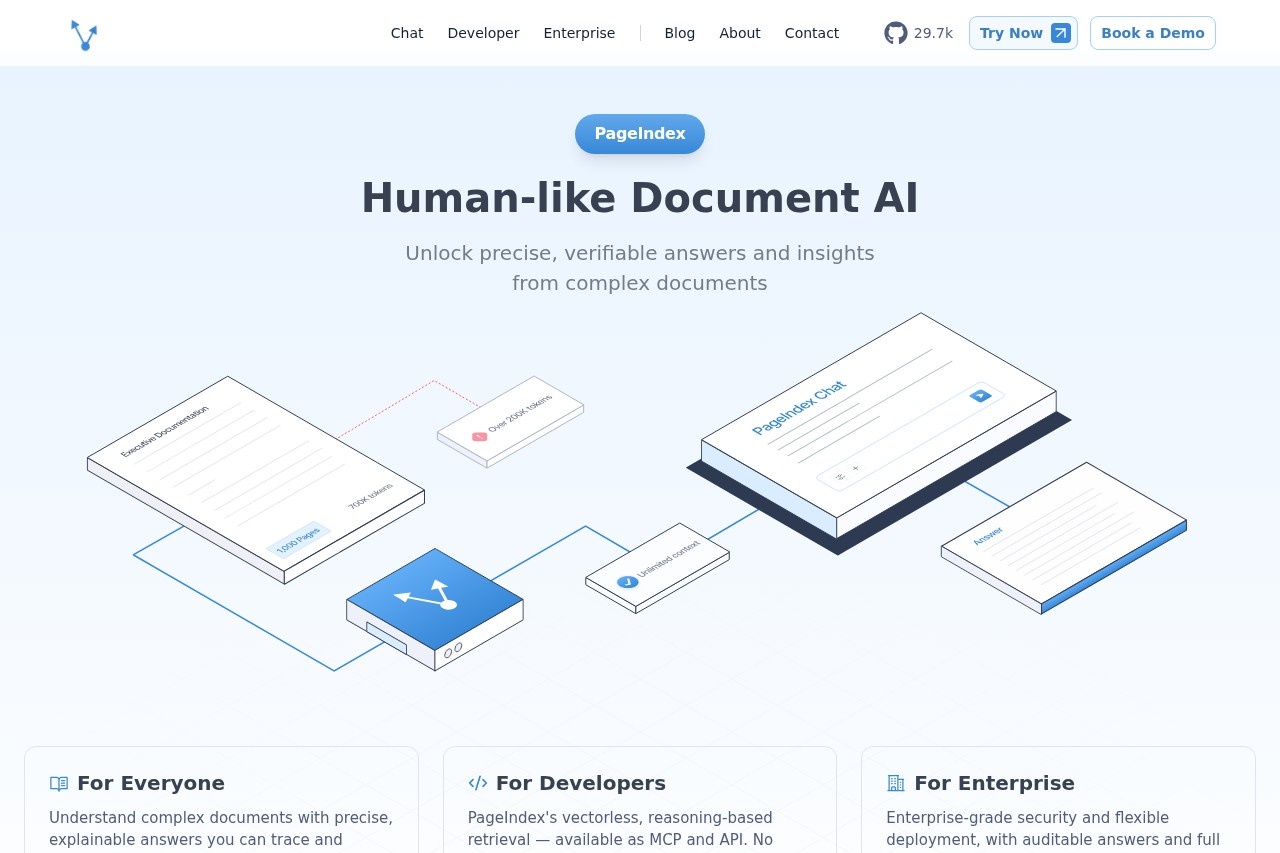
In an age of information overload, processing long documents—such as financial reports, legal contracts, or academic papers—often demands significant time and effort. Traditional retrieval-augmented generation (RAG) techniques can assist with comprehension, but they frequently rely on vector embeddings that break contextual connections, leading to fragmented and inaccurate answers. PageIndex was created to solve this problem. It is a groundbreaking vectorless, reasoning-based RAG engine designed to mirror the way humans read and understand documents. By following a unique "understand first, retrieve second" approach, PageIndex achieves 98.7% accuracy on the FinanceBench benchmark, delivering not only precise answers but also ensuring that every retrieval step is clearly traceable. This makes intelligent document understanding genuinely reliable and explainable.
Key Features
Pricing & Fees
- Pricing: Not publicly listed on the pages we reviewed; check the official site for current plans.
- Access options: Available as a hosted Chat app, a Developer dashboard with self-serve signup and API key management, and a REST API with a Python SDK and MCP server for integration.
- Open-source component: PageIndex Flash, a fast tree-indexing tool, is offered as open source.
- Deployment footprint: The engine is vectorless, so no vector database or chunking infrastructure is required, which can lower deployment costs.
- Demo available: Enterprises can request a demo via the official site for tailored onboarding.
Who It's For
Financial analysts and auditors can quickly extract key data from prospectuses and financial statements while ensuring accurate citations, boosting the efficiency of due diligence and report writing. Legal and compliance professionals can precisely interpret contract clauses and regulatory documents with automatic cross-reference linking, reducing the risk of oversight in manual review. Researchers and academic editors can efficiently navigate paper reviews and experimental methods, using traceable retrieval to support literature analysis and peer review. Enterprise knowledge management teams can turn massive internal document repositories into intelligent Q&A systems, empowering employees with self-service search and reducing repetitive support work.
Related Tutorials
View all →
Related Tools
View all → OmniRoute - Free AI Gateway for Multi-Provider LLMs Free, open-source AI router with auto-fallback. 236 providers, one endpoint, 95 MCP tools, 17 routing strategies, A2A protocol, auto-combo engine, semantic cache, memory & skills. Deploy anywhere.
 wigolo - Local-First Web Intelligence for AI Agents wigolo provides local-first web intelligence for AI agents, covering 18+ data sources. It supports MCP, SDK, and REST APIs for seamless integration.
 Perplexity AI Perplexity AI is an answer engine that combines web search with large language models to deliver sourced, up-to-date answers for researchers, professionals, and everyday users.
 PaddleOCR: The Ultimate Document Solution A powerful OCR tool for accurate text extraction from documents and images.
 Hermes Agent - Autonomous Problem Solver An autonomous agent that solves complex problems, powered by Nous Research.