
Hippocratic AI provides AI-powered healthcare solutions, offering personalized patient care and clinical support.
About
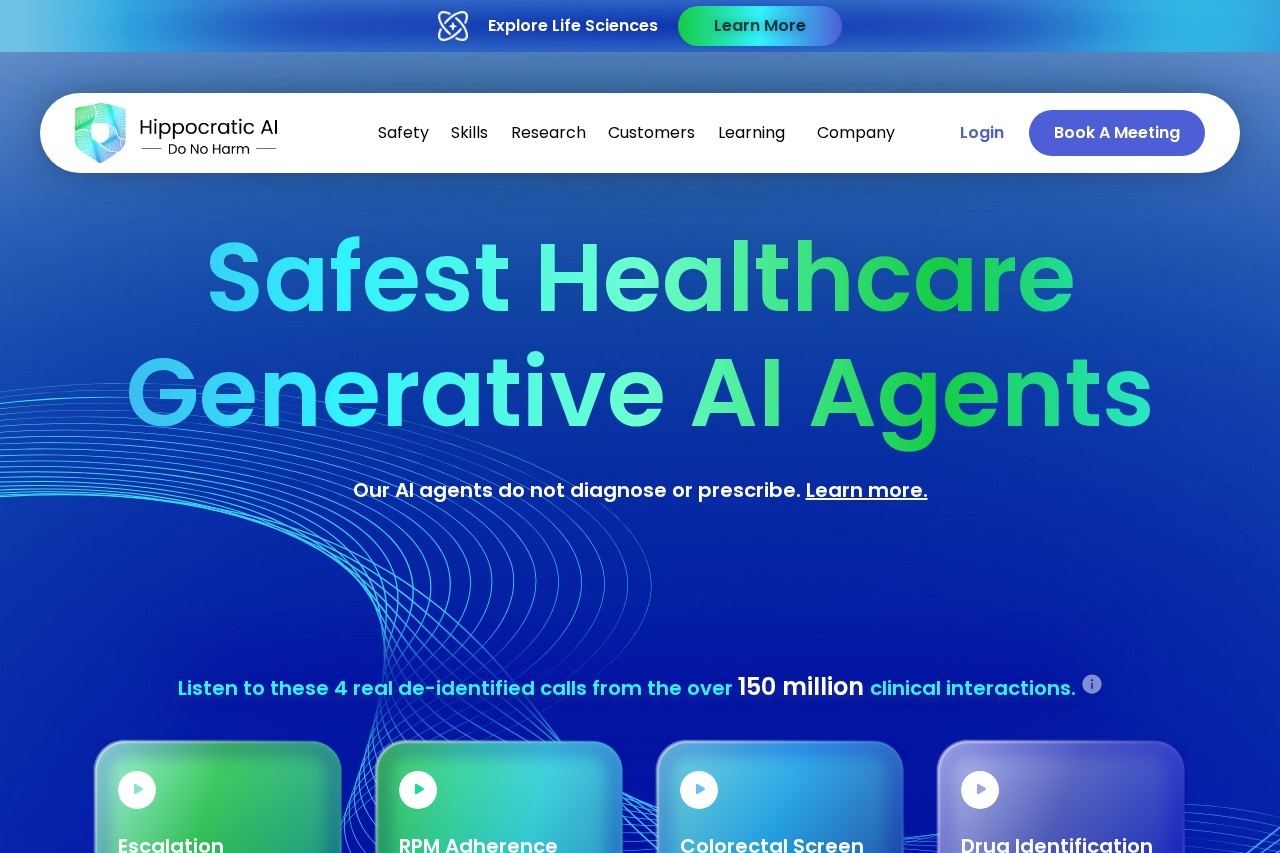
In the healthcare industry, safety and assistance are the core principles guiding the use of technology. Hippocratic AI was created with this exact focus in mind—it is a generative AI agent built specifically for medical and health-related scenarios. It is not designed to replace healthcare professionals, but rather to serve as a powerful safety net and supportive tool that improves the accessibility and efficiency of healthcare services while keeping patient safety as the top priority.
Key Features
Pricing & Fees
- Safety-first design philosophy: Every interaction operates within strict safety guardrails, preventing the delivery of harmful or misleading medical advice.
- A bridge between patients and professionals: Hippocratic AI acts as a smart "front-end filter" and connector between users and the formal healthcare system, optimizing the allocation of human resources.
- 24/7 availability: It offers round-the-clock initial health consultations and companionship, helping to ease anxiety in non-urgent situations.
- Reduced burden on medical staff: By handling a high volume of routine and repetitive inquiries, it allows clinicians and nurses to focus on complex cases that require professional judgment and human compassion.
Who It's For
Hippocratic AI is designed for a wide range of users and settings. It is ideal for individuals seeking preliminary health information who want a reliable understanding of their symptoms and access to trustworthy care guidance. It also supports chronic disease patients in daily management, serving as a tool for basic queries about medication, lifestyle, and health monitoring. Hospitals, clinics, and senior care facilities can use it as an online front-line assistant to efficiently triage patient inquiries. Additionally, health-conscious individuals can turn to it for education on disease prevention and health promotion. In all cases, it complements—not replaces—the professional healthcare system.
Related Tutorials
View all →.webp)
Related Tools
View all → AI Tool - AI-Powered Solutions This AI tool provides intelligent solutions to streamline workflows, enhance productivity, and deliver accurate results across various tasks.
  OpenMed - Clinical AI that never leaves the device OpenMed 1.5.5 runs clinical AI on-device for privacy. Supports PII MLX, PyTorch/MLX, Faker, 1000+ LLMs, Swift, and OpenMedKit. Apache-2.0.
  DeepEval by Confident AI - LLM Evaluation Framework Open-source LLM evaluation framework with 50+ plug-and-play metrics for AI agents, RAG, chatbots, and more.
  Hallmark - AI-Powered Greeting Cards Hallmark uses AI to help you create personalized greeting cards. It leverages AI to generate messages and designs, powered by Together AI.
  CrushOn.AI - NSFW AI Chat Engage in uncensored AI conversations with CrushOn.AI. Explore a wide range of topics in a safe, private environment.