
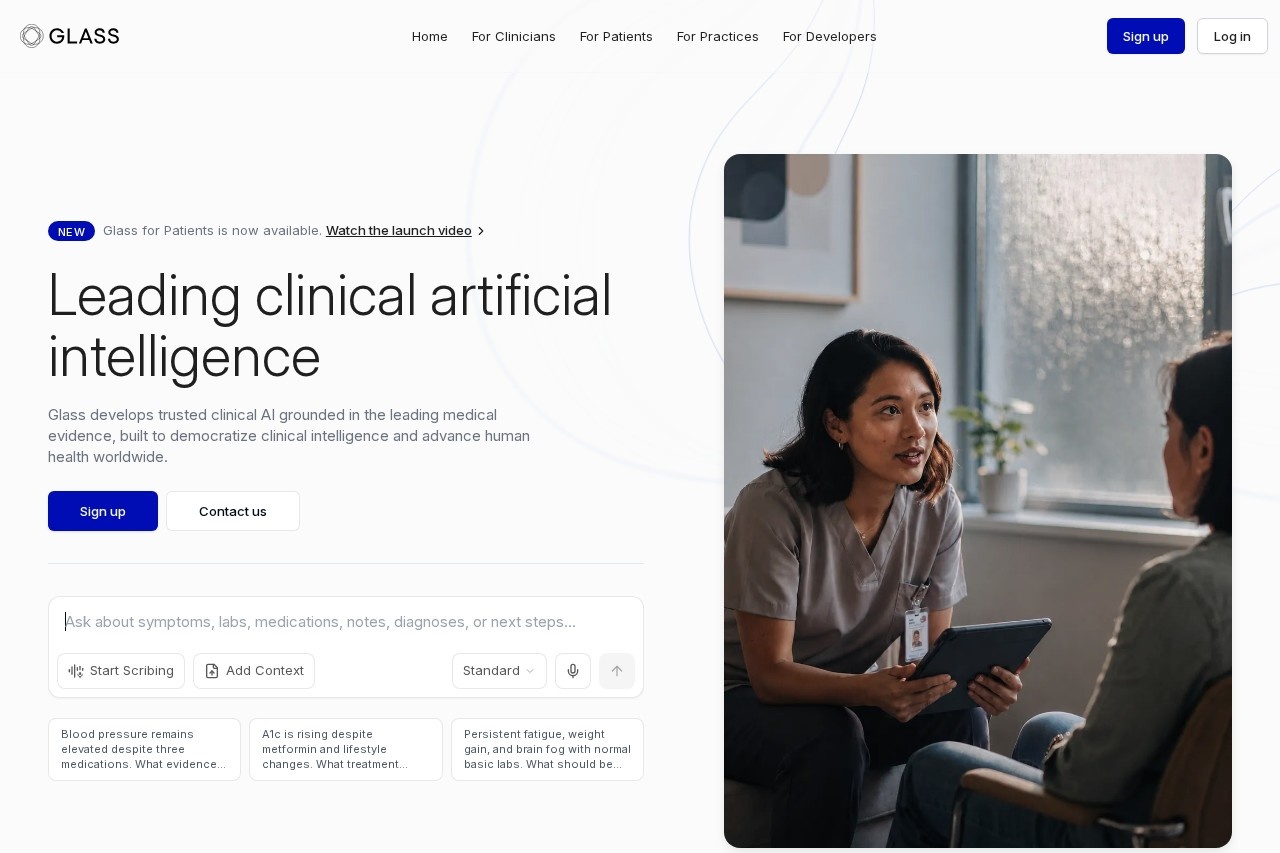
Glass (Glass.health) is a clinical AI assistant grounded in current medical evidence, built to support clinicians and patients with trusted clinical intelligence.
About
Glass, available at glass.health, is a healthcare AI platform that the company describes as "frontier clinical intelligence for everyone." It aims to make clinically grounded artificial intelligence widely accessible, so that medical knowledge and decision support are not limited to large institutions. The product is positioned around a simple idea: clinical AI should be grounded in leading medical evidence and trustworthy enough to support real-world health decisions.
According to its official site, Glass is built to democratize clinical intelligence and advance human health worldwide. The platform combines language-model technology with medical evidence sources, an approach intended to reduce the risk of unsupported or inaccurate medical output. Because the publicly available detail about its specific features is limited, this overview focuses on what the vendor states directly on its homepage; readers should treat feature specifics as unverified until confirmed on the official site.
Key Features
Pricing & Fees
- Pricing: Not publicly listed on the pages we reviewed; check the official site for current plans.
- Feature detail: The public site reviewed provided only a high-level description, so specific capabilities, supported specialties, and workflows should be confirmed directly with the vendor.
- Intended audience: The vendor's language indicates it targets both clinicians and the broader public interested in clinical intelligence.
Who It's For
Glass is aimed at healthcare professionals such as physicians, nurses, and medical trainees who want evidence-grounded AI support for clinical questions. Its emphasis on accessibility also suggests use by health educators, students, and members of the public seeking medically grounded information. Organizations exploring clinical AI adoption may find it relevant as well. Because detailed feature and pricing information is not publicly listed on the pages reviewed, prospective users should verify capabilities, regulatory status, and terms directly on glass.health before relying on it for care-related work.
FAQ
What is Glass.health?Glass is a clinical AI platform that describes itself as frontier clinical intelligence for everyone, grounded in leading medical evidence and intended to make trusted clinical intelligence widely accessible.
Is Glass free to use?Pricing is not publicly listed on the pages we reviewed; the official site should be checked for current plans and any free options.
Who is Glass designed for?The vendor positions it for clinicians and the broader public, with the stated goal of democratizing clinical intelligence and advancing human health.
How is Glass different from a general AI chatbot?According to its own description, Glass grounds its output in leading medical evidence rather than functioning as an unrestricted general-purpose assistant.
Can Glass replace a doctor?No. Glass is a support tool, and nothing on its public materials suggests it substitutes for professional medical diagnosis or treatment; users should consult qualified clinicians for care decisions.
Related Tutorials
View all →
Related Tools
View all → Ubie Ubie is a free AI-powered symptom checker that helps people in Japan find possible conditions, care guidance, and suitable medical departments or nearby clinics from their symptoms.
 Dr.Oracle Dr.Oracle is a medical AI assistant that answers complex clinical questions with guideline-directed responses and citations for physicians and medical students.
 Doctronic Doctronic is a free AI doctor chat that assesses symptoms 24/7 and connects users to licensed physicians for $39 video visits and prescriptions in all 50 US states.
 OpenEvidence - AI Medical Search OpenEvidence is an AI-powered medical search engine that provides evidence-based answers to clinical questions, helping healthcare professionals make informed decisions quickly.
 Baichuan-M3-Plus - Multilingual AI Baichuan-M3-Plus is a multilingual AI model supporting multiple languages. It excels in translation, summarization, and cross-lingual tasks.