
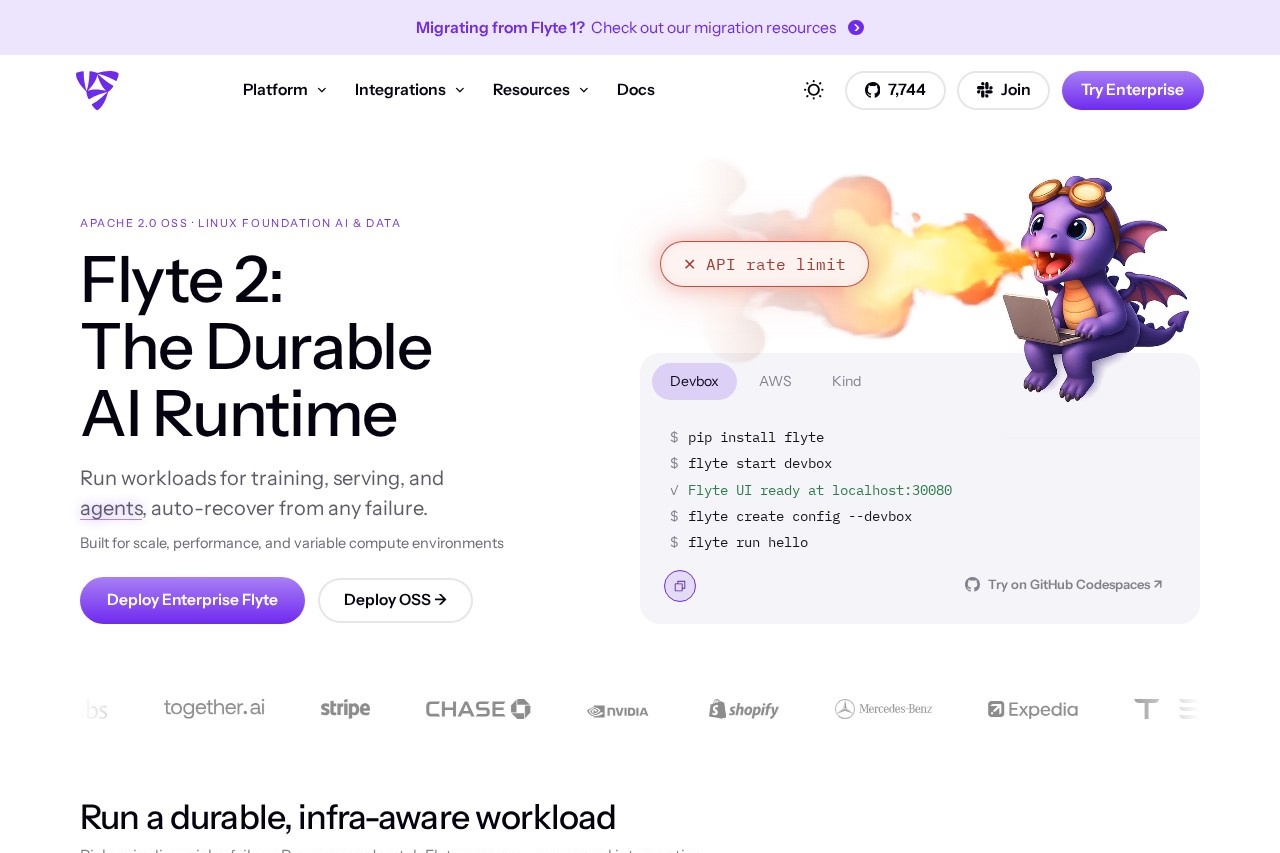
Flyte is an open source, Apache 2.0 durable AI runtime that orchestrates training, serving, and agent workloads in Python while automatically recovering from infrastructure and code failures.
About
Flyte is an open source runtime for building and running AI workloads — batch inference, fine-tuning, pretraining, reinforcement learning, and agent loops — with automatic recovery from both infrastructure failures and code errors. It addresses a common pain point in machine learning pipelines: when one step fails, the whole job often has to be rerun, wasting compute and time. Flyte records input and output for every step so execution resumes from the failed task instead of restarting the pipeline.
The project is licensed under Apache 2.0 and governed under the Linux Foundation AI & Data initiative. Developers define workflows as ordinary code using language-native SDKs (Python, TypeScript, Rust, Go, and Mojo), with a TaskEnvironment construct declaring images, resources, secrets, and retry policy. The same code can run locally, on a dev environment, or on a production cluster. Union.ai offers a managed enterprise distribution of Flyte for teams that want a hosted platform.
Key Features
Pricing & Fees
- Pricing: Flyte itself is free and open source under the Apache 2.0 license; enterprise plans through Union.ai are not publicly listed on the pages we reviewed, so check the official site for current terms.
- License and governance: Apache 2.0 licensed, with open governance under Linux Foundation AI & Data.
- Interactive environments: Flyte Devbox and a GitHub Codespaces option let developers try the platform quickly, with harness support for tools like Claude Code, Codex CLI, and OpenCode.
- Documented production users: Case studies on the official site describe usage at Spotify (financial forecasting pipelines), Wayve (petabyte-scale vision workloads for autonomous driving R&D), and Cradle (ML pipelines for protein design).
- Migration support: Dedicated migration resources exist for teams moving from Flyte 1 to Flyte 2.
Who It's For
Flyte is aimed at machine learning engineers, platform teams, and researchers who run training, batch inference, or agent workloads on variable or spot compute and need pipelines that survive failures. Typical use cases include fine-tuning and pretraining jobs, distributed training with Ray or PyTorch, warehouse queries against BigQuery or Snowflake, and serving LLM endpoints with vLLM or SGLang. It suits organizations that want reproducible, resumable pipelines and observability across experiment and production stages, as well as teams building agent systems that require tracing of every LLM call.
FAQ
What is Flyte?Flyte is an open source, Apache 2.0 durable AI runtime for orchestrating training, serving, and agent workloads, designed to recover automatically from infrastructure and code failures.
Is Flyte free to use?Yes, the open source project is free under the Apache 2.0 license; a managed enterprise offering is available separately through Union.ai, whose pricing is not publicly listed on the pages reviewed.
Which languages and integrations does Flyte support?Flyte provides SDKs for Python, TypeScript, Rust, Go, and Mojo, and integrates with Apache Spark, Ray, PyTorch Elastic, BigQuery, Snowflake, Weights & Biases, MLflow, vLLM, SGLang, LangGraph, CrewAI, and more via official and community plug-ins.
How does Flyte handle failures?It retries failed tasks with their original inputs, backs off on errors such as API rate limits according to a configured retry strategy, resubmits tasks after infrastructure failures, and resumes from the failed step instead of rerunning the whole pipeline.
Who uses Flyte in production?The official site documents case studies from Spotify, Wayve, and Criddle's domain of generative biology — specifically Spotify for financial forecasting, Wayve for autonomous driving research, and Cradle for protein-design machine learning.
Related Tutorials
View all →
Related Tools
View all → DKnownAI Guard DKnownAI Guard is a security API for AI agents that detects prompt injection, jailbreak, and agent hijacking attempts and classifies each request into four risk levels.
 Exa Exa is a web search API and research platform that gives AI agents real-time access to web pages, structured company and people data, and deep research results.
 Composio Composio is an integration platform that gives AI agents and LLMs secure access to 1,500+ apps, with managed authentication, tool execution, skills, and enterprise governance controls.
 Pinecone Pinecone is a fully managed vector database and AI knowledge platform that gives AI agents fast, accurate retrieval over enterprise data at predictable cost.
 Encord Encord is a multimodal data platform that helps AI teams manage, curate, annotate, and evaluate training data for physical AI and enterprise machine learning applications.