
Felo is a free multilingual AI search and creation platform that answers questions across languages and generates slides, mind maps, documents, images, and webpages.
About
Felo is an AI search and creation platform built by Felo Inc. that combines question answering with content generation. It addresses a common research bottleneck: users often need answers that draw on sources in multiple languages, and then want to turn those answers into usable outputs such as presentations, documents, or images without switching between separate tools.
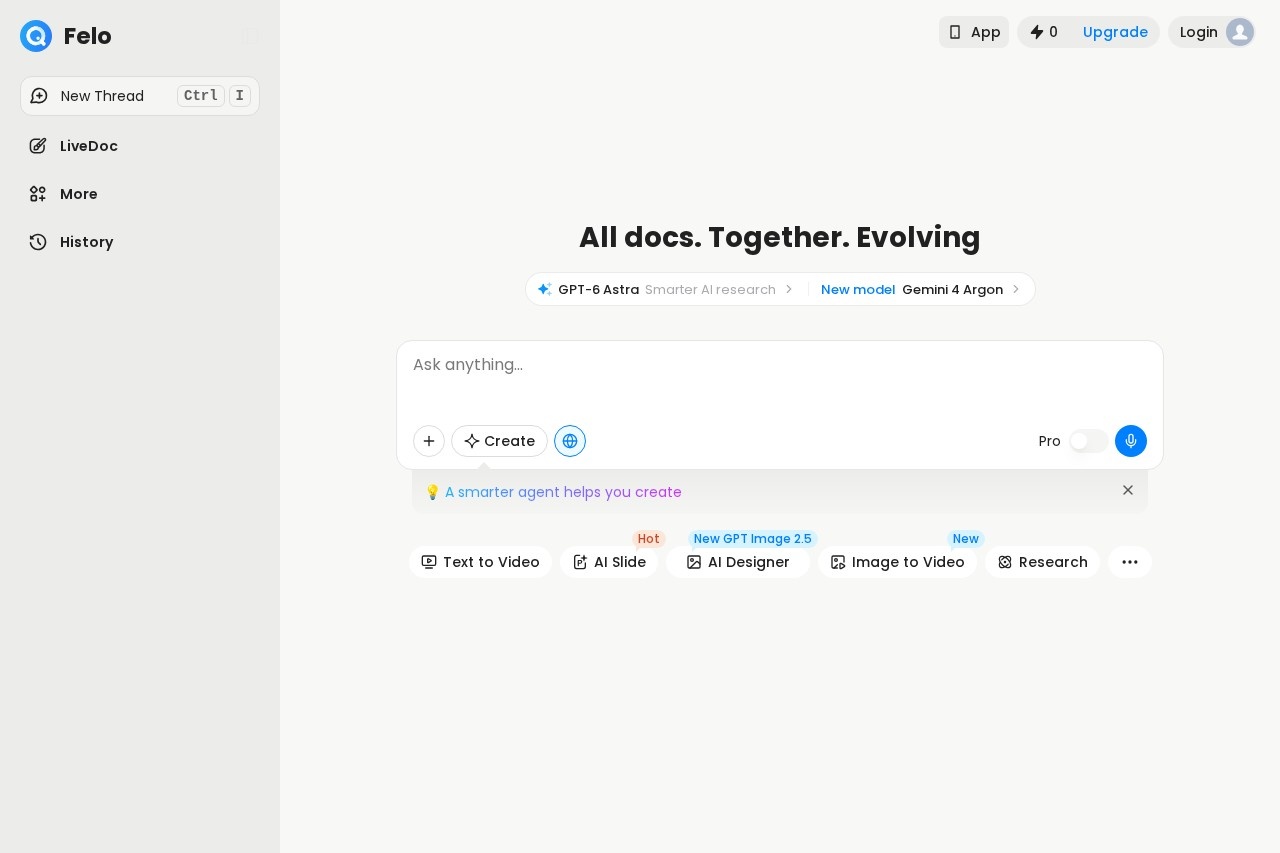
At a high level, Felo works as an AI search engine that accepts natural-language questions, supports searching across languages, and returns answers users can then transform into slides, mind maps, documents, images, and webpages. The platform positions itself as free to start, with an upgrade option, and its site is offered in many languages including English, Japanese, Korean, Chinese, Russian, French, Spanish, German, Arabic, and Portuguese, reflecting its multilingual focus.
Key Features
Pricing & Fees
- Pricing: Not publicly listed on the pages we reviewed; check the official site for current plans.
- Free access: Felo presents itself as a free platform and shows an "Upgrade" option on its site, consistent with a freemium model.
- Language support: The interface and search experience support a wide range of languages, from English and Japanese to Arabic, Hebrew, Thai, and Indonesian.
- Developer access: An API and an LLM Playground are listed among the platform's tools.
Who It's For
Felo suits students and researchers who need multilingual answers they can convert into structured outputs such as slides, mind maps, and documents. Content creators and marketers can use it to draft material, generate images and webpages, and apply the listed SEO automation tools. Professionals working across languages, for example those comparing sources in Japanese, Chinese, and English, are a natural fit, as are developers interested in the API and agent capabilities for building workflows on top of the platform.
FAQ
What is Felo?Felo is a free multilingual AI search and creation platform from Felo Inc. that answers questions across languages and generates slides, mind maps, documents, images, and webpages.
Is Felo free to use?Felo presents itself as a free platform and displays an upgrade option, which suggests paid plans exist; specific prices are not publicly listed on the pages reviewed.
Which languages does Felo support?The site is available in numerous languages including English, Japanese, Korean, Simplified and Traditional Chinese, Russian, Hebrew, Arabic, French, Spanish, German, Thai, Portuguese, Polish, Italian, Turkish, Vietnamese, and Indonesian.
Does Felo offer an API?Yes, the platform's site lists an API alongside an LLM Playground and an Agent tool, indicating developer-facing options.
What can you create with Felo?Users can generate slides, mind maps, documents, images, and webpages from their questions or research results.
Related Tutorials
View all →
Related Tools
View all → OmniRoute - Free AI Gateway for Multi-Provider LLMs Free, open-source AI router with auto-fallback. 236 providers, one endpoint, 95 MCP tools, 17 routing strategies, A2A protocol, auto-combo engine, semantic cache, memory & skills. Deploy anywhere.
 wigolo - Local-First Web Intelligence for AI Agents wigolo provides local-first web intelligence for AI agents, covering 18+ data sources. It supports MCP, SDK, and REST APIs for seamless integration.
 Hermes Agent - Autonomous Problem Solver An autonomous agent that solves complex problems, powered by Nous Research.
 K-Dense Web | Research. Analyze. Synthesize. K-Dense Web is an AI agent that autonomously executes complex tasks across science, engineering, healthcare, finance, and beyond. From question to insight, problem to solution.
 Floatboat Floatboat is the first AI workspace designed for one-person companies, offering out-of-the-box 'Lobster Mode' and AI team collaboration powered by Tacit Engine.