
EverOS by EverMind is a memory operating system that gives AI agents persistent, self-evolving long-term memory across sessions, users, and platforms via API.
About
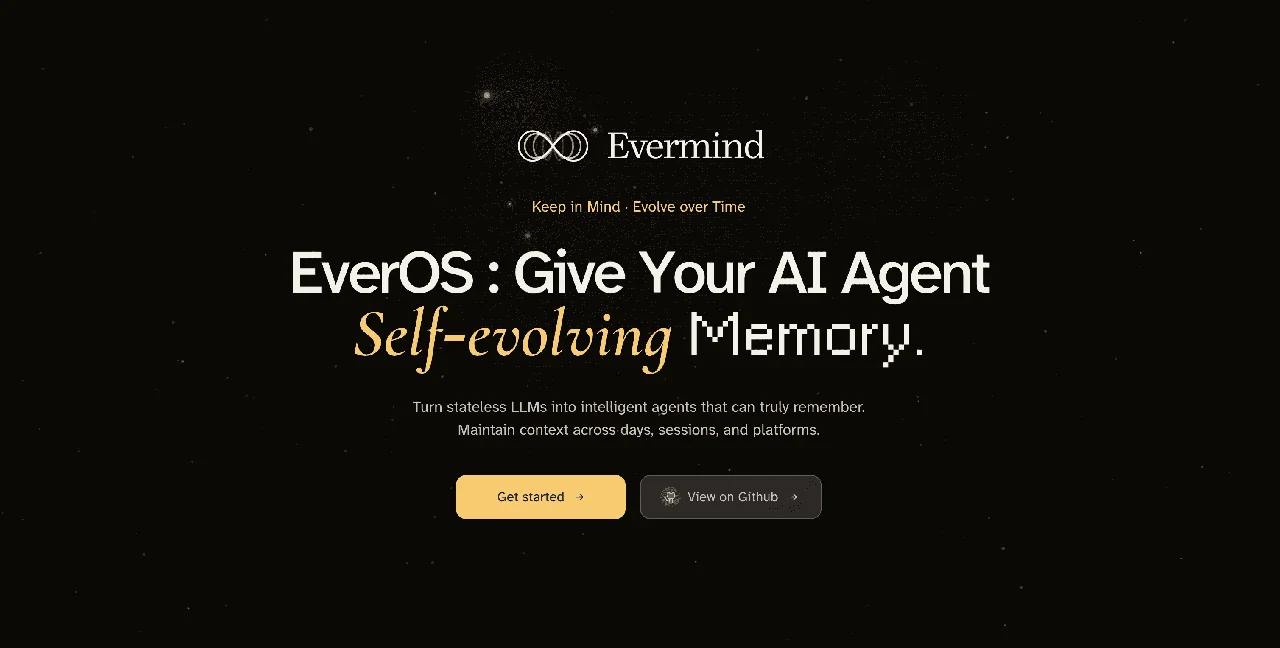
EverOS, developed by EverMind, is a memory operating system that adds persistent, structured long-term memory to large language model agents. Standard LLMs are stateless: once a conversation ends or a context window fills, prior interactions are lost, so users must repeat themselves and agents cannot learn from experience. EverOS addresses this by extracting, organizing, and retrieving memories automatically so an agent maintains consistent context across days, sessions, and platforms.
At a technical level, EverOS segments conversations into units the company calls MemCells — containing an episode, atomic facts, foresight, and metadata — and clusters them into thematic MemScenes. Developers integrate it with three API calls: adding messages, triggering memory extraction, and searching stored context. It supports four retrieval methods (keyword BM25, vector, hybrid, and agentic), works with any LLM since memory is model-agnostic, and is available both as a managed cloud service and as an Apache 2.0-licensed open-source project for self-hosting.
Key Features
Pricing & Fees
- Pricing: Not publicly listed on the pages we reviewed; check the official site for current plans. The site mentions a promotional offer giving EverOS Pro users 3X usage for 6 months.
- Open source availability: EverOS is released under the Apache 2.0 license on GitHub, so teams can self-host it on their own infrastructure for full data locality.
- Benchmarks: The vendor reports scores on public long-term memory benchmarks, including LoCoMo (93.05%, vs. 85.22% for Zep), LongMemEval (83.00%, vs. 77.80% for MemOS), and HaluMem (93.04%), with the benchmarks described as reproducible.
- Quick integration: Installation is via `pip install everos`, with a quickstart built around three API endpoints (add messages, flush extraction, search).
Who It's For
EverOS is aimed at developers and engineering teams building AI agents that need durable memory — including companion apps and personal assistants, customer support systems with cross-session history, educational and coaching agents, and long-lived enterprise agents. Teams coordinating multiple agents that must share knowledge across platforms will find the multi-agent namespace model relevant. It also suits organizations with strict data requirements, since the open-source version allows fully self-hosted deployment. A consumer product, EverMe, is in development for personal memory management.
FAQ
What is EverOS?EverOS is a memory operating system from EverMind that gives LLM-based agents persistent, structured, self-evolving memory across sessions, users, and platforms.
Is EverOS free?EverOS has an Apache 2.0-licensed open-source version that can be self-hosted at no license cost, plus a managed cloud service; full plan pricing is not publicly listed on the pages we reviewed, so check the official site for details.
Which models and data formats does EverOS support?It is model-agnostic, so the same memory base works regardless of the LLM used, and it can parse text, images, PDFs, audio, video, spreadsheets, presentations, emails, HTML, and URLs.
How does EverOS differ from standard RAG?Traditional RAG retrieves similar text chunks without deeper understanding or temporal tracking, whereas EverOS extracts structured facts, resolves conflicts, and distinguishes current information from outdated facts.
How does EverOS handle data privacy?Memory is namespaced by user_id and group_id so one user's memory is not accessible under a different scope, users can delete data individually or in bulk, and self-hosting via the open-source release keeps data on local infrastructure.
Related Tutorials
View all →
Related Tools
View all → AutoGen AutoGen simplifies the creation of multi-agent AI systems, providing tools for orchestration and collaboration.
 OnDemand OnDemand is a Platform as a Service (PaaS) built on RAG AI and intelligent agents, helping businesses integrate AI agents and data into their existing systems.
 OpenRouter OpenRouter is a unified, OpenAI-compatible API that gives developers pay-as-you-go access to 500+ AI models for text, image, video, and audio from 80+ providers.
 OmniRoute - Free AI Gateway for Multi-Provider LLMs Free, open-source AI router with auto-fallback. 236 providers, one endpoint, 95 MCP tools, 17 routing strategies, A2A protocol, auto-combo engine, semantic cache, memory & skills. Deploy anywhere.
 OpenHands Open-source, model-agnostic platform for building and deploying cloud coding agents. Automate real engineering work securely with full transparency and control.