
Deepgram Voice AI is a developer platform for speech-to-text, text-to-speech, and voice agents, offering real-time APIs for building enterprise conversational applications.
About
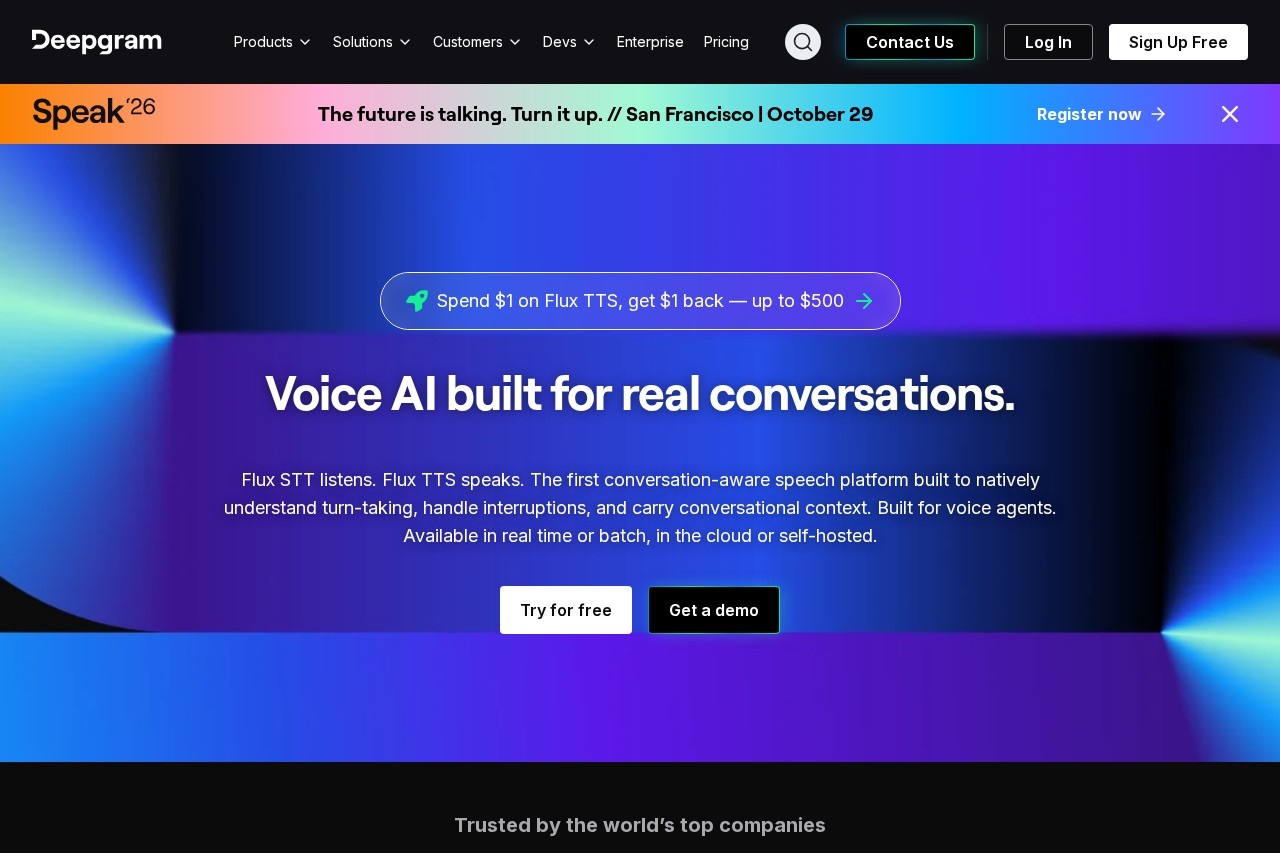
Deepgram Voice AI is a speech platform that gives developers APIs for speech-to-text (STT), text-to-speech (TTS), and voice agents. It is designed for applications that need to hold real conversations — handling turn-taking, interruptions, and conversational context — rather than simply converting audio to text.
The platform combines its recognition models (Flux and Nova-3), its Flux TTS voices, and a unified Voice Agent API that stitches transcription, LLM orchestration, and speech synthesis into a single WebSocket connection. Developers attach their own or a managed language model for reasoning; Deepgram handles the speech layer. It is available as a managed API with endpoints in the US, EU, and Australia, as well as in-VPC and self-hosted deployment options. Companies including Cloudflare, Twilio, Daily, Vapi, Sierra, and Granola publicly describe using Deepgram's APIs in their products.
Key Features
Pricing & Fees
- Pricing: Pay As You Go starts with $200 in free credit with no credit card required and no minimums or expiration; Growth plans are prepaid annual credits from $4K/year with savings up to 20%; the Voice Agent API is flat-rate from $4.50/hour. Enterprise pricing is by volume commitment through sales.
- Free access: Flux TTS was offered free through September 12th with up to 45 concurrent streaming connections in the US and 5 in the EU and Australia, per the site's promotion.
- Limitation: Flux models only work on the `/v2/listen` endpoint and are not compatible with `/v1/listen`.
- Scope: Deepgram provides the speech stack, not the reasoning LLM — developers connect a managed or bring-your-own LLM provider.
Who It's For
Deepgram targets developers and product teams building real-time voice applications: voicebot and AI assistant builders, contact center and CCaaS platforms, transcription products, and healthcare organizations that need HIPAA-compliant medical transcription. Typical use cases include transcribing recorded calls and meetings, live captioning, phone and drive-thru voice ordering, and end-to-end voice agents that listen, reason via an attached LLM, and speak back. Enterprises with specialized workflows can work with Deepgram on custom models and dedicated or self-hosted deployments.
FAQ
What is Deepgram Voice AI?It is a developer platform providing APIs for speech-to-text, text-to-speech, and voice agent orchestration, available as a managed cloud API, in-VPC, or self-hosted.
Does Deepgram offer a free plan?Yes. The Pay As You Go tier includes $200 in free credit, with no credit card required and no minimums or expiration.
Which speech models should I use?Use Flux when the application must detect end-of-turn and handle interruptions in live conversations; use Nova-3 for recorded audio, live transcription without turn management, and its broader language support (50+ languages).
Does Deepgram include a language model for reasoning?No. Deepgram supplies STT, TTS, and orchestration; developers connect a managed or bring-their-own LLM provider for response generation.
Can Deepgram be deployed on-premises?Yes. In-VPC and self-hosted deployment options are available, which the company positions for compliance needs such as HIPAA-regulated healthcare workloads.
Related Tutorials
View all →
Related Tools
View all → FunASR - End-to-End Speech Recognition Toolkit Industrial-grade speech recognition toolkit. 170x realtime on GPU, 50+ languages, speaker diarization, emotion detection, OpenAI-compatible API, vLLM acceleration, and agent integration.
 Inworld AI Inworld AI provides realtime voice models (text to speech, speech to text, speech to speech) and hosted open LLM inference for developers building consumer apps.
 AI Translator - Accurate Translation AI Translator provides high-accuracy translations with 98% precision, supporting 1200+ AI models and 100+ languages.
 IBM Watson Text-to-Speech Convert text to natural speech using IBM Watson's API and SaaS.
 NaturalReader NaturalReader is an AI text-to-speech platform that converts documents, webpages and scanned text into natural-sounding audio for personal, commercial and educational use.