
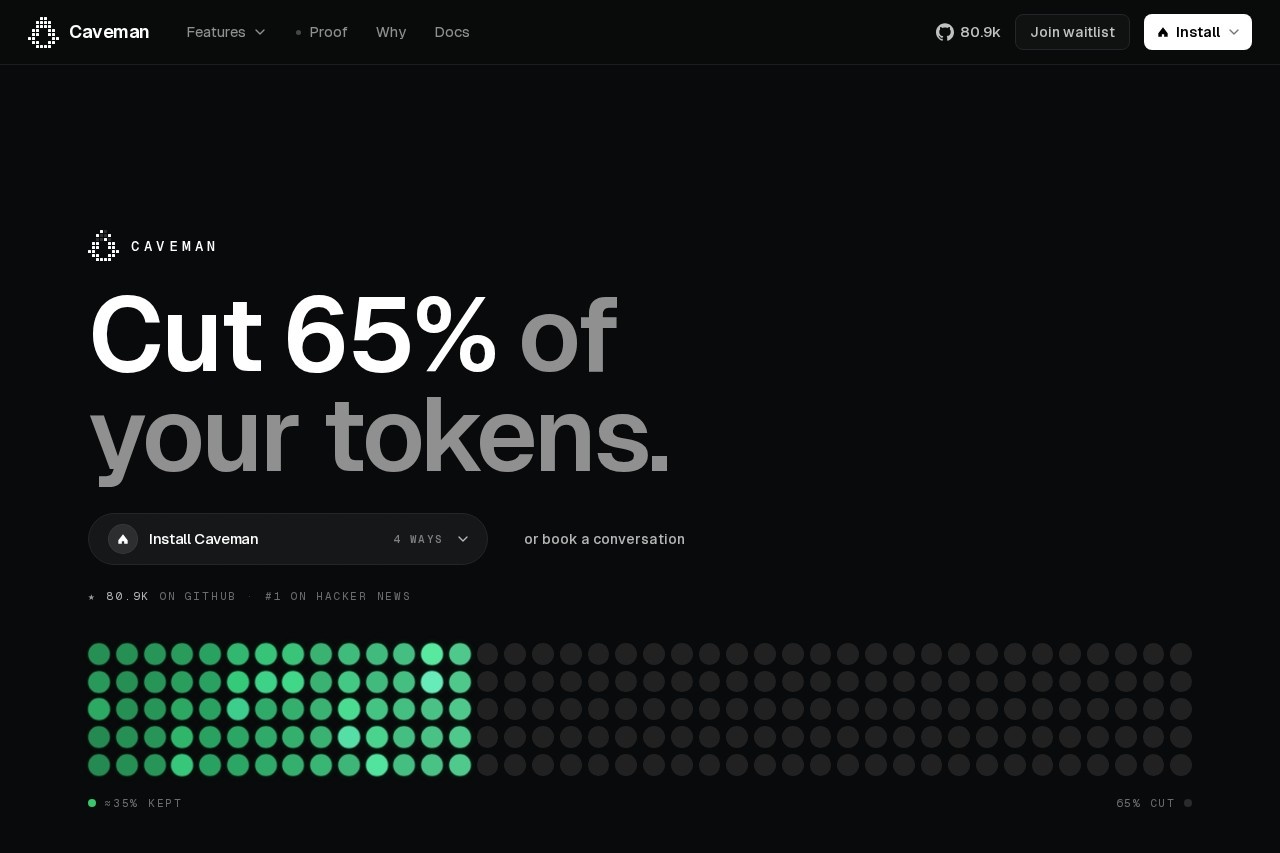
Caveman optimizes AI prompts to cut token usage by 65%, saving costs. Compatible with Claude Code, Cursor, Windsurf, Cline, and 30+ agents. GitHub 74k+ stars.
About
Caveman is an open-source optimization tool stack for AI coding agents, built around one simple philosophy: "Why use many token when few token do trick" — making AI output as concise as a caveman. It started as a Claude Code skill plugin that dramatically cuts token consumption by changing how AI responds (lean, direct, no fluff), and has since evolved into a full-stack solution spanning five layers including a gateway, memory layer, and terminal agent. The project has earned 74k+ stars on GitHub, once hit #1 on Hacker News, and is supported by 30+ mainstream AI coding agents including Claude Code, Codex, Gemini, Cursor, Windsurf, Cline, and Copilot. Core author Julius Brussee has fully open-sourced it under the MIT license, with a managed cloud service available at caveman.so.
Key Features
Pricing & Fees
- Pricing: Caveman itself is free and open source; Caveman Cloud is free for one person, $300/month for a team (including $300 of monthly usage), and Enterprise is custom-priced annually for VPC deployment.
- Free tier: The Free Cloud plan includes every Cloud feature for one person — 100,000 events, 600 agent minutes, 25,000 routing decisions and $10 of Caveman AI per month, with no card needed.
- Trial: The Team plan starts with a 7-day free trial; cancel within the trial and pay nothing.
- Plan limits: Included Team usage does not roll over; past the allowance, standard rates apply (events from $0.00035), and overage is capped at $50 a month per product unless you raise the limit.
- Deployment options: The open-source tool runs locally at $0; Team adds semantic cache, project access control and audit logs, while SSO is available on the Scale package at $750 a month.
Who It's For
Heavy AI coding users who rely on tools like Claude Code or Cursor daily and want to cut API costs. Development teams that can set up Caveman Gateway once and let the whole team enjoy automatic token compression without per-developer configuration. AI agent developers building custom agents who want to integrate Caveman's compression and memory capabilities. And token-budget-sensitive teams — startups and indie developers — who need precise control over AI API spending.
Related Tutorials
View all →


Related Tools
View all → CodeBuddy - AI-Powered IDE for Efficient Coding CodeBuddy is an AI-driven IDE that boosts coding efficiency with intelligent assistance.
 RTK - Rust Token Killer RTK reduces Claude Code token usage by 60-90%, measured across 2,900+ real commands. Removes 89% avg noise, extends sessions 3x, zero config. MIT licensed.
 Code-review-graph - Local Code Intelligence for MCP Persistent local code graph for token-efficient AI code review through MCP and CLI. 8.2x avg context reduction, 30 MCP tools, local-first by default.
 CodeBuddy - AI IDE & Assistant CodeBuddy is an AI-driven IDE and assistant that simplifies coding, offering intelligent features to boost developer efficiency.
 CodeRider CodeRider is an AI-powered coding assistant integrated with GitLab, providing intelligent code completion, generation, and analysis to streamline development.